
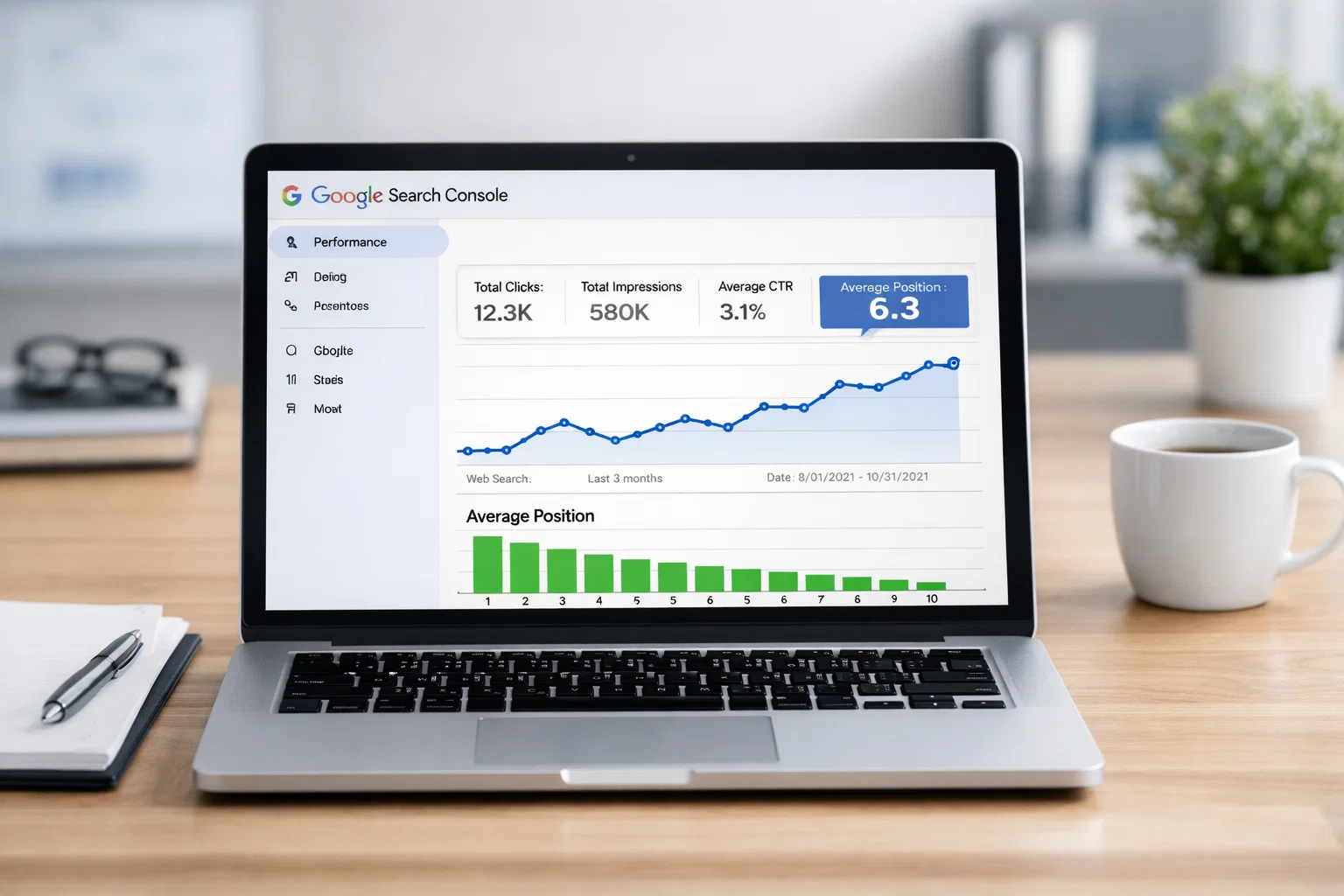
A good average position in Google Search Console generally falls within positions 1–10, which indicates page-one visibility in Google search results. However, what’s considered “good” depends on keyword intent, competition, and impressions, since average position is calculated across multiple queries, pages, locations, and devices.
Key Takeaways
- ✔ Average position in Google Search Console is an average, not a fixed ranking.
- ✔ Positions 1–10 generally indicate strong page-one visibility.
- ✔ A “good” average position depends on keyword intent, competition, and impressions.
- ✔ Average position should always be reviewed alongside clicks and CTR.
- ✔ Segmenting data by query and page gives more accurate insights than sitewide averages.
What Is the Average Position in Google Search Console?
Average position in Google Search Console represents the average ranking of your website’s URLs for all impressions shown in Google search results. It is calculated based on where your page appears each time it is displayed for a search query.
For example, if your page appears in position 3 for one search and position 7 for another, Google averages those positions to calculate your overall average position.
It’s important to understand that average position:
- Is calculated per impression, not per click
- Includes all queries, pages, devices, and locations by default
- Reflects visibility, not guaranteed traffic
Because of this, the number shown in Google Search Console is often a blended metric, not an exact ranking for a single keyword. This is why average position should be used as a directional indicator rather than a precise measurement of performance.
What Is Considered a Good Average Position?
A good average position in Google Search Console depends on where your pages typically appear in search results and how much visibility those positions generate. In general, the closer your average position is to the top of page one, the better your potential performance.
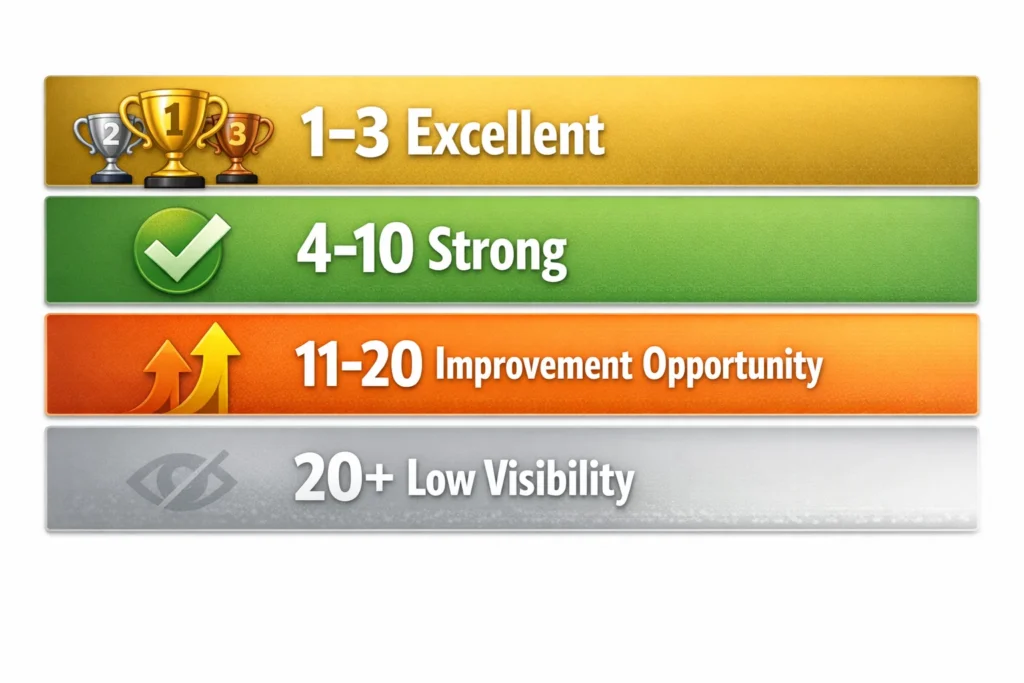
Here’s how average position ranges are commonly interpreted:
Average Position 1–3
This average position 1-3 range is considered excellent. Pages appearing in the top three positions usually receive the highest visibility and the majority of clicks, especially for non-branded searches.
Average Position 4–10
Positions within this 4-10 range still indicate strong performance, as your pages appear on the first page of Google. While click-through rates are lower than the top three, these positions can still drive consistent organic traffic.
Average Position 11–20
This 11-20 range means your pages are typically appearing on the second page of search results. Visibility and clicks drop significantly here, but it often signals good optimization potential with further SEO improvements.
Average Position 20+
Positions beyond page two generally indicate low visibility. In most cases, pages in this range require content improvements, better keyword alignment, or stronger authority to compete.
A “good” average position should always be evaluated in context. For high-competition keywords, an average position around 8–10 may be strong, while for low-competition or branded terms, expectations are usually higher.
Why Average Position Can Be Misleading
Average position in Google Search Console is useful, but it’s also one of the most misunderstood SEO metrics. Because it’s calculated as an average, it can hide important performance details.
4 Common reasons average position can be misleading include:
- Multiple keywords and pages averaged together. A page may rank very high for one query and much lower for another, resulting in an average that doesn’t reflect either position accurately.
- Location and device differences. Rankings can vary by country, city, mobile vs desktop, and personalization, all of which are blended into one number.
- Impression-based averaging. Pages that appear frequently at lower positions can pull the average down, even if top-ranking keywords perform well.
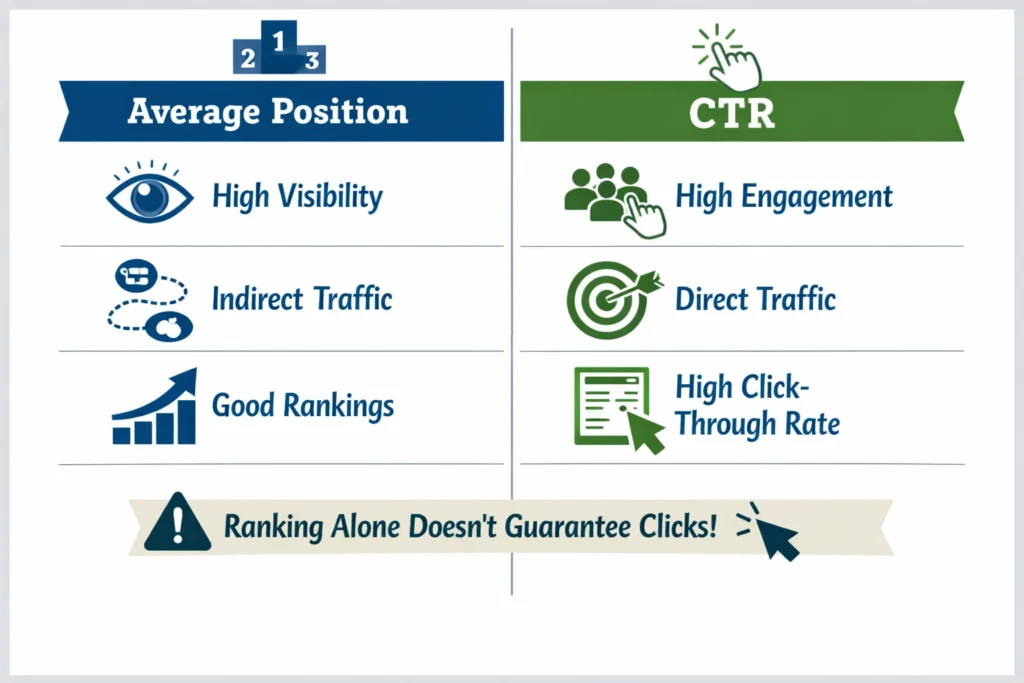
- Visibility doesn’t equal traffic. A strong average position doesn’t guarantee clicks if search intent or CTR is low.
Because of these factors, average position should be treated as a directional indicator, not a precise ranking. It’s most useful when analyzed alongside clicks, impressions, and CTR.
Average Position vs Click-Through Rate (CTR)
| Metric | Average Position | Click-Through Rate (CTR) |
| What it Measures | Where your page appears in search results | How often users click your result |
| Focus | Visibility in Google Search | User engagement |
| Indicates | Ranking placement across impressions | Effectiveness of titles and descriptions |
| Can It Be Misleading? | Yes – averages multiple queries, devices, locations | Yes – influenced by SERP features and intent |
| Direct Traffic Impact | Indirect | Direct |
| Best Used For | Tracking ranking trends over time | Measuring real performance and appeal |
| Should Be Analyzed With | CTR, clicks, impressions | Position, impressions, intent |
| SEO Insight | Shows ranking potential | Shows conversion from visibility to clicks |
When Average Position Matters (and When It Doesn’t)
Average position is a useful metric, but it isn’t equally important in every situation. Knowing when to rely on it, and when to look deeper, helps avoid misleading conclusions.
When average position matters most:
- Non-branded keywords: For competitive, non-branded searches, average position is a strong indicator of how visible your site is compared to competitors.
- High-impression keywords: Keywords with high search volume make average position more meaningful, as small ranking changes can significantly impact traffic.
- Tracking trends over time: Monitoring whether average position improves or declines helps measure SEO progress.
When average position matters less:
- Branded keywords: Branded searches often rank high by default and can skew average position upward.
- Low-impression queries: Keywords with few impressions don’t provide reliable averages.
- New or recently published pages: Rankings fluctuate early on, making average position unstable.
- Pages targeting multiple intents: Mixed search intent can distort average ranking data.
For accurate insights, average position should be analyzed in context, alongside clicks, impressions, and CTR, not in isolation.
How to Improve Your Average Position in Google Search Console
Improving your average position requires focusing on the factors that directly influence rankings, visibility, and relevance. Rather than chasing the metric itself, the goal is to improve the underlying SEO signals.
6 Key ways to improve average position include:
- Optimize content for search intent. Ensure each page fully matches what users are searching for. Pages that clearly answer search queries tend to rank higher and more consistently.
- Improve on-page SEO. Optimize titles, headings, internal links, and meta descriptions to help search engines understand page relevance.
- Fix technical SEO issues. Address crawl errors, indexing problems, slow page speed, and mobile usability issues that can hold rankings back.
- Strengthen internal linking. Proper internal links help distribute authority and signal which pages are most important.
- Build authority with quality backlinks. Earning relevant, high-quality links improves trust and competitiveness in search results.
- Focus on high-impression queries first. Improving rankings for keywords with many impressions can quickly impact overall average position.
If you want to improve your average position using data-driven SEO strategies instead of guesswork:
Request an SEO Consulting SessionCommon Mistakes When Analyzing Average Position (and How to Fix Them)
Many SEO decisions go wrong because average position is misunderstood or analyzed incorrectly. The table below shows common mistakes and the right way to fix them.
Average Position Analysis: Mistakes vs Solutions
| Common Mistake | Why It’s a Problem | Correct Solution |
| Looking only at sitewide average position | Blends all pages and keywords, hiding real performance | Analyze by page, query, device, and country |
| Treating average position as an exact ranking | It’s an average, not a fixed position | Use it as a trend indicator, not a precise rank |
| Ignoring impressions | Low-impression keywords skew averages | Focus on high-impression queries first |
| Comparing unrelated keywords together | Different intents distort performance insights | Segment keywords by intent and topic |
| Overreacting to short-term drops | Rankings naturally fluctuate | Track changes over weeks and months, not days |
| Focusing only on position | High rank doesn’t guarantee clicks | Always analyze CTR, clicks, and impressions |
| Including branded keywords in analysis | Brand terms inflate average position | Separate branded vs non-branded keywords |
| Ignoring page-level performance | Strong pages get buried in averages | Review top-performing and underperforming pages |
Why This Matters
Correctly analyzing average position helps you:
- Identify real SEO opportunities
- Avoid unnecessary changes
- Prioritize actions that actually improve visibility and traffic
This is where expert interpretation makes a major difference.
Why Businesses Use SEO Specialist USA to Interpret Google Search Console Data
Google Search Console provides powerful data, but without proper interpretation, it can easily lead to confusion or missed opportunities. Many businesses see metrics like average position, clicks, and impressions, but struggle to turn those numbers into actionable SEO improvements.
At SEO Specialist USA, we help businesses go beyond surface-level metrics. Instead of focusing on averages alone, we analyze Google Search Console data in context, by page, query, intent, device, and competition, to identify what’s actually holding performance back and where growth is possible.
Our approach focuses on:
- Turning GSC data into clear SEO priorities
- Identifying quick wins and long-term opportunities
- Improving rankings where impressions already exist
- Aligning SEO actions with real business goals, not vanity metrics
Using Google Search Console together with technical SEO, content optimization, and careful planning, we help businesses make informed decisions and grow consistently in search results.
If you want expert help understanding your Google Search Console data and improving your average position the right way:
FAQs: Average Position in Google Search Console
What is a good average position in Google Search Console?
A good average position is generally between 1 and 10, which means your pages appear on the first page of Google. Positions closer to 1–3 usually generate the most visibility and clicks.
Is an average position under 10 always good?
Not always. While under 10 indicates page-one visibility, performance should also be evaluated using CTR, impressions, and clicks. A position of 8 with high CTR can outperform a position of 3 with low engagement.
Why did my average position drop but traffic increase?
This often happens when your site starts appearing for more keywords, including lower-ranking ones. Increased impressions from new queries can lower the average position while still driving more overall traffic.
Should I focus more on average position or clicks?
Clicks are more important. Average position shows visibility, but clicks and CTR show real performance. The best analysis combines position, impressions, CTR, and traffic trends.
How often should I check the average position in Google Search Console?
Weekly or monthly reviews are ideal. Checking daily can be misleading due to natural ranking fluctuations. Focus on long-term trends, not short-term changes.
Can the average position be different by country or device?
Yes. Rankings vary by location, device (mobile vs desktop), and personalization. Google Search Console averages these variations unless you segment the data.
What’s the best way to improve a low average position?
Focus on improving search intent alignment, content quality, internal linking, technical SEO, and authority. Prioritizing high-impression queries often delivers the fastest improvements.