
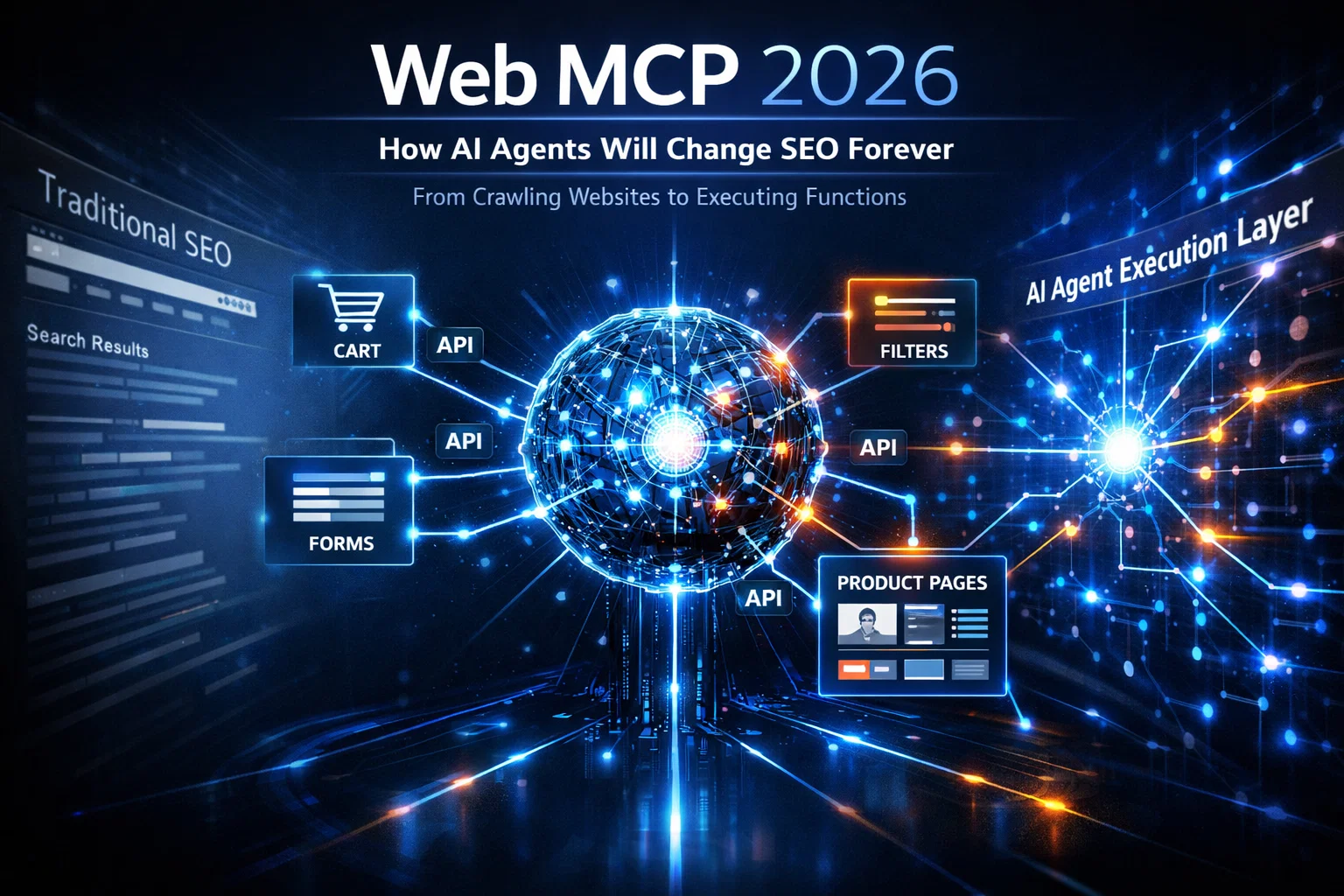
Web MCP (Model Context Protocol) is Google’s upcoming framework that allows AI agents to interact directly with website functions through structured APIs. Launching after August 2026, it will fundamentally change technical SEO by requiring websites to optimize for AI-agent accessibility, not just human users and search crawlers.
Key Takeaways
- ✔ Web MCP enables structured communication between websites and AI agents.
- ✔ It introduces two APIs: Declarative (static HTML) and Imperative (dynamic JavaScript).
- ✔ Websites will not become MCP-ready automatically.
- ✔ SEOs will need continuous optimization for AI interactions.
- ✔ AI-agent traffic could become as important as traditional search traffic.
What Is Web MCP?
Web MCP stands for Web Model Context Protocol.
Originally developed by Anthropic, MCP allows AI systems to connect directly to external tools and structured data sources. Google’s Web MCP extends this concept to websites.
Instead of AI agents “looking” at a website visually like a human browser would, Web MCP allows websites to expose:
- Available functions
- Buttons
- Forms
- Search boxes
- Product data
- Pricing logic
In simple terms: Your website stops being something AI “sees” and becomes something AI can “use.”
Why Current AI Interaction With Websites Is Inefficient
Today, AI agents interact with websites in a slow and expensive way:
- Load page in a browser
- Capture screenshot
- Analyze layout visually
- Identify buttons and inputs
- Click and reload
- Repeat
This process:
- Consumes high token usage
- Increases cost
- Slows automation
- Reduces reliability
Web MCP eliminates this guesswork by providing machine-readable function mapping.
How Web MCP Works: The Two APIs
Google’s Web MCP includes two primary APIs:

1. Declarative API (Static Functions)
This API exposes standard HTML elements and basic interactions:
- Sign-up buttons
- Forms
- Text fields
- Navigation links
- Product listings
AI agents can directly understand available actions without visual scanning.
This is similar to how structured data helps search engines — but focused on function execution.
2. Imperative API (Dynamic JavaScript Functions)
This API handles dynamic interactions powered by JavaScript:
- Product color selection
- Size variations
- Quantity updates
- Cart price recalculations
- Real-time filtering
E-commerce and SaaS platforms heavily depend on these dynamic actions.
If not properly exposed, AI agents won’t understand them.
Why Web MCP Is the Next Core Web Vitals Moment
When Google launched Core Web Vitals in 2020:
- Websites didn’t automatically become fast.
- WordPress didn’t magically fix everything.
- SEOs had to manually optimize LCP, CLS, and FID.
- Continuous monitoring became mandatory.
Web MCP will follow the same pattern.
Even if CMS platforms enable MCP:
- Themes
- Plugins
- Custom code
- Builders
Will still require manual configuration and testing.
This creates a new technical SEO layer.
What SEOs Will Actually Have to Do
Web MCP optimization will include:
1. MCP Compatibility Audits
Check if website functions are properly exposed.
2. Dynamic Function Testing
Ensure JavaScript-based interactions are reflected via Imperative API.
3. Ongoing Monitoring
Every time a new:
- Button
- Landing page
- Form
- Checkout flow
- Filter system
Is added — it must be validated.
4. Collaboration With Developers
SEO will become more API-driven and technical.
AI Traffic: The New Visibility Layer
Search is evolving.
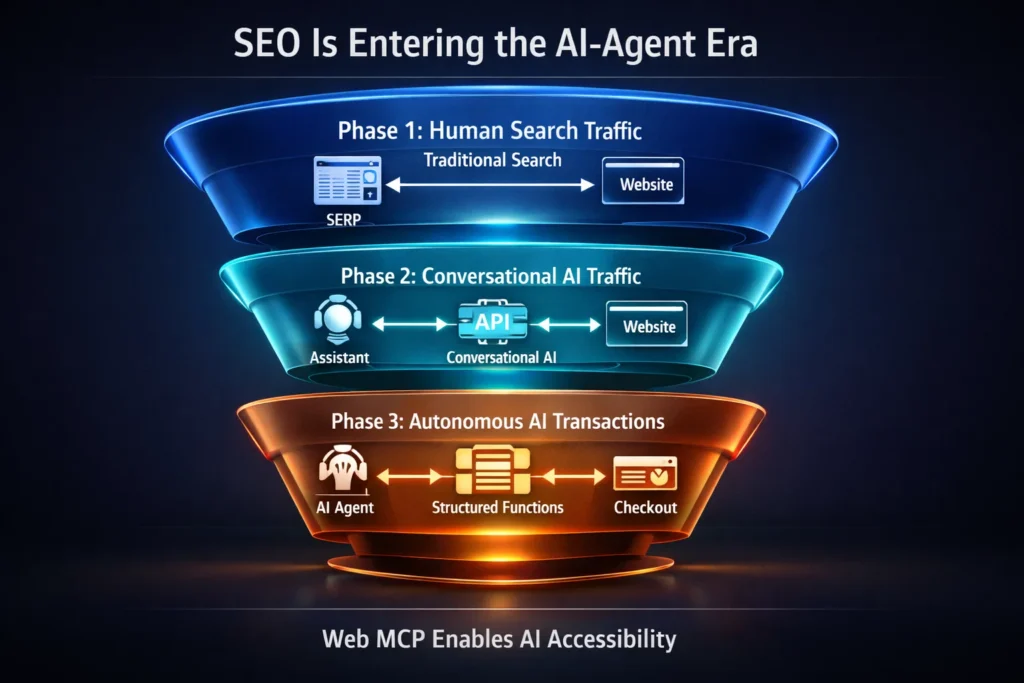
In the coming years:
- AI agents will browse on behalf of users.
- AI assistants may complete transactions.
- Conversational search will replace some traditional SERPs.
If AI agents cannot properly interact with your website, you risk losing:
- AI-recommended traffic
- AI-generated shopping flows
- Automated purchasing visibility
Web MCP optimization becomes essential for future discoverability.
Impact on E-Commerce and Dynamic Websites
E-commerce websites will be most affected.
They must ensure:
- Variant selections are exposed
- Pricing logic is structured
- Cart updates are API-accessible
- Filters are machine-readable
This is not a one-time implementation.
It requires ongoing testing, similar to Core Web Vitals monitoring.
Will This Negatively Impact SEO?
No.
It expands SEO.
Just like:
- Mobile-first indexing increased SEO demand
- Core Web Vitals increased technical SEO work
Web MCP will:
- Increase technical responsibilities
- Expand service offerings
- Create new audit categories
- Open new revenue streams
SEO is evolving — not disappearing.
When Will Web MCP Launch?
Google is expected to make Web MCP publicly available after August 2026.
However, preparation should begin earlier:
- Educate clients
- Upskill teams
- Update technical processes
- Build MCP-readiness frameworks
Early adopters will benefit most.
FAQs
What is Web MCP in simple terms?
Web MCP is a protocol that allows AI agents to directly interact with website functions instead of visually analyzing pages like humans.
Is Web MCP replacing Core Web Vitals?
No. Core Web Vitals focuses on performance. Web MCP focuses on AI accessibility and structured function exposure.
Will WordPress automatically support Web MCP?
Possibly at the core level, but themes, plugins, and custom code will still require manual optimization.
Who will need Web MCP optimization most?
E-commerce platforms, SaaS tools, marketplaces, and any dynamic website with JavaScript-based interactions.
Is Web MCP mandatory for rankings?
Initially, it may not directly affect rankings. However, AI-agent discoverability and interaction may significantly impact future traffic.
Final Thoughts
Web MCP represents a structural shift in how websites interact with AI systems.
This is not just a technical update.
It is a new optimization category.
SEO in 2026 will not only be about:
- Crawling
- Indexing
- Performance
- Content
It will also be about:
- Function exposure
- API validation
- AI interaction readiness
Those who adapt early will lead the next phase of SEO growth.