
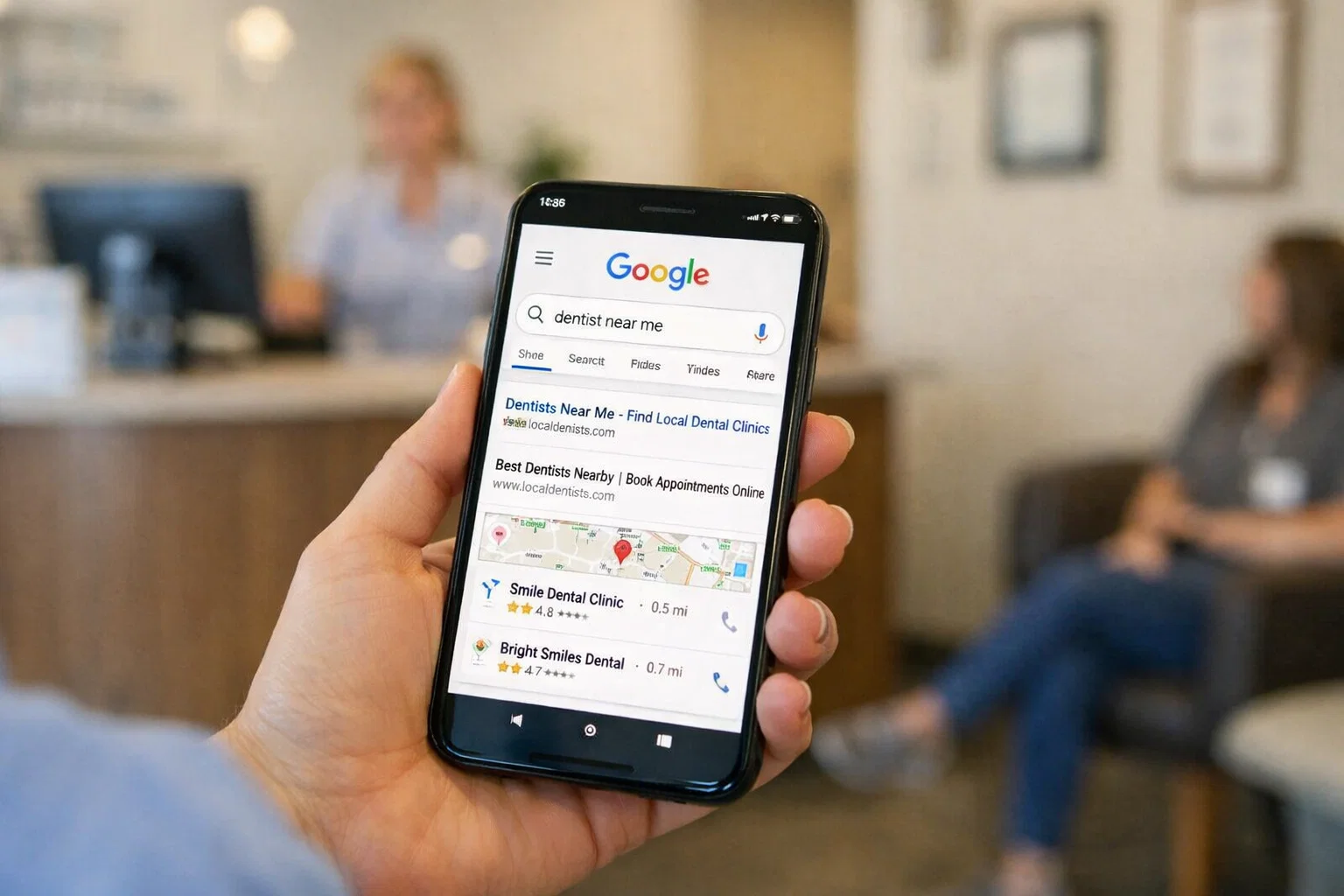
Dental SEO is the process of optimizing a dental clinic’s website and local presence to rank higher on Google for searches like “dentist near me” and treatments such as Invisalign or implants. SEO Specialist USA helps dentists improve visibility, generate more calls, and increase appointment bookings through proven dental SEO services.
Key Takeaways
- ✔ Dental SEO helps dentists rank for “dentist near me” and service-based searches.
- ✔ Local SEO (Google Business Profile + Map Pack rankings) is the #1 driver of patient leads.
- ✔ Optimized service pages help rank for treatments like Invisalign, implants, whitening, and emergency dentistry.
- ✔ Reviews, citations, and NAP consistency build trust and improve local rankings.
- ✔ Technical SEO (speed, mobile-first, Core Web Vitals) impacts both rankings and conversions.
- ✔ Content marketing helps attract patients researching procedures before booking.
- ✔ SEO Specialist USA helps dental clinics increase calls and appointments through proven dental SEO services.
What Is Dental SEO? (Simple Definition for Dentists)
Dental SEO (Search Engine Optimization) is a marketing strategy that helps dental clinics appear higher in Google search results when potential patients search for services like:
- teeth cleaning
- Invisalign
- dental implants
- emergency dentist
- teeth whitening
- pediatric dentist
In simple terms, dental SEO helps your practice get found online by the right patients at the right time, especially when they are ready to book an appointment.
Dental SEO focuses on two main areas
A strong dental SEO strategy combines:
1. Website SEO: This includes optimizing your dental website so Google understands:
- what services you offer
- where you are located
- which pages are most important
- why your clinic is trustworthy
2. Local SEO: Local SEO helps your clinic appear in:
- Google Maps
- the “3-pack” Map Pack listings
- location-based searches like “dentist near me”
This is why dental SEO is different from general SEO, dentists rely heavily on local search traffic.
Why Dental SEO Matters for Dentists and Dental Clinics
Dental SEO is one of the most effective ways for dentists to attract new patients because it targets people who are already searching for dental services. Unlike social media marketing (which interrupts users), SEO helps your clinic show up exactly when someone needs treatment.
Patients search online before booking
Today, most people don’t choose a dentist from a flyer or directory. Instead, they search Google for terms like:
- “dentist near me”
- “emergency dentist open now”
- “Invisalign dentist in [city]”
- “best dentist for implants”
If your clinic isn’t visible on the first page, especially in the Google Map Pack — you lose those patients to competitors.
Dental SEO brings high-quality leads
SEO traffic is valuable because these users have strong intent. That means they are more likely to:
- call your clinic
- book an appointment online
- request pricing
- visit your office location
In other words, dental SEO doesn’t just bring traffic, it brings patients.
SEO reduces dependency on paid ads
Google Ads can generate leads quickly, but the downside is simple:
- once you stop paying, leads stop.
- ad costs increase over time (competitive dental markets).
- many clinics overspend without strong tracking.
Dental SEO builds long-term visibility, so your clinic can keep generating leads without relying only on ads.
Dental SEO improves trust and credibility
When your clinic ranks on Google, especially in local results, patients automatically trust you more. SEO also strengthens credibility through:
- Google reviews
- accurate business listings
- strong service pages
- helpful educational content
These factors increase both rankings and conversions.
Want more dental patients from Google search?
Get SEO ConsultationHow Dental SEO Works (Step-by-Step)
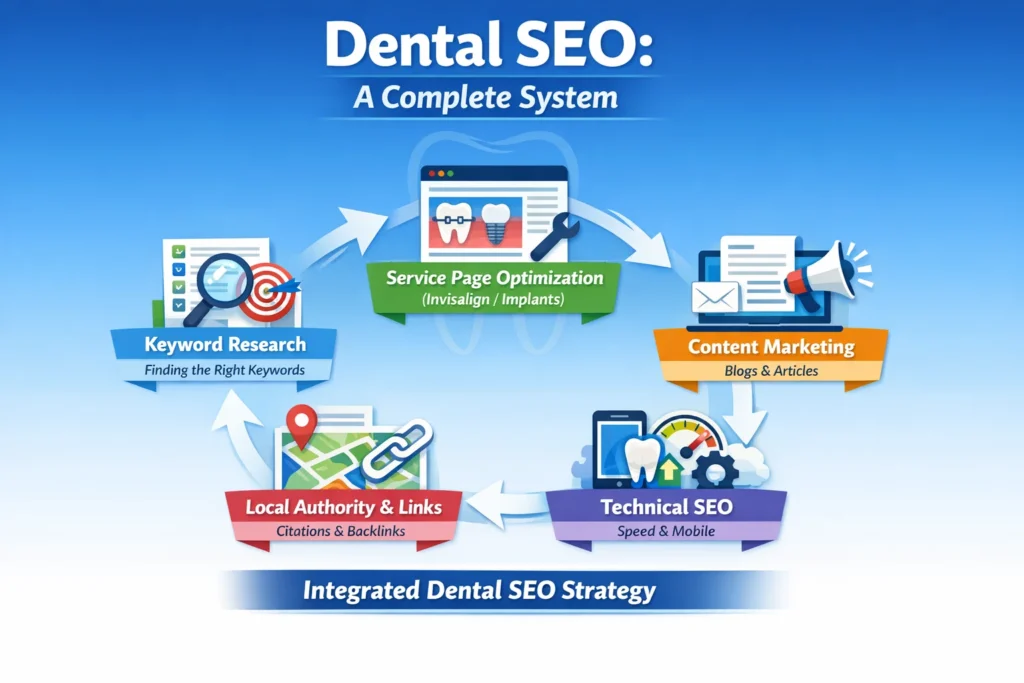
Dental SEO is not one single tactic, it’s a system. When done correctly, it improves your visibility across Google Search and Google Maps so more patients can find your clinic and book appointments.
Here’s how dental SEO works step by step.
Keyword Research for Dental Services
Everything starts with keyword research, identifying what real patients type into Google.
Dental keyword research usually includes:
1. Local intent keywords
- “dentist near me”
- “dentist in [city]”
- “best dentist in [city]”
2. Service + location keywords
- “Invisalign dentist [city]”
- “dental implants [city]”
- “teeth whitening [city]”
- “emergency dentist [city]”
3. Problem-based keywords
- “tooth pain treatment”
- “bleeding gums dentist”
- “broken tooth dentist”
The goal is to map keywords to the correct pages so Google understands exactly what your clinic offers.
Optimizing Dental Service Pages (Most Important Website SEO)
A major dental SEO mistake is having only one general “Services” page.
Instead, SEO-friendly dental websites have separate service pages for treatments such as:
- Dental implants
- Invisalign / braces
- Teeth whitening
- Root canal
- Emergency dentistry
- Pediatric dentistry
Each service page should include:
- Clear explanation of the procedure
- Benefits + outcomes
- FAQs
- Pricing guidance (if possible)
- Internal links to related services
- Strong CTA (call/book)
This improves rankings because Google can match each page to a specific search intent.
Creating SEO Content Patients Search For
Not every patient is ready to book immediately. Many search first to understand treatments.
That’s where content marketing supports dental SEO through blog posts like:
- “How long does Invisalign take?”
- “Are dental implants painful?”
- “What to do in a dental emergency”
- “Teeth whitening: in-office vs at-home”
This content:
- builds trust
- increases topical authority
- Attracts long-tail search traffic
- Brings future patients into your funnel
Technical SEO Foundation (Speed + Mobile + Crawlability)
Google won’t rank a dental website well if it performs poorly.
Technical SEO includes:
- Improving page speed
- Fixing Core Web Vitals
- Making the site mobile-first
- Removing broken links and redirect issues
- Ensuring pages are indexable
A fast, clean site improves both:
- Rankings
- Patient conversion rate
Link Building & Local Authority
Google ranks trusted websites higher — and backlinks are a major trust signal.
Dental link building often includes:
- Local business directories and citations
- Partnerships with local organizations
- Dental associations
- Sponsorships (schools, charities, events)
- Local PR mentions
The goal is to build authority in your area so your clinic becomes a top local result.
If you want a complete dental SEO plan built for your clinic:
Request a Dental SEO Strategy SessionLocal SEO for Dentists (Most Important Part)
For most dental clinics, local SEO is the #1 factor that drives new patient leads.
Why? Because the majority of people search for dentists locally using terms like:
- “dentist near me”
- “emergency dentist near me”
- “best dentist in [city]”
- “Invisalign dentist [area]”
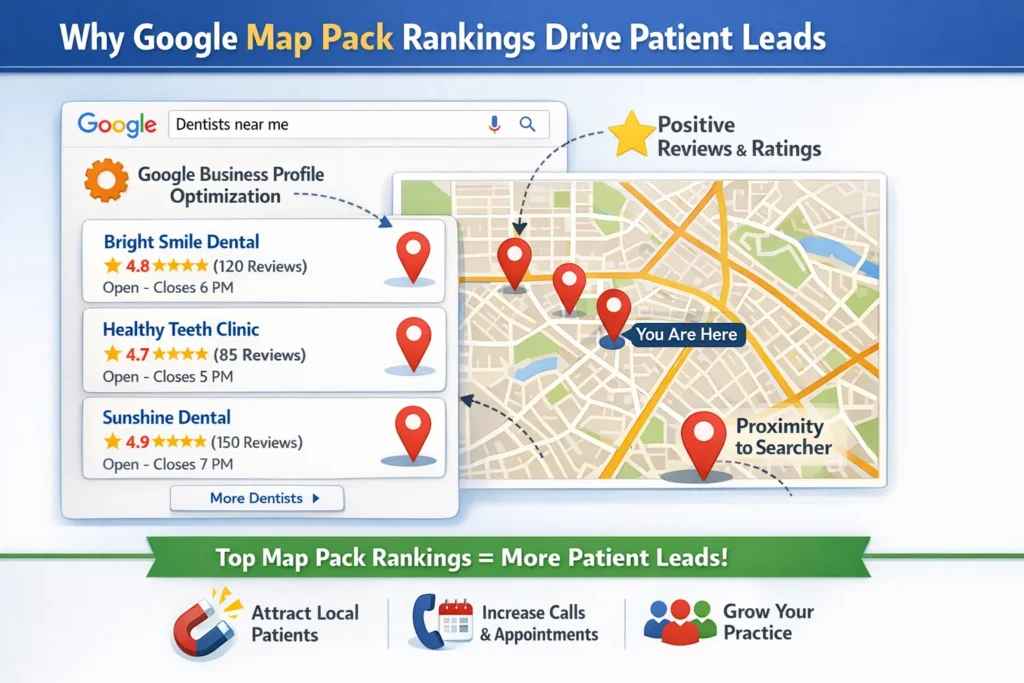
When Google detects local intent, it often shows the Google Map Pack (top 3 local listings) before the normal website results. If your clinic ranks there, you can generate a consistent flow of calls and appointment bookings.
Google Business Profile Optimization for Dentists
Your Google Business Profile (GBP) is the foundation of local dental SEO.
Mistakes to avoid:
- incomplete profile
- wrong business category
- missing services
- outdated photos
- inconsistent business hours
A fully optimized GBP should include:
- correct primary category (Dentist / Dental Clinic)
- services list (implants, Invisalign, whitening, emergency)
- strong business description with keywords
- real clinic photos + team photos
- appointment link + phone number
- regular Google Posts (optional but helpful)
NAP Consistency and Dental Citations
NAP means:
- Name
- Address
- Phone Number
Google expects your NAP details to be consistent everywhere online.
Common citation sources:
- Dental directories
- Local business directories
- Healthcare listing sites
- Map services
If your NAP is inconsistent, Google loses confidence, and your Map Pack ranking can drop.
Best practice: Keep the exact same formatting across all platforms.
Reviews and Reputation Management
Reviews are one of the strongest ranking and conversion signals in dental SEO.
Reviews help with:
- Higher local rankings
- Stronger click-through rate
- More calls and bookings
Dental review strategy should include:
- Requesting reviews after appointments
- Responding to all reviews (positive and negative)
- Using keywords naturally in responses (without stuffing)
- Avoiding fake reviews (high risk)
A clinic with more quality reviews often outranks competitors, even with a weaker website.
Ranking in the Google Map Pack
To rank in the Map Pack, Google uses three core factors:
- Relevance – does your clinic match the search?
- Distance – how close are you to the user?
- Prominence – how trusted/known is your clinic?
You can improve prominence through:
- Reviews
- Citations
- Backlinks
- Consistent branding
- Strong website + service pages
Want to rank your clinic in the Google Map Pack?
On-Page SEO for Dental Websites
On-page SEO is what helps Google understand your dental website pages and rank them for the right searches. It also improves how patients experience your site — which directly affects conversions (calls and bookings).
Here are the key on-page SEO elements dentists should focus on.
Title Tags and Meta Descriptions for Dental Pages
Your title tag is one of the strongest SEO signals on a page. It should clearly describe the service and location.
Example (Service Page)
- Title: Dental Implants in Austin, TX | [Clinic Name]
- Meta Description: Get permanent tooth replacement with dental implants. Book a consultation with our Austin implant dentist today.
Mistakes to Avoid
- Using the same title on multiple pages
- Leaving default titles like “Home”
- Writing titles without service keywords
- Missing location modifiers when needed
Proper H1 / H2 Structure
Your headings help both:
- Google understand the topic structure
- Patients scan the page quickly
Best Practices
- Use one H1 per page
- Include the main service keyword naturally in the H1
- Use H2 sections like Benefits, Process, FAQs, Cost, etc.
Avoid
- Multiple H1s
- Vague headings like “Welcome”
- Headings created only for design styling
Internal Linking Strategy (Very Important for Dental SEO)
Internal linking helps Google crawl your site and understand relationships between services.
Examples
- Invisalign page links to Orthodontics or Cosmetic Dentistry
- Dental Implants page links to Bone Grafting or Dentures
- Emergency Dentist page links to Same-Day Appointment booking
Internal linking also improves the user journey by guiding patients to:
- Related treatments
- FAQ answers
- Appointment or Contact pages
Image Optimization (Before / After Photos & Alt Text)
Dental websites often use many images such as:
- Before and after results
- Team photos
- Clinic photos
- Procedure visuals
Mistakes to Avoid
- Uploading huge image files (slow site speed)
- Missing alt text
- Generic filenames like
IMG_001.jpg
Best Practices
- Compress images (WebP format recommended)
- Use descriptive filenames
- Write natural alt text describing the service
CTA Placement on Dental Pages
SEO brings traffic, but CTAs convert visitors into patients. A strong dental page should include:
- “Call Now” CTA (sticky on mobile)
- “Book Appointment” CTA
- Short and simple contact form
CTA Visibility
- Above the fold
- Mid-page
- Near the FAQ section
Technical SEO for Dental Websites (Common Issues)
Technical SEO is what makes your dental website easy for Google to crawl, index, and rank — and easy for patients to use. Even if your clinic has great content, technical issues can prevent your website from ranking or converting.
Here are the most common technical SEO problems dentists should avoid.
Slow Loading Dental Websites
Speed is one of the biggest issues in dental SEO because dental websites often use:
- Large images (before/after galleries)
- Sliders and animations
- Heavy themes/plugins
- Embedded videos
Slow websites lead to:
- Lower rankings
- Higher bounce rates
- Fewer calls and bookings
To improve speed, dental websites should focus on:
- Image compression (WebP)
- Caching
- Reducing unnecessary scripts
- Faster hosting
- Clean theme design
Mobile UX Problems (Mobile-First Indexing)
Google evaluates your website primarily using the mobile version.
Common mobile issues:
- Hard-to-click buttons
- Tiny text
- Slow mobile loading
- Forms that are too long
- Popups blocking the screen
A search-optimized dental website should be:
- Responsive on all devices
- Easy to navigate with one hand
- Designed for fast appointment booking
Duplicate Pages and Thin Content
Dental sites often create duplicate content accidentally through:
- Service pages that are too similar
- Location pages with the same template
- Multiple URLs showing the same page
This can cause:
- Keyword cannibalization
- Weaker rankings
- Index bloat (too many low-value pages)
Each page should have:
- Unique content
- Unique intent
- Unique keyword target
Schema Markup for Dentists (Highly Recommended)
Schema markup helps Google understand your clinic details and can improve search visibility.
Important schema types for dental SEO:
- LocalBusiness / Dentist schema
- FAQ schema
- Review schema (if valid and compliant)
- Service schema
Schema can help your listing appear with:
- Enhanced results (rich snippets)
- FAQ dropdowns
- Stronger local relevance signals
Security & Crawlability (HTTPS + Clean Structure)
Google expects dental websites to be secure and accessible.
Technical best practices include:
- HTTPS enabled (SSL certificate)
- No broken internal links
- Clean redirects
- Proper canonical tags
- XML sitemap submitted to Search Console
How Long Does Dental SEO Take to Work?
Dental SEO isn’t instant, but it is one of the most reliable long-term strategies for getting consistent patient leads from Google.
Most dental clinics start seeing measurable improvements within 30–90 days, but the exact timeline depends on your market, competition, and current online presence.
Typical Dental SEO Timeline (30/60/90 Days)
First 30 Days (Foundation + Fixes)
In the first month, SEO work focuses on building the foundation:
- Technical SEO audit and fixes
- Google Business Profile optimization
- Keyword research + SEO plan
- Optimizing main service pages
- Fixing crawl/index issues
- Improving site speed and mobile usability
What to expect: Early improvements in indexing, local visibility, and traffic, but major ranking jumps usually take more time.
60 Days (Growth + Authority Building)
In month two, the focus shifts to expansion:
- Adding or improving service pages
- Publishing SEO content (blogs + FAQs)
- Building citations and local links
- Review strategy implementation
- Internal linking improvements
What to expect: Higher rankings for long-tail keywords and more local impressions, calls, and direction requests.
90 Days (Stronger Rankings + Lead Increase)
By month three, you typically start seeing stronger movement:
- Map Pack ranking improvements
- Higher rankings for service + city keywords
- Increased website traffic
- More calls + bookings from organic search
What to expect: More consistent lead flow — especially with strong reviews and optimized service pages.
What Affects Dental SEO Results?
Dental SEO results depend on:
- Competition in your area (big cities take longer)
- Current website quality and technical health
- Number of reviews and GBP strength
- Content depth and service page quality
- Backlinks and local authority
- Consistency of SEO work month-to-month
If you’re in a highly competitive market, it may take 4–6 months to see major first-page dominance. The long-term payoff is worth it because SEO keeps delivering leads without paying per click.
How SEO Specialist USA Helps Dentists Rank on Google
Dental SEO requires the right mix of local optimization, technical fixes, content strategy, and authority building. At SEO Specialist USA, we help dental clinics improve rankings and generate consistent patient leads through a proven dental SEO framework.
Our Dental SEO Services Include
1. Dental SEO Audit
- Full website + technical SEO review
- Crawl/indexing issues
- Core Web Vitals + speed optimization opportunities
2. Local SEO for Dentists
- Google Business Profile optimization
- Citation building + cleanup
- Local link strategy
- Map Pack ranking improvements
On-Page SEO Optimization
- Service page optimization (implants, Invisalign, whitening, emergency)
- Metadata + heading structure
- Internal linking improvements
Dental Content Strategy
- Keyword mapping
- Blog + FAQ content creation
- Topical clusters for long-term rankings
Tracking + Reporting
- GA4 setup + conversion tracking
- Search Console monitoring
- Monthly reporting with actionable insights
Ready to grow your clinic with SEO?
FAQs
What is dental SEO and how does it work?
Dental SEO is the process of optimizing a dental clinic’s website and local presence to rank higher on Google. It works through local SEO, keyword targeting, service page optimization, technical SEO improvements, and trust-building signals like reviews and backlinks.
Is dental SEO better than Google Ads?
Dental SEO is better for long-term growth because it generates consistent traffic and leads without paying per click. Google Ads can deliver faster results, but SEO builds sustainable rankings and typically lowers lead costs over time.
How much does dental SEO cost?
Dental SEO costs vary depending on competition, location, and clinic goals. Pricing often depends on the scope of services such as local SEO, content creation, technical fixes, and link building. A customized dental SEO audit helps define the right budget.
How do dentists rank #1 on Google?
Dentists rank #1 by optimizing their Google Business Profile, earning more quality reviews, building citations, improving website service pages, and strengthening local authority through backlinks. Consistent SEO work and strong trust signals are key in competitive markets.
What keywords should dentists target?
Dentists should target local, high-intent keywords such as “dentist near me,” “emergency dentist near me,” and service + city terms like “Invisalign dentist [city]” or “dental implants [city].” These keywords attract patients ready to book.
How long does dental SEO take to work?
Most dental clinics see improvements within 30–90 days, but stronger results often take 3–6 months depending on competition and current online presence. Local SEO and review growth can speed up visibility, especially in Google Maps.
Does Google Business Profile help dentists get patients?
Yes. Google Business Profile is one of the most powerful tools for dentists because it helps clinics rank in the Map Pack. A strong profile with optimized services, photos, reviews, and accurate NAP details can generate calls and bookings daily.
Can a dentist do SEO without hiring an agency?
Yes, dentists can do basic SEO by improving their Google Business Profile, collecting reviews, and optimizing service pages. However, competitive areas often require technical SEO, content strategy, and link building, where a dental SEO agency can deliver faster results.
Read More Articles with SEO Specialist USA