

ChatGPT and Semrush serve different roles in SEO. ChatGPT helps generate content, ideas, and explanations, while Semrush provides real SEO data, keyword metrics, competitor insights, and site audits. ChatGPT supports SEO creation, but Semrush delivers the analytics required for accurate optimization and data-driven decisions.
Key Takeaways
-
 ChatGPT is ideal for generating content, ideas, prompts, and SEO explanations.
-
Semrush provides real keyword data, competitor analysis, and technical SEO insights.
-
ChatGPT supports creativity; Semrush supports accuracy and decision-making.
-
The best SEO results come from using both tools together.
What ChatGPT Is and How It Supports SEO
ChatGPT is an AI language model designed to generate text, answer questions, create outlines, and assist with content development. For SEO, it works as a creative and strategic assistant that can speed up writing, brainstorming, and planning tasks that normally take hours.
ChatGPT doesn’t provide real-time SEO data, but it enhances the content creation process in several meaningful ways. It helps you draft articles, refine messaging, simplify complex topics, and build keyword-rich content when guided with strong prompts.
Here’s how ChatGPT supports SEO:
- Generates blog post drafts, outlines, and topic ideas
- Assists with keyword integration when given a keyword list
- Improves readability, clarity, and structure
- Creates FAQs, meta descriptions, intros, and summaries
- Explains SEO concepts in simple terms for better planning
ChatGPT’s strength is speed and creativity, making the content side of SEO smoother and more efficient.
What Semrush Is and Its Role in SEO Optimization
Semrush is a professional-grade SEO platform built for real data, technical analysis, keyword research, and competitor insights. Unlike ChatGPT, which generates content, Semrush focuses on providing the metrics and analytics needed to make informed SEO decisions. It is a data-driven tool used by marketers, agencies, and businesses to track performance and identify growth opportunities.
Semrush offers detailed keyword volumes, ranking trends, backlink data, SERP analysis, and site audits, all essential components for accurate optimization. It doesn’t generate content like ChatGPT, but it shows what needs improvement and where opportunities exist.
Key ways Semrush supports SEO include:
- Keyword research with accurate volume, difficulty, and competitive data
- Technical site audits to identify issues affecting rankings
- Competitor analysis and traffic insights
- Backlink discovery and link-building opportunities
- SERP tracking and monitoring for ranking performance
Semrush provides the data, while ChatGPT provides the content, making both valuable for different stages of SEO.
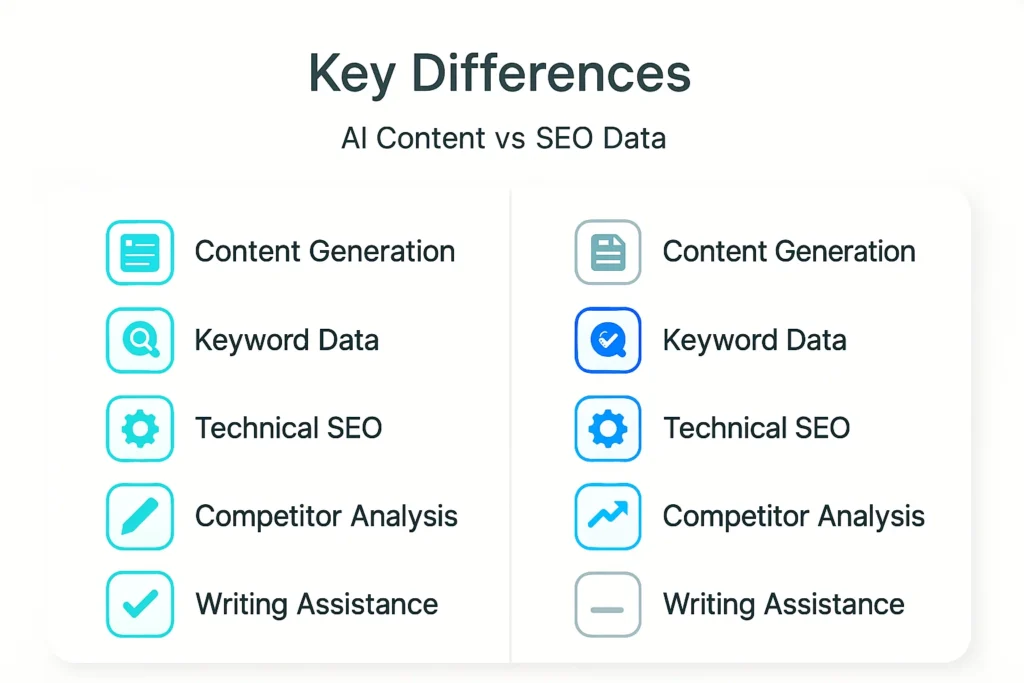
Revised: ChatGPT vs Semrush — Key Differences
What ChatGPT Can Do That Semrush Can’t
ChatGPT offers unique creative and conversational capabilities that Semrush cannot match, even with its content generation tools. While Semrush can create SEO-structured content, ChatGPT provides deeper flexibility, broader ideation, and human-like language generation that supports a wide range of SEO tasks.
ChatGPT acts like a real-time writing assistant that understands nuance, rewrites text in any tone, and creates highly customized content formats. Semrush’s AI tools are built specifically for SEO workflows, while ChatGPT can generate a virtually unlimited range of styles, ideas, and formats beyond SEO alone.
Here’s what ChatGPT excels at:
- Creative content generation in any style or format ChatGPT can write landing pages, social posts, scripts, emails, long-form blogs, FAQ sections, and more, with full stylistic control.
- Human-like rewriting and tone adaptation It can rewrite content in casual, professional, persuasive, or brand-specific tones with high accuracy.
- Flexible ideation and brainstorming ChatGPT can generate topic ideas, angles, outlines, intros, hooks, and headlines far beyond SEO-based briefs.
- Answering complex questions in real time Semrush cannot explain concepts conversationally, ChatGPT can break down strategies, simplify technical ideas, and provide contextual guidance.
- Prompt-based customization at any level You can instruct ChatGPT to follow any format structure, keyword model, or writing system instantly.
ChatGPT’s strength comes from its adaptability. It helps with content creation in ways that go beyond Semrush’s structured AI tools, making it a valuable partner for SEO teams,writers, and marketers.
What Semrush Can Do That ChatGPT Can’t
Semrush provides real SEO data, analytics, and performance insights that ChatGPT simply cannot access. While ChatGPT generates content based on patterns it has learned, Semrush pulls live information directly from search engines, giving marketers the data needed to make accurate optimization decisions. This makes Semrush essential for any data-driven SEO strategy.
Semrush’s strength lies in its ability to analyze markets, competitors, keywords, and websites in real time. It identifies opportunities, exposes weaknesses, and delivers actionable SEO insights that cannot be generated through AI text alone.
Here’s what Semrush can do that ChatGPT cannot:
- Provide real-time keyword metrics: Including search volume, keyword difficulty, trends, and competitor rankings, data ChatGPT cannot retrieve on its own.
- Perform technical site audits: Semrush scans your website for errors, speed issues, broken links, indexing problems, and SEO health issues.
- Analyze competitors: It shows what keywords competitors rank for, how they gain traffic, and where their backlinks come from.
- Track SERP changes and rankings over time: You can monitor position movements, featured snippet wins, and daily fluctuations.
- Deliver backlink data and link-building insights: Semrush shows which sites link to you and where new opportunities exist.
- Generate SEO content briefs based on real data: While ChatGPT can follow a prompt, Semrush creates briefs from competitor performance, SERP data, and keyword metrics.
Semrush gives you the data backbone of SEO, insights ChatGPT cannot provide because it doesn’t access the live web or analytics systems. Together, the two tools complement each other, but Semrush remains irreplaceable for accurate optimization.
Which Tool Is Better for Keyword Research?
When it comes to keyword research, Semrush has a clear advantage because it provides real, up-to-date search data directly from search engines. ChatGPT can suggest keywords based on patterns in its training data, but it cannot supply accurate metrics like search volume, keyword difficulty, or current competition levels.
ChatGPT is useful for brainstorming keyword ideas, clusters, and long-tail variations, especially when you want creative angles or content themes. But these ideas still need to be validated with a data-driven tool, and that’s where Semrush becomes essential.
Here’s how they compare during keyword research:
- ChatGPT helps you brainstorm ideas (topic clusters, long-tail suggestions, related concepts).
- Semrush gives you the real numbers (volume, competition, intent, SERP data, trends).
- ChatGPT accelerates creativity, but Semrush ensures accuracy.
For keyword research, Semrush is the superior choice, and ChatGPT works best as a supportive tool to expand or refine your keyword strategy.
Which Tool Is Better for Content Optimization?
Both ChatGPT and Semrush can help with content optimization, but they do so in very different ways. ChatGPT focuses on improving the writing itself, clarity, tone, structure, readability, and keyword integration (when keywords are provided). Semrush focuses on data-backed optimization, ensuring your content aligns with search intent, competitor benchmarks, and SEO best practices.
ChatGPT is excellent for rewriting paragraphs, fixing flow, improving grammar, and transforming content into a more engaging format. But Semrush provides optimization suggestions based on real data, including keyword usage gaps, readability scores, competitor analysis, and content structure recommendations.
How they compare for optimization:
- ChatGPT enhances writing quality, making content clear, engaging, and well-structured.
- Semrush enhances SEO accuracy, showing what’s missing based on real SERP data.
- ChatGPT helps with creative refinement, while Semrush helps with ranking refinement.
For content optimization, Semrush is the stronger tool from a data perspective, while ChatGPT is better for improving the quality and readability of the writing itself. Together, they create highly optimized content that performs well for both users and search engines.
Which Tool Is Better for Competitor & SERP Analysis?
For competitor and SERP (Search Engine Results Page) analysis, Semrush is the far superior tool because it pulls live ranking data directly from search engines. ChatGPT can’t access real-time rankings, traffic metrics, or competitor insights. It can explain analysis concepts, but it can’t perform the analysis itself.
Semrush shows how competitors rank, which keywords drive their traffic, what backlinks support them, and how SERP results shift over time. This gives you a complete picture of your competitive landscape, something no AI writing model can replicate.
Meanwhile, ChatGPT is helpful for interpreting what the data means and turning insights into content ideas, strategies, or action plans. But it cannot generate the data itself.
In practice:
- Semrush identifies competitors and tracks real-time SERP positions.
- ChatGPT helps explain the data and suggests actionable strategies.
For any serious SEO strategy, Semrush is the clear winner for competitor and search result analysis, while ChatGPT plays a supporting role in planning and execution.
When to Use ChatGPT, Semrush, or Both Together
ChatGPT and Semrush are most powerful when used together, not as replacements for each other. ChatGPT enhances the creative and content-production side of SEO, while Semrush delivers the data, analytics, and performance insights needed for accurate optimization. Knowing when to use each tool helps you build a complete, effective SEO workflow.
Use ChatGPT when you need help with writing, outlining, brainstorming, or transforming ideas into structured content. It’s also ideal for rewriting sections, improving readability, and generating SEO-focused drafts when given the right prompts and keyword list.
Use Semrush when you need real SEO metrics, keyword difficulty, search volume, competitor rankings, backlink data, site audits, or technical performance checks. Semrush provides the insights you need to make decisions grounded in factual search engine behavior.
The best results come from using both tools together, especially for content planning and execution:
- Semrush provides the data and strategy.
- ChatGPT turns that strategy into clear, engaging content.
- Both combined help you scale SEO efficiently without sacrificing quality or accuracy.
This hybrid workflow ensures your content is not only well-written but data-backed and ready to rank.
Limitations of ChatGPT Compared to Semrush
While ChatGPT is powerful for generating and improving content, it has clear limitations when compared to Semrush’s data-driven SEO capabilities. ChatGPT relies on patterns learned from past data and cannot access live search metrics or real-time SEO insights. This means it cannot independently validate keywords, analyze competitors, or measure actual ranking performance.
ChatGPT can support SEO strategy and execution, but it cannot replace tools designed for analytics. It cannot evaluate site health, detect technical errors, or determine whether a keyword is worth targeting based on real competition or search volume.
Key limitations include:
- No live keyword data, search volume, or ranking metrics
- No technical SEO or site audit capabilities
- Can’t perform backlink analysis or identify linking opportunities
- Can’t track SERP changes or competitor activity
- Can’t confirm whether content meets current SEO benchmarks
These limitations make it clear that ChatGPT should be used as a content and strategy tool, while Semrush provides the essential data foundation needed for accurate SEO decision-making.
Limitations of Semrush Compared to ChatGPT
Semrush combines analytics with AI-powered writing tools, making it one of the most complete SEO platforms available. However, even with integrated AI, Semrush’s content generation tools are built primarily for SEO briefs, structured drafts, and optimization—not for flexible, conversational, or fully creative writing. This is where ChatGPT remains far stronger.
Semrush’s AI operates inside a predefined SEO framework. It generates articles, content briefs, and optimization suggestions based on real data, but it doesn’t offer the same breadth of creativity or adaptability that ChatGPT provides. ChatGPT can follow any writing style, tone, instruction, or unique format, whereas Semrush’s AI tools focus on SEO-driven outputs.
Semrush’s AI is excellent for data-backed content, but it’s not designed to think creatively, engage conversationally, or produce complex narrative styles.
Key limitations compared to ChatGPT:
- Semrush AI generates SEO-structured content but lacks ChatGPT’s open-ended creativity
- Content outputs follow templates and may feel more mechanical than naturally written
- Limited ability to create long, fully custom formats (scripts, emails, storylines, brand voices)
- Less effective for conversational writing, rewriting, or adapting tone
- Cannot hold long contextual dialogues or reason through complex instructions like ChatGPT
- Not ideal for brainstorming beyond SEO topics
In short:
Semrush AI = SEO-focused writing inside a data framework
ChatGPT = fully flexible writing assistant with unlimited content styles
Both are powerful — but in different ways.
Final Verdict: Can ChatGPT Replace Semrush?
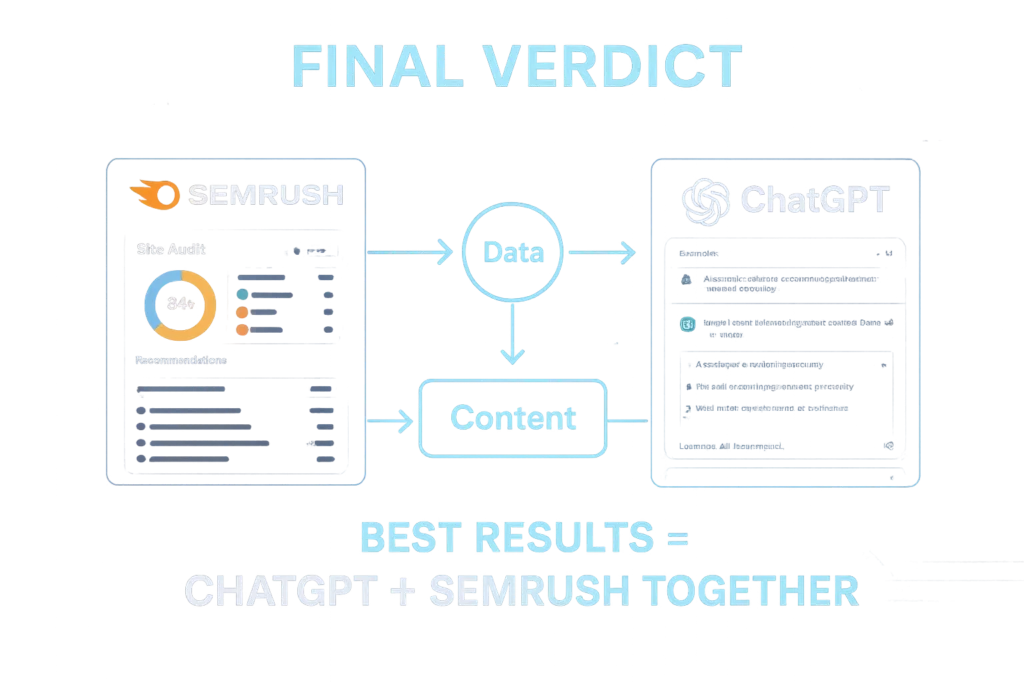
ChatGPT cannot replace Semrush because both tools serve fundamentally different roles in SEO. ChatGPT is exceptional for writing, brainstorming, explaining concepts, and generating content in any style, while Semrush provides the real, data-driven foundation of SEO — keyword metrics, competitor insights, site audits, SERP tracking, and performance analysis.
Even though Semrush now includes AI content tools, they work best when paired with ChatGPT’s creative flexibility. ChatGPT can produce detailed explanations, transform writing styles, build long-form drafts, and interpret complex instructions in ways Semrush’s AI cannot. However, without Semrush’s data, ChatGPT-generated content cannot be accurately optimized or validated.
The reality is simple:
- ChatGPT can’t replace Semrush’s SEO intelligence.
- Semrush can’t replace ChatGPT’s creative reasoning and language generation.
- The strongest SEO workflow uses both tools together.
Semrush provides the data, ChatGPT provides the content, and the combination delivers measurable improvements in rankings, content quality, and workflow efficiency.
FAQs
Can ChatGPT replace Semrush for SEO?
No. ChatGPT can generate and improve content, but Semrush provides the real keyword data, competitor insights, and technical audits that AI models cannot produce.
Does Semrush have AI content tools?
Yes. Semrush includes AI writing features inside its Content Toolkit, but these tools are SEO-focused and less flexible than ChatGPT’s open-ended writing capabilities.
Can ChatGPT help with keyword research?
ChatGPT can brainstorm keyword ideas, but it cannot provide accurate search volume, difficulty scores, or competition data. Semrush is required for real keyword metrics.
Is ChatGPT good for writing SEO content?
Yes. ChatGPT is excellent for drafting, outlining, rewriting, and structuring SEO-focused content when given clear prompts and a keyword list.
Do I need both ChatGPT and Semrush?
For the best results, yes. ChatGPT handles writing and ideation, while Semrush ensures the content is data-backed, accurately optimized, and aligned with search intent.
Which tool is better for competitor analysis?
Semrush. It tracks real competitors, SERP positions, backlinks, and ranking trends — data ChatGPT cannot access.
Can Semrush automatically optimize content?
Semrush can analyze content using its Writing Assistant and Content Toolkit, but ChatGPT is better for rewriting, tone adjustment, and creative improvement.