

SEO-optimized content written with ChatGPT combines strategic keyword research, clear structure, and AI-assisted drafting to create high-ranking articles. To do this effectively, provide precise prompts, outline the article first, integrate keywords naturally, and refine the final output with human editing for accuracy and quality.
Key Takeaways
-
 ChatGPT helps you create SEO content faster with structured prompts.
-
Always start with keyword research before generating any content.
-
Use clear outlines to guide ChatGPT’s writing.
-
Optimize headers, formatting, and keyword placement manually.
-
Human editing is essential for accuracy, SEO strength, and EEAT.
What Is SEO-Optimized Content?
SEO-optimized content is writing that’s intentionally structured to rank high on search engines by matching user intent, targeting relevant keywords, and delivering high-quality, helpful information. It includes clear headings, keyword integration, internal linking, and strong readability signals that help Google understand and prioritize the content.
Why Use ChatGPT for SEO Content Writing?
ChatGPT helps streamline research, drafting, and content structuring, allowing you to produce SEO-friendly articles faster. It can generate outlines, discover subtopics, improve readability, and repurpose content. When combined with strong keyword research and human oversight, ChatGPT becomes a powerful tool for creating scalable, high-quality SEO content.
How to Write SEO-Optimized Content With ChatGPT (Step-by-Step)
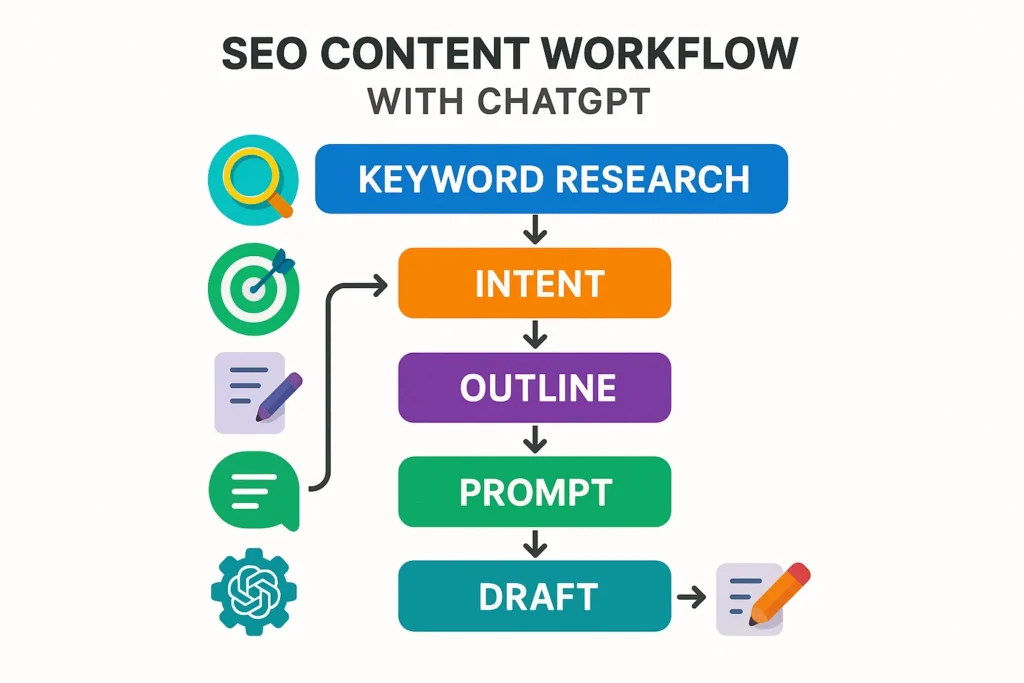
Writing SEO-optimized content with ChatGPT requires strategy, structure, and human refinement. AI helps you generate ideas quickly, but the ranking power comes from how you guide, edit, and optimize the output. Below is a complete, expanded step-by-step process with clear explanations.
1. Start With Strong Keyword Research
Before using ChatGPT, you must understand which keywords you’re targeting. This forms the foundation of your content strategy.
What to do:
- Identify a primary keyword: This is the main phrase you want to rank for. It should match your user’s intent and have a reasonable search volume.
- Gather secondary keywords: These support the main keyword and help Google recognize the topic depth (e.g., “ChatGPT SEO writing tips,” “AI SEO workflow”).
- Include semantic / NLP keywords: These are related phrases Google expects in high-quality content (e.g., “on-page optimization,” “content structure,” “search intent”).
- Analyze keyword difficulty: Check KD in Ahrefs or Semrush to understand competition and the effort needed to rank.
- Review SERP competitors: Studying top-ranking pages helps you understand the content depth Google prefers.
2. Analyze Search Intent Thoroughly
Search intent determines what the reader expects from your content, and ChatGPT must follow that direction.
How to analyze intent:
- Check if the query is informational (like this one): Users want a guide, explanation, or steps — not a sales pitch.
- Review SERP features: Look at “People Also Ask,” featured snippets, and top results to see what Google pushes.
- Define the user’s goal: Example: For this keyword, the goal is to learn how to use ChatGPT to write SEO content.
- Match the format to intent: If competitors use guides, lists, or tutorials, ChatGPT must write in the same format.
3. Create a Clear SEO-Focused Outline
Providing ChatGPT with an outline ensures structure, consistency, and complete topic coverage.
What the outline must include:
- H1 title aligned with the keyword: Helps Google understand the main topic immediately.
- H2 sections representing major topics: These divide the article logically — Google uses them to crawl context.
- H3s for additional depth: These allow ChatGPT to expand details without breaking flow.
- Sections for examples, checklists, and FAQs: These improve user experience and increase time-on-page.
- A featured-snippet style introduction: Ensures the article matches AEO guidelines right from the start.
4. Use Detailed, Instruction-Based Prompts
ChatGPT delivers the best results when the prompts are specific, structured, and contextual.
Your prompt must include:
- Audience description: Example: “Write for beginners in SEO.”
- The style and tone: Friendly, expert, technical, engaging — whichever fits the brand.
- The keyword list: Tell ChatGPT exactly which keywords to use naturally throughout the content.
- Content structure: Specify the introduction style, heading structure, bullet usage, and required sections.
- Writing requirements
Examples: “Use 40–50 word direct answer,” “Insert key takeaways,” “Provide real examples,” “Ensure high readability.” - Quality instructions
For example: Avoid repeating yourself, avoid generic sentences, and prioritize value-based explanations.
5. Generate the Draft With ChatGPT
Once the prompt and outline are ready, ChatGPT can produce a strong first draft.
What to expect:
- Complete structure based on your outline: Ensures no key section is missing.
- Natural keyword usage: AI will integrate keywords without stuffing.
- Topic depth: Properly guided prompts make ChatGPT produce deeper, more informative content.
- Readable formatting: Short paragraphs, bullets, and clarity signals improve user engagement.
- Consistent tone: ChatGPT follows your defined brand voice.
6. Edit and Optimize the Output Manually
AI-generated content must always be edited by a human to ensure ranking quality and accuracy.
What you must refine:
- Factual accuracy: Replace outdated or generic claims with verified data.
- Depth and completeness: Add missing information or expand where ChatGPT is too brief.
- Keyword optimization: Ensure keywords appear in headings, intro, conclusion, and naturally in paragraphs.
- Readability and flow: Adjust transitions and fix repetitive sentences.
- EEAT signals: Add insights, statistics, or expert notes to strengthen authority.
- Remove AI fluff: Delete long filler phrases or overly generic statements.
7. Add On-Page SEO Elements
Strong on-page optimization helps Google crawl, understand, and rank the content effectively.
Must-have elements:
- Internal links: Connect to relevant pages or other blogs to boost authority and navigation.
- External authoritative sources: Linking to credible references increases trustworthiness.
- Optimized header structure: Ensure all headers contain descriptive, keyword-rich titles.
- Images with alt text: Increases accessibility and keyword relevance.
- Meta title & description: Must match search intent and include the primary keyword.
- Short URLs: Make sure the permalink is clean and keyword-focused.
8. Run the Final SEO Check
Before publishing, run a final review with SEO tools.
Use tools like:
- SurferSEO – checks content score & NLP keywords
- Clearscope – improves topical coverage
- RankMath or Yoast – evaluates on-page SEO
- Grammarly or Hemingway – ensures clarity & readability
A final polish ensures your content performs at its highest potential.
Best ChatGPT Prompts for SEO Content Creation
Using the right prompts is the key to generating high-quality, SEO-optimized content with ChatGPT. Powerful prompts provide clear instructions, define tone, specify structure, and signal the level of expertise required. Below are the best prompt types along with expanded explanations and examples you can immediately use.
1. Prompts for Keyword-Optimized Blog Posts
These prompts help ChatGPT generate full structured articles designed for SEO performance.
Why this prompt works: It tells ChatGPT the keyword, structure, tone, required sections, and SEO expectations, ensuring a complete, professional-quality draft.
Example Prompt: “Write an SEO-optimized blog post about ‘how to write SEO optimized content with ChatGPT.’ Include a 50-word direct answer, a key takeaways section, detailed H2s, natural keyword usage, examples, and a final checklist. Use a clear, helpful, expert tone.”
2. Prompts for SEO Outlines
These prompts create high-quality article structures that match user intent and help your content rank.
Why this is useful: A strong outline prevents gaps and ensures ChatGPT covers everything Google expects.
Example Prompt: “Create an SEO-optimized outline with H2 and H3 headings for the topic ‘how to rank higher on Google in 2025.’ The outline should reflect search intent, include key subtopics, and follow a logical structure.”
3. Prompts for Optimizing Existing Content
Use these when you want to enhance or update your current content.
Why this matters: Google rewards updated, improved content. ChatGPT can help restructure, simplify, or expand.
Example Prompt: “Improve the following content for SEO. Make it clearer, more detailed, keyword-rich, and better structured. Maintain a professional tone. Here is the content: [paste text].”
4. Prompts for Meta Titles and Meta Descriptions
These prompts help you create click-worthy metadata quickly.
Why this is important: Strong meta tags increase CTR and improve ranking signals.
Example Prompt: “Write 5 meta titles (≤60 characters) and 5 meta descriptions (≤150 characters) for the keyword ‘local SEO tips for small businesses.’ Make them engaging and keyword-focused.”
5. Prompts for Keyword Integration
Use these prompts when you need natural keyword placement without stuffing.
Why this helps: ChatGPT can balance readability with SEO relevance when given clear keyword instructions.
Example Prompt: “Rewrite this paragraph to include these keywords naturally: [keywords]. Keep the tone smooth and avoid keyword stuffing. Here is the paragraph: [text].”
6. Prompts for Writing FAQs
FAQs help boost semantic relevance and voice-search optimization.
Why FAQs matter: They target long-tail questions and help Google understand content depth.
Example Prompt: “Create 8 FAQ questions and 40-word answers for the topic ‘SEO writing with ChatGPT.’ Make the answers helpful, concise, and SEO-friendly.”
7. Prompts for Improving EEAT Signals
These prompts help strengthen expertise and authority in your content.
Why this matters: Google prioritizes content written by knowledgeable sources — these prompts help reflect that.
Example Prompt: “Strengthen the EEAT of this section by adding expert insights, examples, or statistics. Keep the tone authoritative but readable. Here is the section: [text].”
8. Prompts for Social Media SEO Posts
Use these when you want SEO-focused micro-content for social platforms.
Why they help: Repurposing long-form content improves visibility and reinforces authority across multiple channels.
Example Prompt: “Create 5 social posts promoting an article about SEO writing with ChatGPT. Each post should be concise, engaging, and include one SEO tip.”
9. Prompts for Local SEO Content
These drive location-based ranking signals for businesses targeting local keywords.
Why this matters: Local intent requires region-specific optimization and ChatGPT handles this well when instructed.
Example Prompt: “Write a local SEO service page for ‘SEO agency in Los Angeles.’ Include service descriptions, benefits, location references, and strong conversion copy.”
10. Prompts for Competitor Analysis Content
AI can help summarize differences and competitive advantages.
Why this is useful: Content comparing tools, services, or strategies ranks well and attracts high-intent users.
Example Prompt: “Compare ChatGPT SEO writing to traditional content writing methods. Include pros, cons, examples, and a clear recommendation.”
How to Structure SEO Content for Higher Rankings
A powerful SEO structure helps search engines clearly understand your content and ensures that readers stay engaged. ChatGPT can assist with drafting and formatting, but ranking depends on how well you apply structure, clarity, hierarchy, and user intent throughout the article.
Here’s the complete breakdown of how to structure content for maximum rankings.
Start With a Strong, Keyword-Focused H1
Your H1 must instantly signal the topic to both readers and Google.
Best practices:
- Include the primary keyword naturally
- Keep it clear, direct, and user-friendly
- Avoid generic titles, be precise
- Use only one H1 per page
Example: “How to Write SEO Optimized Content With ChatGPT”
Write a 40–50 Word Featured Snippet-Ready Introduction
A short, clear intro helps your content appear in Google’s featured snippets.
What to include:
- A concise answer to the main question
- Keyword placement in the first sentence
- No fluff, purely value
- One paragraph only
This signals high relevance to Google right away.
Add a Key Takeaways Section for Scannability
Searchers love quick summaries, and Google rewards structure that improves user experience.
Why this boosts rankings:
- Reduces bounce rate
- Helps users find answers in seconds
- Suitable for AEO and voice search
Use short bullet points summarizing the main insights.
Use Clear, Descriptive H2 Headings
H2s serve as your content pillars and guide both humans and search engines.
H2 guidelines:
- Use keywords and semantic phrases naturally
- Make headings descriptive, not vague
- Match competitor depth
- Ensure every section answers a specific user question
Bad H2: “Introduction”
Good H2: “How to Use ChatGPT to Create SEO Content”
Use H3 Headings to Break Down Complex Topics
H3s give depth and organization to your content.
Best practices:
- Break long H2 sections into smaller parts
- Use them for steps, examples, or deeper explanations
- Avoid giant text blocks, improve readability
This helps Google understand content hierarchy and topical richness.
Keep Paragraphs Short and Easy to Read
Readability is a ranking factor because it affects engagement.
Guidelines:
- Keep paragraphs between 1–3 sentences
- Use conversational but expert tone
- Avoid long, confusing blocks of text
- Use transitional phrases for flow
Google prioritizes content that users don’t struggle to read.
Use Bullet Points to Improve Skim-Reading
Bullet points break complexity into digestible pieces.
When to use them:
- Listing steps
- Sharing examples
- Highlighting features
- Summarizing insights
Bullet points help users stay engaged, a major ranking factor.
Add Data, Examples, and Real-World Insights
Search engines reward content that provides expert-level depth.
Recommended enhancements:
- Case studies
- Real examples
- Statistics
- Comparisons
- Screenshots or visuals
This strengthens EEAT (Expertise, Experience, Authority, Trust).
Use Internal and External Links Strategically
Proper linking improves credibility and SEO signals.
Internal links:
- Connect related articles
- Help Google understand topic clusters
- Increase time-on-site
External links:
- Link to high-authority sources
- Strengthen trustworthiness
- Support facts or statistics
Both link types improve ranking potential.
Add a Final Checklist or Summary
A closing checklist helps users recap the main steps and keeps content structured.
Why it helps:
- Supports AEO
- Increases chances of snippet capture
- Improves user satisfaction
This section often makes the page stand out compared to competitors.
How to Optimize Keywords, Headers, and Formatting
Optimizing keywords, headers, and formatting is essential for helping search engines understand your content and for keeping readers engaged. Even when ChatGPT generates the draft, you must refine these elements manually to ensure the highest ranking potential. Below is a simplified, but fully expanded, version with clear explanations and no H3 subheadings.
Primary Keyword Optimization
Your primary keyword must appear naturally in the most influential parts of your content. This signals to Google what the page is about.
Important placements include:
- H1 Title Clearly tells search engines the main topic.
- First 40–50 Words Helps capture featured snippets and confirms relevance.
- One H2 Heading Reinforces topical authority.
- Meta Title & Description Improves click-through rate and ranking signals.
- Throughout the Content Naturally Only where it fits, never force it.
A well-placed keyword improves discoverability and ensures your content aligns with search intent.
Secondary Keyword Integration
Secondary keywords support your primary keyword by covering additional themes users search for. They improve relevance and help your content compete on a broader set of queries.
How to integrate secondary keywords effectively:
- Use them inside your body text when explaining related topics.
- Place them in bullet lists describing steps, benefits, or strategies.
- Include them in example sections or explanations.
- Mention them in your FAQ answers to cover more user questions.
This approach strengthens semantic depth without forcing keyword stuffing.
Semantic / NLP Keyword Usage
Semantic keywords are natural variations and related phrases that help Google understand context. They make your article read more like human expert writing.
Where to include NLP keywords naturally:
- Inside normal sentences when explaining concepts.
- As part of definitions, examples, or comparisons.
- Occasionally in sub-points or supporting bullets.
- Within explanatory paragraphs that naturally relate to them.
These keywords increase topic completeness and boost your ability to rank.
Clear, Keyword-Enhanced Headings
Your headings guide both readers and search engines. They must be descriptive and helpful.
Best practices for strong SEO headings:
- Use natural keyword variations in some H2s.
- Make headings specific rather than generic.
- Ensure each heading addresses a single user question or topic.
- Keep headings readable and aligned with search intent.
Google uses headings to understand the structure of your content, so clarity is essential.
Proper Header Hierarchy
Good hierarchy improves readability and makes your content easier for Google to crawl.
Rules to follow:
- Use one H1 only (the page’s main topic).
- Use H2s to divide core content sections.
- Avoid unnecessary over-nesting.
- Keep formatting clean enough that readers can skim quickly.
Simple hierarchy almost always performs better than complex structures.
Clean, Skimmable Formatting
Readers rarely read full pages word-for-word. Formatting affects how long they stay, which directly impacts SEO.
Formatting guidelines:
- Keep paragraphs short and digestible (1–3 sentences).
- Use bullet points for clarity when listing steps or examples.
- Bold key terms occasionally for emphasis.
- Maintain ample spacing between blocks of text.
- Avoid walls of text, break them up for readability.
Good formatting increases time-on-page and reduces bounce rates.
Strategic Visual Elements
Visuals help users absorb information faster, making your content more engaging.
What to include:
- Images
- Diagrams
- Infographics
- Screenshots
- Tables or comparison boxes
Always add descriptive alt text with a natural keyword to support SEO and accessibility.
Mobile-Friendly Structure
Most people consume content on mobile devices, so readability must prioritize small screens.
Mobile best practices:
- Use short paragraphs that don’t look overwhelming.
- Ensure visuals scale correctly on small screens.
- Keep headings concise so they fit mobile layouts.
- Avoid overly wide tables that break layout.
Mobile-first indexing means your mobile structure affects your rankings directly.
Natural Keyword Density
Keyword density should never feel forced. It must support clarity, not disrupt it.
General recommendation:
- Use the primary keyword naturally 1–1.5% of the text.
- Include secondary and semantic keywords where they naturally fit.
- Avoid repeating the same phrase too often.
A human editing pass ensures balance.
Final Optimization With Tools
SEO tools help confirm whether your structure, keywords, and readability are aligned with ranking standards.
Useful tools include:
- SurferSEO
- Clearscope
- RankMath or Yoast
- Grammarly or Hemingway
These validate clarity, keyword coverage, and SEO quality before publishing.
10 Common Mistakes to Avoid When Using ChatGPT for SEO
Below is a fully bullet-based list of common mistakes, each with a short, clear explanation. No subheadings. No extra formatting levels. Just clean bullets with expanded detail.
- Using vague prompts When instructions are unclear, ChatGPT produces generic, low-quality content. Always give structure, keywords, tone, and format.
- Skipping human editing AI drafts often include errors, repetition, or shallow details. Human editing improves accuracy, depth, and authority.
- Keyword stuffing Overusing keywords hurts readability and can trigger penalties. Use natural placement and semantic variations.
- Ignoring search intent If your content doesn’t match what users actually want, Google won’t rank it. Always analyze SERP results first.
- Publishing fluffy or generic text AI sometimes produces filler. Remove fluff, add examples, and strengthen explanations to make content valuable.
- Lack of EEAT (Expertise, Experience, Authority, Trust) Content needs expert notes, stats, or real-world insights. AI alone cannot establish authority without human input.
- Poor readability and formatting Long blocks of text push users away. Use short paragraphs, bullet lists, and spacing for scannability.
- Not adding internal or external links Internal links boost site structure; external links add credibility. Both help search engines understand your content.
- Not fact-checking the information AI may provide outdated or incorrect details. Always verify data such as statistics, SEO updates, or guidelines.
- Skipping the final SEO check Without reviewing keyword usage, NLP terms, readability, and structure, rankings suffer. Tools like SurferSEO or RankMath help validate quality.
How to Fact-Check and Improve AI-Generated SEO Content
AI-generated content is fast and helpful, but it must be verified and refined before publishing. Fact-checking ensures accuracy, reinforces EEAT, and prevents outdated or incorrect information from harming your rankings. Below is a clear, expanded list of how to improve AI-written content effectively.
- Verify all statistics and data: ChatGPT may generate outdated stats or approximate numbers. Cross-check facts using reliable sources like Google’s official blogs, government data, or top industry websites.
- Check dates and timelines: SEO trends, ranking factors, and Google updates change frequently.
- Review technical details manually: AI explanations about indexing, ranking algorithms, or schema markup can be oversimplified or incorrect. Make sure technical points are realistic and accurate.
- Confirm keyword relevance: Ensure the primary keyword still has search volume and aligns with user intent. Update secondary and semantic keywords if needed.
- Remove generic or repetitive text: AI may use repetitive patterns like “This helps improve your SEO.” Replace generic sentences with specific, actionable insights.
- Add expert input or personal experience: Google prioritizes content backed by real experience. Insert expert commentary, observations, or lessons learned to improve E-E-A-T.
- Strengthen clarity and flow: AI sometimes produces long or unclear sentences. Break them into shorter lines, improve transitions, and simplify wording.
- Improve section depth where needed: Some sections may be too thin or lacking detail. Expand explanations, add examples, or use real scenarios to give the content depth.
- Check on-page SEO elements: Verify that headings, metadata, alt text, and keyword placement follow best practices. Correct any structural issues.
- Ensure originality: AI content may unintentionally resemble other pages. Run a plagiarism check and adjust phrasing where needed to maintain uniqueness.
- Link to credible external sources: Adding citations to reputable sites increases authority and trust. Link to studies, reports, or recognized SEO industry sources.
- Add internal links to relevant pages: Strengthen your site’s topic cluster and navigation by linking to related content on your website.
- Improve hook and readability: Rewrite the intro, simplify large paragraphs, and make the text scannable so readers stay longer, a positive ranking signal.
- Optimize tone and style: Ensure the writing matches your brand voice. AI may sound too formal or too casual; adjust accordingly.
- Run a final quality check through tools: Tools like SurferSEO, Clearscope, Grammarly, and Hemingway help evaluate keyword coverage, clarity, and structure before publishing.
Final Checklist for SEO-Optimized Content
Before publishing your SEO content, it’s important to run a final review to ensure everything aligns with Google’s ranking standards. A good SEO checklist focuses on keyword placement, readability, structure, search intent, and technical accuracy.
Below is a simplified, balanced version that uses short paragraphs supported by a few essential bullet points.
1. A strong SEO article begins with proper keyword placement. Make sure your primary keyword appears in the H1 and naturally within the first few lines of the introduction. This helps search engines immediately understand the topic and improves your chance of appearing in featured snippets.
2. Your content should also match user intent from start to finish. When readers search your keyword, they expect a specific type of answer — whether that’s a guide, definition, tutorial, or comparison. Confirm that your article delivers the exact information users expect and does it in a clear, structured way.
3. Readability plays a major role in rankings. Paragraphs should be short, easy to follow, and organized with logical transitions. Add bullets only when breaking down steps, clarifying key points, or summarizing information so readers can quickly digest important details.
- Use bullet points only where they genuinely simplify information.
- Keep paragraph length short so users can scan easily, especially on mobile.
- Ensure your headings are descriptive and aligned with the core questions users ask.
4. Your content should sound natural and avoid AI repetition or filler text. Expand any weak or generic sections with examples, explanations, or simple real-life context. This enhances depth and strengthens EEAT, Google’s measurement of expertise, experience, authority, and trust.
5. Internal and external links also matter. Include a few internal links to pages that support your topic and guide readers deeper into your site. Add external links where factual accuracy or credibility is needed, but only from trusted, high-authority sources.
6. Finally, complete a quality check using tools like SurferSEO, Clearscope, or RankMath. These help validate keyword coverage, on-page SEO structure, and clarity.
Follow this simple checklist, and your content will be fully optimized, accurate, and ready to rank.
Why SEO Specialist USA Is Your Partner for SEO Content
SEO Specialist USA helps you turn AI-assisted content into high-ranking, high-impact SEO assets. If you want expert optimization, stronger keyword strategies, and content that actually ranks, our team is here to support your growth.
Work with SEO Specialist USA to get:
- Professionally optimized SEO content.
- Strategic keyword and content planning.
- Human-edited, high-performing articles.
Ready to improve your search rankings?
Contact SEO Specialist USA today
Final Thoughts
Writing SEO-optimized content with ChatGPT becomes powerful when you combine AI efficiency with human strategy. By using clear prompts, strong keyword research, readable formatting, and proper editing, you can create content that ranks higher, delivers real value, and supports long-term SEO growth. With the right workflow, ChatGPT becomes a reliable partner, but expert refinement is what truly elevates your content above competitors.
If you want professional support to scale and optimize your content, SEO Specialist USA ensures every article meets search intent, follows best SEO practices, and performs at the highest level.
FAQs
How can ChatGPT help with SEO content writing?
ChatGPT helps generate structured drafts, expand topics, and speed up the writing process. When paired with human editing, it becomes a powerful tool for creating high-quality SEO content.
Is ChatGPT good for writing long-form SEO articles?
Yes, as long as you provide strong prompts, a clear outline, and refine the final output. ChatGPT handles structure well, but humans must ensure accuracy and depth.
Does Google allow AI-generated content?
Yes, Google allows AI-assisted content as long as it’s helpful, accurate, original, and reviewed by humans. Low-quality or unedited AI content is discouraged.
How do I make ChatGPT content rank on Google?
Use solid keyword research, match search intent, use readable formatting, and optimize metadata. Most importantly, edit and enrich the AI text with expert insights.
Does ChatGPT automatically optimize for keywords?
ChatGPT can integrate keywords naturally, but you must give it the keyword list and instructions. Manual refinement ensures proper placement without stuffing.
Can ChatGPT replace a human SEO writer?
No, ChatGPT supports writing, but it cannot replace human expertise, strategy, or EEAT. The best results come from combining AI speed with human editing.
Is AI content detectable by Google?
Google doesn’t penalize AI content. It only penalizes low-quality content, regardless of who wrote it. Quality, accuracy, and usefulness matter most.