
Google Sandbox in SEO refers to an unconfirmed theory that new websites experience a temporary ranking delay despite being indexed. This period allows Google to evaluate trust, content quality, and link signals before allowing stronger rankings, especially for competitive keywords.
Key Takeaways:
-
 Google Sandbox is an SEO theory, not a confirmed Google algorithm.
-
It describes a ranking delay commonly experienced by new websites.
-
New domains may be indexed but struggle to rank for competitive keywords.
-
Google evaluates trust, content quality, and link signals over time.
-
The sandbox effect varies by industry, competition, and SEO practices.
-
Consistent, quality SEO helps reduce its impact over time.
What Is the Google Sandbox Effect?
The Google Sandbox effect describes a situation where new websites are indexed by Google but do not rank well for competitive keywords during their early months. Even with optimized content and proper SEO setup, visibility may remain limited.
This effect was first observed by SEO professionals who noticed that new domains often struggled to rank, while older, established sites performed better under similar conditions. Over time, rankings would improve without major changes, leading to the idea of a temporary evaluation phase.
It’s important to distinguish between indexing and ranking. Google can index a website quickly, but ranking requires confidence in a site’s reliability, authority, and relevance. The sandbox effect is believed to give Google time to assess these signals and reduce the risk of spam or low-quality sites ranking too quickly.
While Google has never officially confirmed a “sandbox,” the pattern of delayed rankings for new websites continues to be widely observed in SEO practice.
Is Google Sandbox Real or a Myth?
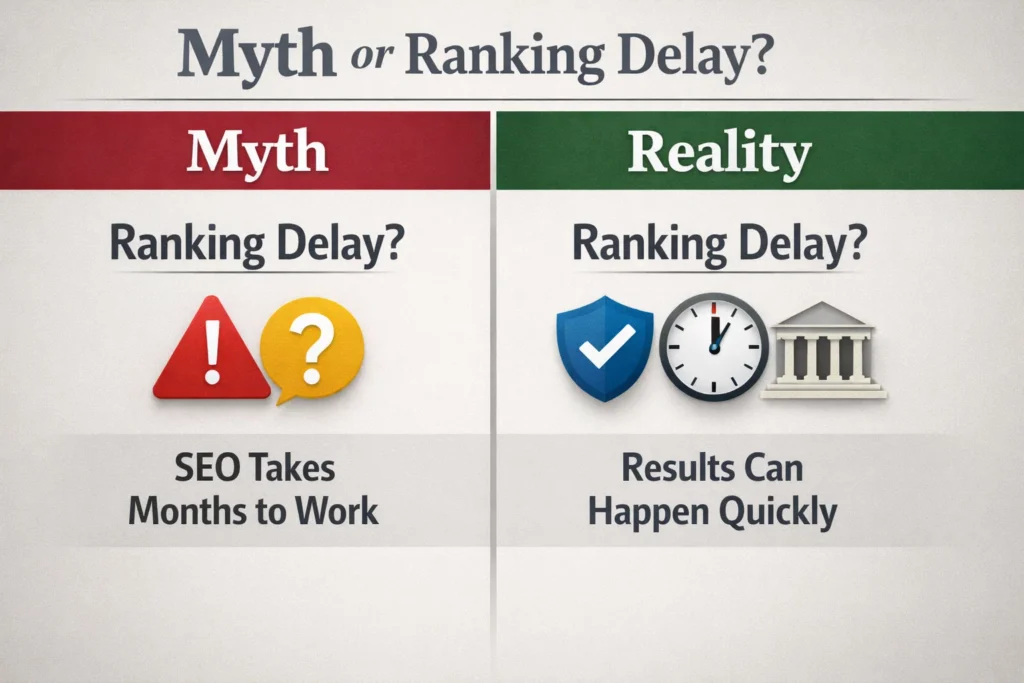
Google has never officially confirmed the existence of a “Google Sandbox” algorithm. No public documentation or statements indicate that new websites are deliberately placed into a sandbox or penalty state.
However, Google has repeatedly explained that new websites need time to earn trust. Ranking systems rely on historical data, link patterns, and user signals, which new domains naturally lack. This creates the perception of a sandbox effect, even without a dedicated filter.
From an SEO perspective, the sandbox is best understood as a natural ranking delay, not a punishment. Google evaluates content quality, backlink legitimacy, and engagement patterns before allowing stronger visibility, especially in competitive search results.
So while the Google Sandbox may be a myth as a named system, the ranking delay for new websites is very real and driven by how Google assesses trust and authority over time.
Why New Websites Don’t Rank Immediately
New websites often struggle to rank because Google needs sufficient data to assess their reliability and relevance. This delay is not a penalty but part of how search engines prevent low-quality or spam websites from gaining visibility too quickly.
- Lack of trust signals: New domains have no history, making it harder for Google to evaluate credibility.
- Limited backlinks: Authoritative links take time to earn and are a key ranking factor.
- Content evaluation period:Google needs time to understand content quality and topical relevance.
- Low user engagement data: New sites lack behavioral signals such as clicks and dwell time.
- Competitive keyword environment: Established sites dominate competitive queries due to proven authority.
Several factors contribute to this ranking delay:
As a result, new websites often rank first for long-tail or low-competition keywords before gaining visibility for broader terms. This gradual progression reflects Google’s emphasis on trust and long-term quality.
How Long Does the Google Sandbox Last?
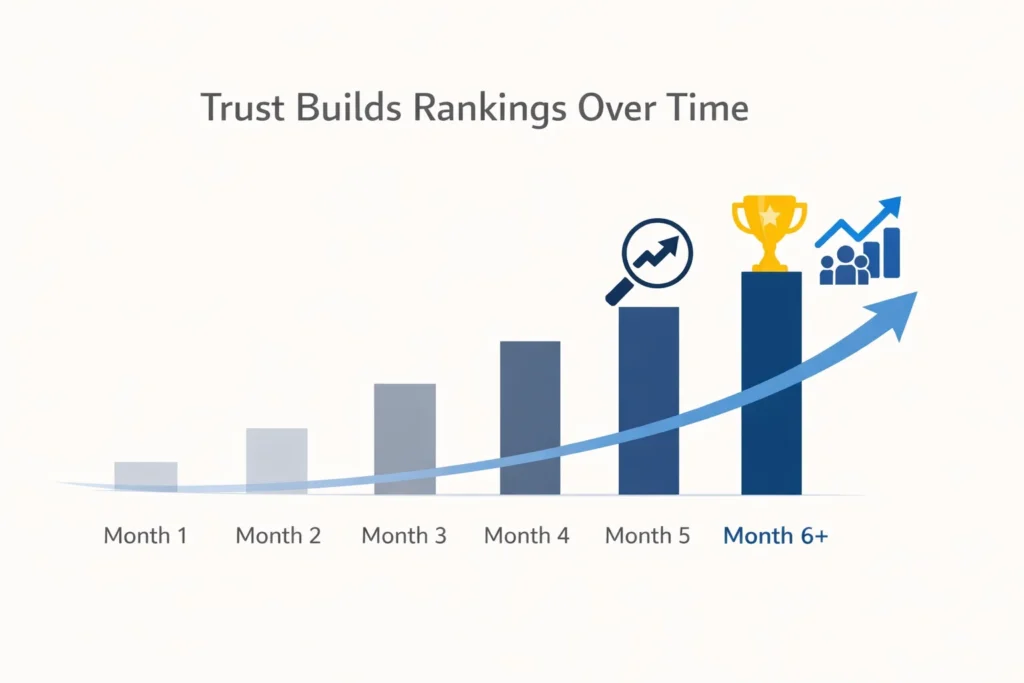
There is no fixed timeline for how long the Google Sandbox effect lasts because it is not a confirmed system. In practice, most new websites experience a ranking delay that can range from a few weeks to several months, depending on multiple factors.
- Industry competition: Highly competitive niches usually take longer to gain visibility.
- Content quality and consistency: Regularly publishing high-quality content can shorten the evaluation period.
- Backlink profile: Earning natural, authoritative links helps build trust faster.
- Technical SEO health: Clean site structure, fast loading speeds, and proper indexing support quicker progress.
- User engagement signals: Early clicks, time on site, and interactions help reinforce relevance.
The duration of this delay is influenced by:
Some websites begin ranking within 1–3 months, while others in competitive markets may take 6 months or longer. The key is consistency, strong SEO practices reduce the perceived “sandbox” effect over time.
5 Signs Your Website Is in the Google Sandbox
While Google does not label websites as being in a sandbox, certain patterns suggest a new site is experiencing a ranking delay. These signs are common during the early stages of SEO and usually improve over time with consistent optimization.
5 Common signs include:
- Pages are indexed but not ranking for competitive keywords.
- Rankings fluctuate frequently, especially in early weeks.
- Long-tail keywords rank first, while main keywords do not.
- Low impressions in Google Search Console, despite published content.
- Traffic grows slowly, even with proper SEO setup.
These indicators do not mean something is wrong. They reflect Google’s need to gather enough trust and performance data before allowing broader visibility. Monitoring progress and focusing on quality SEO are the best responses during this phase.
How to Get Out of the Google Sandbox (SEO Best Practices)
Since the Google Sandbox is not a formal penalty, there is no direct way to “exit” it. Instead, rankings improve as Google gains confidence in a website’s quality, relevance, and trustworthiness over time.
- Publish high-quality, original content consistently: Focus on helpful, in-depth content that clearly satisfies search intent.
- Build natural, authoritative backlinks: Earn links through outreach, PR, partnerships, and valuable resources, avoid aggressive link schemes.
- Strengthen technical SEO foundations: Ensure fast page speed, mobile friendliness, clean site structure, and proper indexing.
- Improve on-page SEO and topical relevance: Optimize titles, headings, internal links, and content depth across related topics.
- Encourage early user engagement: Promote content through social, email, and communities to generate initial traffic signals.
- Avoid shortcuts and spam tactics: Black-hat SEO can extend ranking delays or cause long-term damage.
To reduce the sandbox effect and build SEO trust faster, focus on the following best practices:
Over time, these actions help Google recognize your site as trustworthy, allowing rankings to improve naturally without relying on myths or shortcuts.
Build SEO Trust Faster with SEO Specialist USA
Ranking delays are common for new websites, but the right strategy makes a difference. SEO Specialist USA helps businesses build authority, optimize technical foundations, and create content strategies designed for long-term growth, without relying on outdated SEO myths.
FAQs: Google Sandbox in SEO
What is Google Sandbox in SEO?
Google Sandbox in SEO refers to an unconfirmed theory that new websites experience a temporary delay in rankings. During this time, Google evaluates trust, content quality, and link signals before allowing stronger visibility.
Does Google Sandbox still exist?
Google has never confirmed the Google Sandbox as an algorithm. However, ranking delays for new websites still occur due to the time needed to build authority, trust, and engagement signals.
How long does Google Sandbox last?
There is no fixed duration. Some websites rank within weeks, while others may take several months, depending on competition, content quality, backlinks, and technical SEO strength.
Can you avoid the Google Sandbox?
You cannot fully avoid early ranking delays, but strong SEO practices, quality content, natural backlinks, and clean technical setup—can significantly reduce the impact and duration.
How do you know if your site is in the Google Sandbox?
Common signs include pages being indexed but not ranking, low impressions, fluctuating rankings, and visibility limited to long-tail keywords during early months.
Does Google Sandbox affect all new websites?
Not all new websites experience the same delay. Factors like niche competition, content quality, and early trust signals influence how quickly a site gains visibility.
Final Thoughts: What Is Google Sandbox in SEO Today?
Google Sandbox is best understood as a natural ranking delay rather than a penalty or confirmed system. New websites need time to build trust, authority, and engagement. With consistent, high-quality SEO efforts, visibility improves steadily without relying on myths or shortcuts.
Discover More Articles with SEO Specialist USA