

AI Overview affects SEO for blogging by reducing traditional organic clicks, shifting user attention to AI-generated summaries, and making visibility more dependent on being cited as a source. Blogs now face lower CTR, fewer long-tail visits, and increased competition within Google’s AI-powered results.
Key Takeaways
-
 AI Overview reduces click-through rates (CTR) for many blog posts by answering queries directly in Google’s AI summary.
-
Blogs cited within the AI Overview box can still gain visibility, but competition is higher.
-
Long-tail blog traffic is declining as AI summaries replace multiple traditional search clicks.
-
Search Console may show rising impressions while GA4 shows fewer organic sessions due to attribution gaps.
-
Bloggers must optimize for EEAT, structure, freshness, and topical authority to appear in AI-generated results.
What Is Google AI Overview (SGE) and How It Works
Google AI Overview formerly known as Search Generative Experience (SGE) is Google’s AI-powered feature that generates a summarized answer at the top of search results.
Instead of showing only traditional blog links, Google’s AI now provides an instant explanation using information pulled from multiple web sources. These summaries may include citations that link to blog posts, but the AI answer itself often satisfies user intent without requiring a click.
As AI Overview continues to roll out globally, it is reshaping how users interact with search results and how much traffic blogs receive from Google.
How AI Overview Is Changing User Click Behavior
AI Overview changes how users interact with search results by giving them instant answers at the top of the page. Instead of clicking multiple blog posts, users often read the AI-generated summary and stop there. This reduces scroll depth, lowers demand for long-tail searches, and shifts attention away from traditional organic listings.
When users do click, they tend to choose sources highlighted directly within the AI summary cards, creating a “winner-takes-more” effect where only the cited blogs gain visibility.
As AI Overview becomes the primary entry point for many informational queries, user behavior is moving away from browsing multiple blogs toward consuming short, AI-generated responses.
Impact on Organic Traffic for Blogs
AI Overview is already causing noticeable shifts in organic traffic for many blogs. Since the AI summary answers common questions directly, fewer users scroll down to click traditional blue links. This leads to a decline in click-through rates, especially for informational and how-to queries.
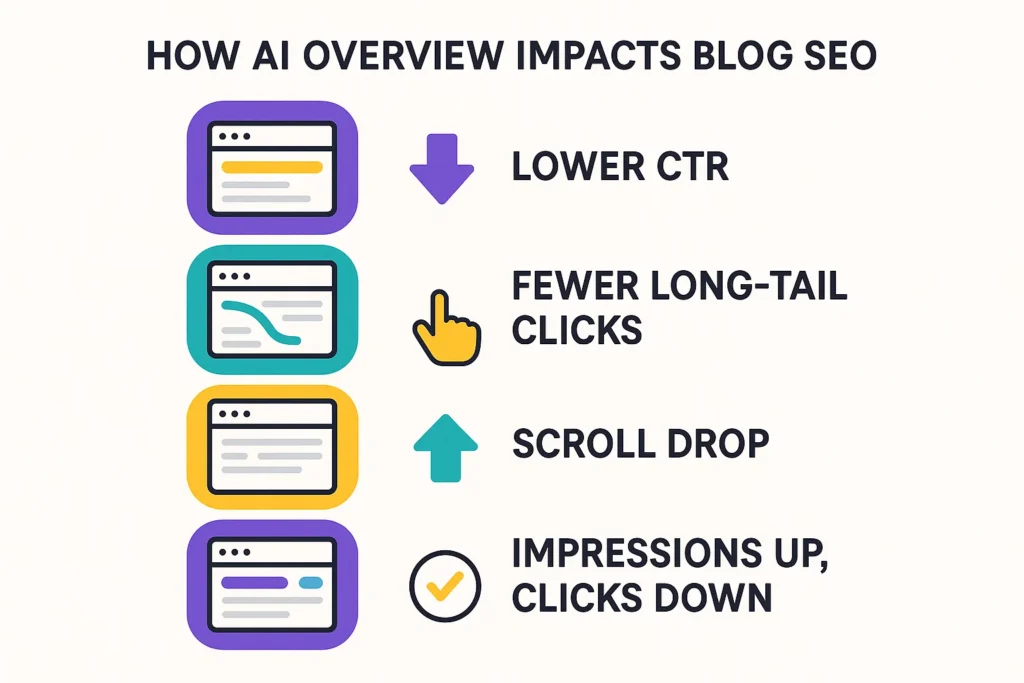
Some blogs are also reporting mismatches between Google Search Console and GA4 where impressions rise but clicks stay flat or drop because AI Overview generates visibility without driving traffic.
Long-tail keywords, which once brought steady visits, are now more vulnerable as AI summaries consolidate multiple queries into a single AI-generated response. The overall effect is a reduction in organic sessions for many blog sites unless they appear as a cited source within the AI Overview box.
How AI Overview Chooses Content Sources
Google’s AI Overview selects sources based on relevance, trust, and authority. It analyzes which pages provide the most accurate, structured, and helpful information for the search query. Blogs that demonstrate strong expertise and topical depth are more likely to appear as citations in AI-generated summaries.
6 Key factors AI Overview uses when choosing blog sources:
- EEAT (Experience, Expertise, Authoritativeness, Trustworthiness): Blogs with clear expertise, author bios, trustworthy sources, and topic specialization are favored.
- Topical Authority: Sites that consistently publish content around a specific niche are more likely to be cited than general websites.
- Content Quality & Depth: Well-explained, structured, and accurate information increases the chances of being included.
- Freshness & Recency: Updated or recently published content performs better because AI aims to provide current information.
- Search Performance: Pages already ranking in traditional search often get cited because Google trusts them more.
- Clear Formatting: Posts that use headings, bullet points, summaries, and strong structure are easier for AI to extract information from. Blogs that align with these factors have a much higher likelihood of appearing as citations inside Google’s AI Overview panel.
Blogs that align with these factors have a much higher likelihood of appearing as citations inside Google’s AI Overview panel.
Why Some Blogs Benefit While Others Lose Traffic
AI Overview doesn’t affect all blogs equally. Some gain visibility when cited in AI summaries, while others lose traffic because users no longer need to click through to multiple posts. The impact depends on topic type, content quality, niche authority, and how well the blog aligns with Google’s AI selection criteria.
Why some blogs lose traffic:
- AI answers the full query, reducing the need for users to click through.
- General or shallow content gets overshadowed by deeper, authoritative sources.
- Highly competitive niches push smaller blogs to lower positions below the AI box.
- Long-tail queries consolidate, meaning fewer keyword variations generate separate clicks.
- Older posts that haven’t been updated are less likely to be cited.
Why some blogs benefit from AI Overview:
- Being cited in the AI panel gives instant credibility and higher click intent.
- Strong E-E-A-T makes the blog a trusted source AI wants to reference.
- Niche authority blogs get more consistent citations because they specialize deeply.
- Structured, well-formatted content is more AI-friendly and easier to extract.
- Fresh, up-to-date posts are often selected over outdated articles.
Blogs that invest in expertise, structure, and niche authority gain the most from AI Overview, while those with generic or outdated content see the largest traffic declines.
What Types of Blog Content Are Most Impacted
AI Overview affects different types of blog content in different ways. Some blog categories see significant traffic declines because AI can easily summarize their information, while others remain strong because they require depth, personal insight, or unique expertise that AI cannot replicate directly.
Content types most negatively impacted:
- How-to guides: AI often summarizes step-by-step instructions directly in the overview.
- Definitions and simple explanations: Short, factual answers rarely require a click.
- Beginner-level guides: Basic information is easy for Google’s AI to condense.
- List posts and simple tips: AI can merge tips from multiple blogs into one summary.
- General informational content: Broad topics get overshadowed by authoritative sources.
Content types that can still perform well:
- Personal experience posts: AI can’t replicate lived experience or firsthand insights.
- Opinion, analysis, and commentary: Thought leadership remains unique to the author.
- In-depth research content: AI often cites and links to original research sources.
- Product reviews and real-world comparisons: AI can summarize, but many users still want detailed opinions.
Niche technical or expert-level guides: Specialized content is harder for AI to simplify.
Blogs focusing on originality, depth, and expertise continue to succeed, while basic informational posts are most likely to lose traffic in AI-driven search environments.
How Bloggers Can Optimize for AI Overview Visibility
With AI Overview reshaping search behavior, bloggers must adjust their content strategy to increase the chances of being cited in AI-generated summaries. While there is no guaranteed method, certain optimization practices significantly improve visibility and trust signals, making blogs more appealing to Google’s AI systems.
8 Key optimization techniques for AI Overview:
- Strengthen EEAT across your blog: Add expert bios, cite reputable sources, show credentials, and include real experience to build credibility.
- Use clear, structured formatting: Add headings, bullet points, short paragraphs, and answer boxes so AI can easily extract information.
- Target deeper, more specific topics: AI often summarizes surface-level content; niche and expert topics make your blog harder to replace.
- Update older content regularly: Freshness matters. Update statistics, screenshots, examples, and publish dates to improve AI relevance.
- Add concise summaries at the top: A short answer section can signal to AI that your blog offers a clean, direct response to the query.
- Improve topical authority within your niche: Publish multiple related posts that build depth and interconnected expertise.
- Include schema markup where relevant: FAQ, How-To, and Article schema help Google understand your content structure more clearly.
- Prioritize original insights and personal experience: AI struggles to replicate firsthand experience, making it a strong differentiator for bloggers.
By aligning content with these practices, bloggers significantly increase their chances of being cited, and benefiting, from Google’s AI Overview.
Measuring AI Overview Impact on Blog SEO (Realistic Methods)
Since AI Overview does not provide separate reporting in GA4 or Search Console, bloggers must rely on indirect signals to understand how AI is affecting their traffic. By monitoring certain patterns and comparing data across tools, you can identify whether AI summaries are influencing your blog’s performance.
Key methods to measure AI Overview’s impact:
- Compare GA4 vs. Search Console trends: If Search Console shows increased impressions but GA4 shows fewer clicks, AI Overview may be absorbing user attention.
- Watch for spikes in direct traffic: AI clicks often lack a referrer, causing GA4 to classify them as “direct” sessions instead of organic.
- Monitor long-tail keyword traffic drops: AI summaries consolidate multiple queries, reducing long-tail visits that previously supported blog traffic.
- Check landing pages cited by AI Overview: If certain posts appear in the AI panel, their traffic may fluctuate differently than uncited pages.
- Analyze changes in click-through rates (CTR): A sudden CTR drop in Search Console, even with stable rankings, is a strong indicator of AI Overview displaying above your blog.
- Track unassigned traffic in GA4: AI-driven clicks sometimes fall into the “unassigned” category due to missing referrer data.
- Use scroll depth and engagement metrics: Lower engagement on SERPs may reflect users getting answers from AI instead of visiting pages.
- Monitor featured snippet and PAA performance: AI often replaces or rewrites these elements, reducing their click potential.
- Use third-party SERP tracking tools: Tools that track AI Overview placements can reveal where your content appears in AI summaries.
Optional advanced methods:
Together, these signals help you estimate the real impact AI Overview is having on your blog traffic and rankings.
Future Predictions: How AI Overview Will Influence Blogging
AI Overview is still evolving, but its long-term impact on blogging is becoming clearer. As Google continues shifting toward AI-generated search experiences, the SEO landscape for bloggers will look very different over the next few years. Click patterns, content formats, and ranking opportunities will all change as AI becomes the default way users consume information.
8 Key predictions for the future of blogging SEO:
- Organic CTR will continue to decline for basic informational queries as AI answers become more accurate and detailed.
- Blogs that rely on simple definitions, how-to basics, and general info will struggle, as AI can summarize these instantly.
- Topical authority will matter more than ever, pushing niche-focused blogs ahead of generalist sites.
- AI citations will become a major traffic source, and being cited will be more valuable than ranking #1.
- EEAT signals will become essential, as Google prefers credible, experienced, and trustworthy sources for AI answers.
- Content originality will rise in importance, with firsthand experience and expert insights outperforming commodity information.
- Search Console and GA4 will likely introduce AI-specific reporting, helping publishers finally measure AI-driven clicks directly.
- Blog monetization models may shift, with creators focusing more on email lists, communities, and direct audience ownership to offset declining organic clicks.
Overall, AI Overview pushes blogging toward higher-quality, expert-driven, unique content instead of mass-produced informational posts.
Why Choose SEO Specialist USA for AI-Adaptive SEO
AI Overview has changed how search works, and many bloggers are now struggling with declining clicks, inconsistent analytics, and unpredictable ranking patterns.
SEO Specialist USA helps you navigate this new landscape with strategies designed specifically for AI-powered search.
We analyze how AI Overview affects your content, identify opportunities to earn AI citations, update on-page structure for AI extraction, and strengthen your E-E-A-T to improve trust signals.
Our team also audits your GA4 and Search Console data to highlight hidden AI-driven trends that most bloggers miss. If your traffic has dropped or your blog isn’t appearing in AI summaries, we can help you adapt your SEO strategy for long-term success.
Final Thoughts on AI Overview’s Impact on Blogging SEO
AI Overview is reshaping how users find and interact with blog content, reducing traditional organic clicks while rewarding blogs that demonstrate strong expertise, depth, and topical authority.
Although many bloggers may see drops in CTR and long-tail traffic, those who adapt their content strategy focusing on EEAT, structure, originality, and niche focus can still thrive in this new AI-driven search environment.
As Google continues refining AI Overview, the long-term winners will be creators who offer real value and expertise that AI alone cannot replicate.
FAQs: How AI Overview Affects Blogging SEO
Does AI Overview reduce clicks to blogs?
Yes. AI Overview often answers user queries directly on the search page, which reduces the need for users to click through to blog posts. This is most noticeable for informational and how-to topics.
Can blogs still rank well even with AI Overview?
Absolutely. Blogs with strong EEAT, niche authority, and structured, in-depth content continue to rank and can even be cited in AI summaries, which may boost visibility despite overall lower CTR.
Why is my Search Console showing more impressions but fewer clicks?
AI Overview can increase impressions because your content appears on the page, but users may not click since the AI summary already answers their question. This leads to a drop in click-through rate.
How do I get my blog cited in AI Overview?
Focus on EEAT, topic depth, structured formatting, and updated content. Google’s AI tends to choose blogs that offer clear, credible, well-organized information that’s easy to extract into summaries.
What blog topics are most affected by AI Overview?
Simple definitions, basic how-to posts, and general informational content are most impacted because AI can summarize them easily. Niche, expert-level, personal, or experience-based content performs better.
Does AI Overview affect long-tail keyword traffic?
Yes. AI consolidates multiple long-tail variations into a single AI response, which can reduce the number of separate clicks that blogs would traditionally receive from long-tail search queries.
Will AI replace blogging entirely?
No. While AI may replace clicks for basic information, blogs that provide unique insights, original research, real experiences, and expert-level guidance will remain valuable and continue attracting engaged readers.