
You create content for local landing pages by using city-specific keywords, writing localized service descriptions, adding local trust signals, optimizing your H1 and metadata, showcasing reviews, and including clear calls-to-action. Effective local landing pages improve rankings, drive local traffic, and increase high-intent conversions.
Key Takeaways
-
 Local landing pages target city-based keywords to attract high-intent searchers.
-
Content must include localized service descriptions, trust elements, and area-specific details.
-
Reviews, schema markup, maps, and CTAs help increase conversions and authority.
-
Proper keyword placement boosts local rankings and improves visibility in search results.
-
Working with an SEO Specialist USA ensures pages are optimized for both traffic and conversions.
What Are Local Landing Pages?
Local landing pages are pages designed to target a specific city, neighborhood, or service area so your business can appear in location-based searches. These pages help Google understand where you operate and make it easier for local customers to find you when they search for services “near me” or in their city.
- A location-specific headline
- Services offered in that city
- Local keywords woven naturally into the content
- Relevant reviews from customers in that area
- Local photos or city references
- Contact information, directions, or a map
- Clear calls-to-action that encourage calls, bookings, or visits
A strong local landing page typically include:
These pages work especially well for multi-location businesses, service-area companies, and any business trying to rank in multiple cities without keyword stuffing or duplicating content.
Why Local Landing Pages Matter for SEO
Local landing pages are one of the strongest ways to increase visibility in city-based searches. Google ranks pages that clearly signal who you serve, what you offer, and where you operate. Without location-specific content, your business struggles to appear in local results, even if your services are excellent.
Local landing pages matter because they:
- Help Google understand your service areas.
- Allow you to target city-level and “near me” keywords.
- Improve relevance for local searches.
- Increase organic traffic from nearby customers.
- Strengthen your Google Business Profile rankings.
- Provide dedicated pages that convert visitors into leads.
- Support multi-location SEO strategies without duplicate content.
If you want to dominate local search, these pages act as your digital storefronts for each city. They give you more opportunities to rank, and more chances to convert customers who prefer local businesses.
Elements Every High-Converting Local Landing Page Needs
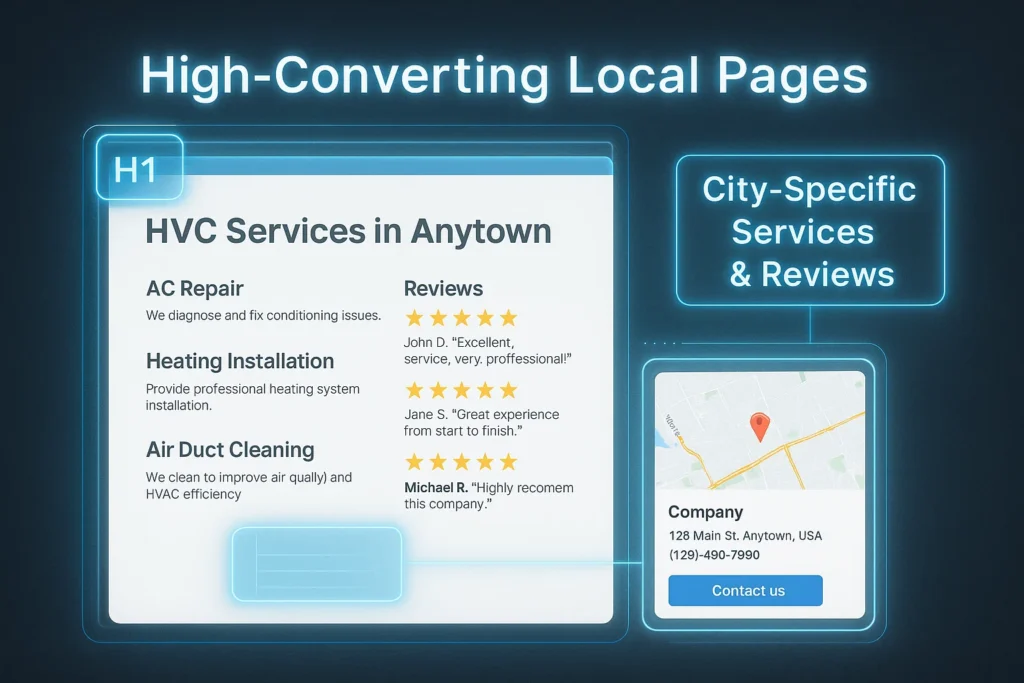
A successful local landing page does more than include a city name—it delivers strong, relevant, trust-building content that helps both Google and customers understand why your business is the best choice in that specific area. The structure should be clear, engaging, and tailored to the needs of local searchers.
- A clear, location-specific H1, such as “Plumbing Services in Denver, CO”.
- A localized introduction mentioning the city, neighborhood, or service area.
- Detailed service descriptions tailored to what people in that area search for.
- Geo-targeted keywords naturally included in titles, paragraphs, and metadata.
- Local reviews or testimonials to build trust and relevance.
- A Google Map embed or service area map for stronger local authority.
- Accurate NAP details (Name, Address, Phone) that match your citations.
- Localized visuals or references such as city landmarks or community details.
- Clear CTAs encouraging calls, bookings, or direction requests.
Every high-performing local landing page should include:
These elements work together to improve rankings, build credibility, and increase conversions. When your page speaks directly to the local audience, Google rewards the relevance—and customers respond with action.
How to Write SEO-Optimized Local Content
Writing SEO-optimized content for local landing pages is all about balancing relevance, clarity, and natural keyword usage. Your goal is to show Google—and your customers—that you truly serve the area and understand local needs. This requires more than just adding a city name; it requires thoughtful, location-specific content.
Begin by writing a strong, localized introduction that mentions the city, service area, and the main service you provide. Avoid generic openings—speak directly to the local audience and reference the community when possible. From there, incorporate local keywords naturally while keeping the writing fluid and helpful.
- Use city-based phrases naturally within sentences
- Include nearby neighborhoods, suburbs, or service areas when relevant
- Add local problems or needs your business solves
- Include local examples, customer stories, or case references
- Write service descriptions tailored to that specific location
- Avoid duplicate content between city pages—rewrite each one uniquely
- Use a consistent tone that builds trust and authority
- Make CTAs specific, such as “Book your service in Houston today”
When writing local content, make sure to:
High-performing local content speaks to both humans and search engines. It tells Google where you operate and tells customers why they should choose you, right now, in their area.
City Pages vs. Service-Area Pages: What’s the Difference?
Local SEO requires understanding when to use a city landing page and when to use a service-area page. Although both attract local customers, they serve different purposes and impact rankings differently. The table below breaks down the essentials:
Comparison Table: City Pages vs. Service-Area Pages
| Feature | City Landing Page | Service-Area Page |
| Primary Focus | One specific city | Multiple cities/towns in a region |
| Ideal For | Businesses with a physical location or strong presence in that city | Businesses operating across many areas without multiple physical locations |
| Content Style | Highly detailed, location-specific content | Broader regional descriptions covering several locations |
| SEO Goal | Rank for “service + city” terms | Rank for “service near me” & wider “service in [region]” terms |
| Local Signals | Includes city references, landmarks, local reviews | Mentions multiple cities, suburbs, service zones |
| Conversion Rate | Typically higher due to stronger local relevance | Moderate, but ideal for capturing wide-area searches |
| Use Cases | “Plumber in Dallas, TX” page | “Plumbing Service Areas in North Texas” page |
| Maintenance | Requires separate pages for each city | One page can cover multiple areas efficiently |
| Best For SEO? | Best for deep, city-level ranking | Best for expanding reach without duplicate content |
City landing pages help you dominate specific locations, while service-area pages help you expand visibility across larger regions. Smart SEO strategies use both: city pages for high-value markets, and service-area pages for broader coverage.
Common Mistakes When Creating Local Landing Pages
Many businesses try to build local landing pages but unintentionally make mistakes that prevent them from ranking, or worse, damage their SEO. These issues often lead to duplicate content, low engagement, and poor visibility in local search results. Avoiding these mistakes is essential if you want your city pages to actually bring in traffic and conversions.
- Copying the same content for every city page, only changing the place name.
- Using thin content with fewer than 400–600 words, which provides no real value.
- Stuffing keywords unnaturally, making the page look spammy.
- Forgetting local relevance signals, like landmarks, neighborhoods, or local service references.
- Not including local reviews, which hurts credibility and conversions.
- Missing on-page SEO basics, like optimized H1s, metadata, schema, or internal links.
- Ignoring mobile optimization, even though most local searches come from phones.
- Using the wrong page type (e.g., creating city pages when a service-area page makes more sense).
- Not adding clear calls-to-action, causing visitors to leave without converting.
- Neglecting a Google Map embed, which reinforces geographic relevance.
Some of the most common errors include:
Fixing these issues alone can dramatically improve your rankings, engagement time, and conversion rates.
How to Scale Local Landing Pages for Multiple Cities
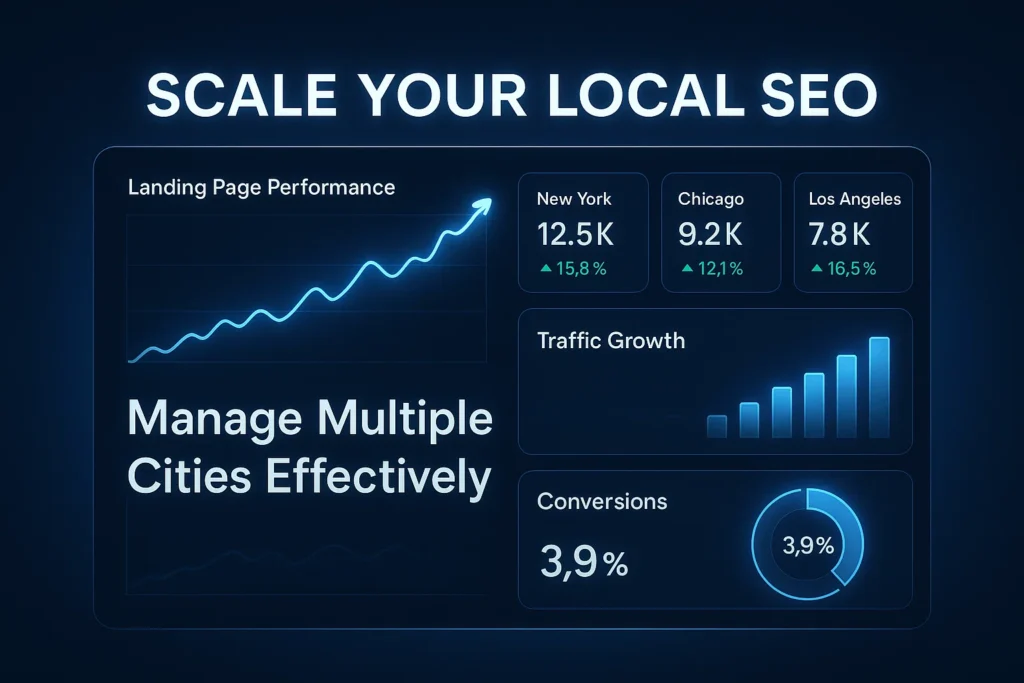
Scaling local landing pages across multiple cities can be one of the most powerful growth strategies for businesses that serve large regions. However, it must be done correctly—Google rewards unique, localized, high-quality content, not copy-and-paste city pages. The goal is to maintain consistency while preserving originality across every location.
The smartest way to scale is to use a repeatable content framework that adapts to each city without duplicating content. This ensures each page has its own identity, local relevance, and ranking potential.
When scaling local landing pages, make sure to:
- Create a master template for structure, not content (H1, intro, service blocks, reviews, CTAs, etc.)
- Write unique introductions referencing each city, landmarks, or local needs
- Customize service descriptions based on what customers in that region search for
- Embed local reviews or testimonials from clients in that specific area
- Include local photos whenever possible (storefronts, team, local landmarks)
- Use city-focused keywords naturally throughout the copy
- Add Google Maps embeds for each location to strengthen relevance
- Internally link from the main “Locations” hub to each city page
- Avoid duplicating FAQs by customizing each one based on local search intent
- Use schema markup with correct location details for each page
Scaling is not about creating dozens of pages at once, it’s about building high-quality local assets that rank in multiple markets and remain sustainable long-term.
Should You Hire an SEO Company for Local Landing Pages?
Building effective local landing pages requires more than content writing—it requires a strategic approach that blends on-page SEO, local keyword targeting, schema markup, internal linking, and localized relevance signals. Many businesses attempt to handle this on their own, but without proper optimization, these pages rarely rank or convert well.Partnering with an experienced SEO Company like SEO Specialist USA ensures your city pages are created with a proven framework designed for search visibility and conversions. Instead of guessing what Google wants, you get a structured process backed by expertise and real data.
Key Takeaways
-
Local landing pages target city-based keywords to attract high-intent searchers.
-
Content must include localized service descriptions, trust elements, and area-specific details.
-
Reviews, schema markup, maps, and CTAs help increase conversions and authority.
-
Proper keyword placement boosts local rankings and improves visibility in search results.
-
Working with an SEO Specialist USA ensures pages are optimized for both traffic and conversions.
Final Thoughts: Local Landing Pages That Drive Real SEO Results
Creating high-quality local landing pages is one of the most effective ways to increase visibility, attract customers from multiple cities, and grow your business through organic search. When your landing pages are optimized with the right keywords, structured properly, and personalized to each location, they send strong signals to Google about your relevance and authority in local search results.
Well-built local pages help you:
- Rank for “service + city” and “near me” keywords
- Stand out in competitive service areas
- Improve conversions through trust-building signals
- Expand into new markets with predictable results
- Build long-term local authority across multiple locations
Local landing pages aren’t just another SEO tactic, they’re powerful digital assets that continue to generate traffic and leads long after they’re published. When executed correctly, they become a core part of your long-term growth strategy.
FAQ
How do you create effective content for local landing pages?
You create effective local landing pages by using city-focused keywords, writing unique localized content, adding local reviews, embedding maps, optimizing metadata, and including trust-building elements. Each page must feel tailored to the specific city or service area.
Why are local landing pages important for SEO?
Local landing pages help Google understand where your business operates and who you serve. They increase visibility for city-specific searches, improve Google Maps rankings, and attract high-intent local customers who convert more frequently than general web traffic.
Can I use the same content for multiple city pages?
No. Duplicate content hurts rankings and damages local trust. Each city page must include unique introductions, service details, localized references, and custom elements. Personalized content performs significantly better in local search results.
How long should a local landing page be?
Ideally 700–1,200 words. This allows room for localized content, service explanations, reviews, and internal links. Short pages provide too little relevance and rarely perform well in competitive city-based searches.
What elements improve conversions on local landing pages?
Clear CTAs, local reviews, Google Maps embeds, localized imagery, strong service descriptions, and easy contact options all boost conversions. These elements reassure customers that you genuinely serve their area and can be trusted.
How many local landing pages can I create?
As many as you need, as long as each one is unique. Multi-location businesses often build pages for each city, neighborhood, or service area. Scaling must be done thoughtfully to avoid duplication and maintain quality.
Should I hire an SEO company to create local landing pages?
Yes. An SEO company like SEO Specialist USA ensures your pages are optimized for rankings, relevance, and conversions. Experts manage keyword research, content creation, schema markup, layout, and ongoing optimization across multiple locations.