

Direct Answer
To find keywords for local SEO, start with Google’s autocomplete and “People Also Ask” results, use tools like Google Keyword Planner or Ubersuggest, research your competitors, and focus on location-based phrases like “[service] in [city].” Combine high-intent terms with your area to attract ready-to-buy local customers.
Key Takeaways
-
 Local SEO keywords combine your service or product with a location (city, neighborhood, or region).
-
Google Autocomplete, Keyword Planner, and Ubersuggest are excellent free or low-cost starting points.
-
Competitor keyword analysis saves time and reveals gaps you can target.
-
Long-tail local keywords (e.g., “emergency plumber in Austin TX”) convert better than broad terms.
-
Consistent keyword research keeps your content aligned with what local customers are searching for.
What Are Local SEO Keywords?
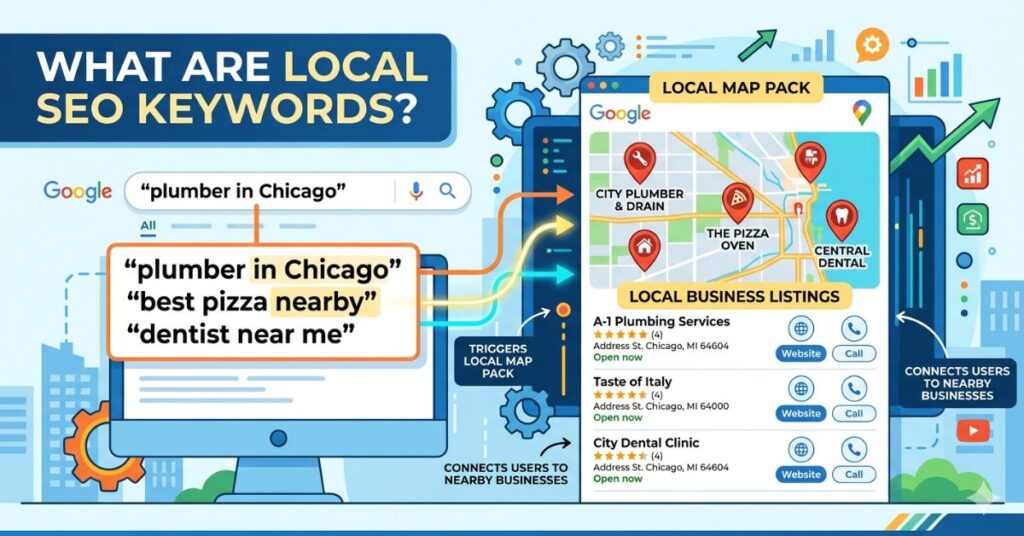
Local SEO keywords are search terms people use when looking for businesses, services, or products near them. They almost always include a geographic modifier, whether that is a city name, neighborhood, zip code, or phrases like “near me.”
For example, a bakery in Chicago might target terms like “custom cakes Chicago,” “bakery near Lincoln Park,” or “gluten-free birthday cakes Chicago IL.” These are not generic phrases. They are intent-driven searches from people who are ready to visit, call, or buy.
Getting these keywords right is what separates a local business that shows up on Google from one that stays invisible to its best potential customers.
Why Local Keyword Research Matters
Most local searches carry purchase intent. Someone searching “roof repair near me” is not doing casual research. They have a problem and want a solution now. If your business shows up for that search, you are in the conversation. If it does not, your competitor is.
According to Google, 76% of people who search for something nearby on their smartphone visit a related business within a day, and 28% of those searches result in a purchase. That kind of conversion rate is hard to match with traditional advertising.
Strong keyword research also feeds your on-page SEO, content strategy, and Google Business Profile optimization, all of which work together to improve your local rankings.
How to Find Keywords for Local SEO: Step-by-Step
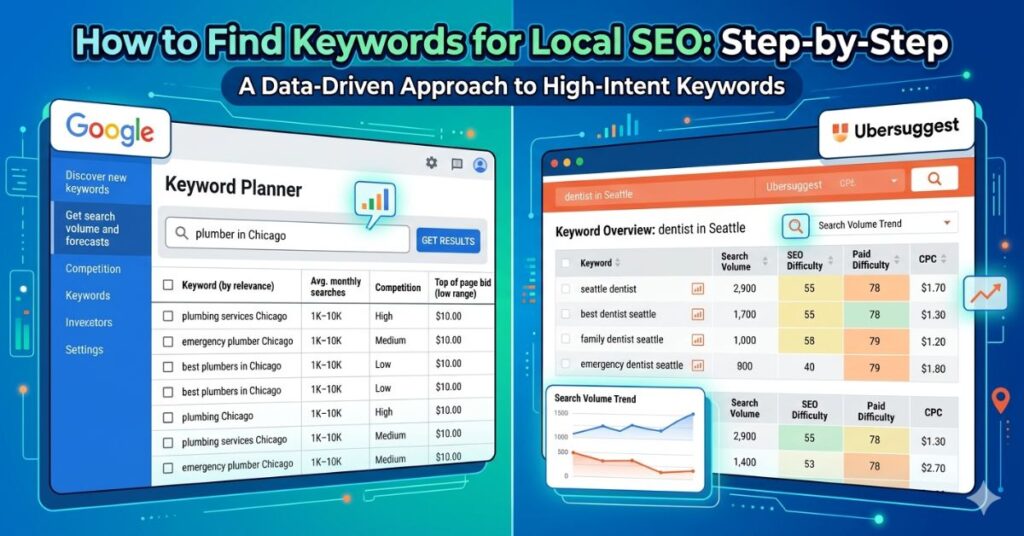
Step 1: Start With Google Autocomplete
Type your core service into Google and watch the suggestions that appear. For example, type “plumber in” and Google will auto-suggest “plumber in Dallas,” “plumber in Houston,” and more. These are real searches people are making right now. They are free data, and they are incredibly accurate because they come straight from Google’s search volume.
Also check the “Related Searches” section at the bottom of the results page. These give you even more keyword variations your competitors may be ignoring.
Step 2: Use Google Keyword Planner
Google Keyword Planner is a free tool inside Google Ads. Even if you do not run paid ads, you can use it for organic keyword research. Enter your service and location to get estimated monthly search volumes, competition levels, and related keyword ideas.
Filter results by your target city or region to get data specific to your market. Focus on keywords with decent volume but lower competition, especially for a newer business or website.
Step 3: Explore Google Search Console
If your website is already live, Google Search Console is one of the most powerful tools available. Go to Performance > Search Results and look at which queries your site already appears for. You will often find local keyword opportunities you were not aware of, and you can see exactly which pages are getting impressions or clicks.
Step 4: Research Competitor Keywords
Pick two or three local competitors who rank well in your area. Use a tool like Ubersuggest, Ahrefs, or SEMrush to see what keywords they rank for. Look for terms that are relevant to your business but where you have no presence yet. That is your roadmap.
Even a basic free Ubersuggest account gives you enough data to identify 10 to 20 solid keyword opportunities without spending a dollar.
Step 5: Mine “People Also Ask” and Local Directories
Search one of your main keywords on Google and look at the “People Also Ask” box. Each question there is a keyword opportunity. These questions are what real users want answered, and writing content around them gives you a strong chance to appear in featured snippets and voice search results.
Also check local directories like Yelp, Angi, and HomeAdvisor. Look at the categories and descriptions competitors use. Those phrases often reflect high-converting keyword language you should be using too.
Step 6: Think About Intent, Not Just Volume
A keyword with 50 monthly searches and strong purchase intent is more valuable than one with 5,000 searches from people who are just browsing. Focus on terms that signal action, such as “hire,” “near me,” “best,” “affordable,” “same day,” or the person’s city combined with a service.
These are the people closest to making a decision, and they are the ones most likely to call your business.
Types of Local SEO Keywords to Target
- Geo-modified keywords: “electrician in Denver” or “Denver electrician”
- Near me keywords: “dentist near me” or “best pizza near me”
- Neighborhood keywords: “coffee shop in Brooklyn Heights”
- Service plus city: “HVAC repair Phoenix AZ”
- Question-based keywords: “how much does roof repair cost in Atlanta”
- Zip code keywords: “auto repair 90210”
Mix all these types into your keyword strategy. They often target different stages of the buyer journey and together create a wider net for local search traffic.
Include LSI and Secondary Keywords Naturally
LSI (Latent Semantic Indexing) keywords are related terms that help search engines understand what your page is about. For local SEO, these might include words like “local search,” “Google Business Profile,” “map pack,” “local listings,” “service area,” “NAP consistency,” and “organic local rankings.”
You do not need to stuff these in. Just write naturally about your topic and they will appear on their own. The goal is coverage, not repetition.
If you need expert help building a keyword strategy, the team at SEO Specialist USA can create a custom plan tailored to your market and business goals.
Local SEO Keyword Research: Key Statistics
- 46% of all Google searches are looking for local information. (Source: HubSpot)
- “Near me” searches have grown by more than 500% in recent years. (Source: Google)
- 76% of people who search locally on mobile visit a store within a day. (Source: Google)
- 28% of local searches result in a purchase. (Source: Google)
- Businesses that appear in the Google 3-Pack receive about 126% more traffic than those below it. (Source: BrightLocal)
These numbers make one thing clear: investing time into local keyword research has a direct impact on traffic, leads, and sales.
How SEO Specialist USA Can Help
Finding the right local keywords is one thing. Building a strategy around them that drives consistent traffic and leads is another. SEO Specialist USA specializes in local SEO for businesses across the United States, helping them rank for the terms that matter most to their customers.
The agency combines data-driven keyword research with content optimization, technical SEO improvements, and off-page authority building to deliver results that last. Whether you are a small local shop or a multi-location business, the approach is customized to your market and goals.
Get a detailed look at your current keyword opportunities with a SEO audit from SEO Specialist USA. No guesswork, just clear data.
Or contact the team directly to discuss a full local SEO strategy built around your business.
Frequently Asked Questions