
To show up in AI Overviews, your content must be highly authoritative, well-structured, and optimized for clear answers. Google’s AI pulls from pages that demonstrate strong EEAT, topical relevance, updated information, and easily extractable formatting. Sites with niche expertise and clean structure have the highest chance of being cited.
Key Takeaways
-
 Google AI Overview cites content that demonstrates strong EEAT (expertise, experience, authoritativeness, trustworthiness).
-
Clear, structured formatting—like headings, bullet points, and concise summaries, helps AI extract information.
-
Blogs with topical authority in a specific niche are more likely to appear in AI Overviews.
-
Holiday weekdays mean fewer trading days; weekend holidays mean more.
-
Fresh, updated content performs better than outdated posts in AI-generated answers.
-
Schema markup (FAQ, How-To, Article) improves AI’s ability to understand and cite your content.
-
Content optimized for direct answers and user intent increases your chances of being included.
What Is Google AI Overview and How It Chooses Sources
Google AI Overview is Google’s AI-generated summary that appears at the top of search results, giving users quick answers sourced from multiple web pages. Instead of relying only on traditional rankings,
AI Overview evaluates content based on relevance, helpfulness, trust signals, and how easily information can be extracted. It selects sources that demonstrate strong EEAT, align well with the search intent, and provide accurate, up-to-date information.
Pages with clear formatting, reliable context, and niche authority are more likely to be chosen as citations inside the AI-generated summary.
Key Ranking Signals AI Overview Relies On (EEAT + Relevance)
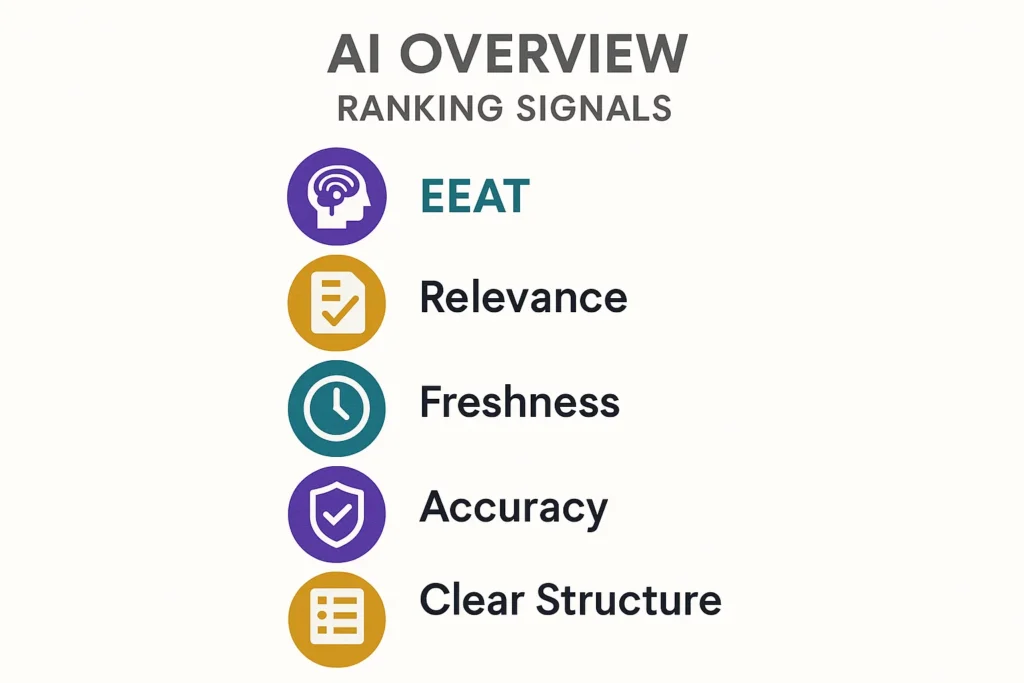
Google’s AI Overview does not simply pull from the highest-ranked pages—it selects content that demonstrates strong trust, expertise, and clear relevance to the user’s query. The AI system evaluates whether your content is accurate, authoritative, and presented in a way that supports fast, reliable summarization.
6 Core ranking signals AI Overview depends on:
- EEAT (Experience, Expertise, Authoritativeness, Trustworthiness): Content written by credible experts, supported by real experience, and backed by trustworthy sources ranks higher for AI citation.
- Topical Relevance: Pages must directly match the search intent, avoid fluff, and provide meaningful, complete answers.
- Content Freshness: AI Overview favors recently updated pages, especially for topics involving trends, data, or evolving information.
- Accuracy & Source Reliability: Blogs that cite reputable studies, reputable websites, or official sources are judged more trustworthy.
- Clear, Extractable Information: AI needs clean formatting, short paragraphs, and organized sections so it can scan and summarize content effectively.
- Semantic Depth: Thorough coverage of related subtopics signals to AI that your page is authoritative on a subject.
Together, these signals determine whether your content is included and cited inside Google’s AI Overview panel.
Content Structures That Help You Appear in AI Overviews
AI Overview works by extracting clean, concise information from webpages. Content that is well-organized, easy to scan, and formatted for quick understanding has a much higher chance of being cited. The goal is to make your information as “AI-readable” as possible so Google can easily pull it into summaries.
Content structures that boost AI Overview visibility:
- Short, direct answer at the top: Begin articles with a 40–50 word answer or clear definition to match AI’s summarization style.
- Use H2/H3 headings to break down topics: Logical, descriptive headings help AI understand topic flow and extract sections cleanly.
- Bullet points and numbered lists: AI prefers structured information that can be lifted directly into summaries.
- Concise paragraphs (2–4 lines): Long blocks of text confuse AI models; short sections are easier to interpret.
- Actionable steps or frameworks: AI often cites step-by-step instructions, checklists, and clear processes.
- FAQ sections: AI pulls answers from FAQ blocks when they directly match user questions.
- Summary boxes or key takeaways: These provide quick insights AI can reuse in its generated response.
- Schema-aligned formatting: Structuring content similar to schema types (FAQs, How-To, Article) increases AI readability.
Content that is neatly structured, precise, and helpful gives Google’s AI exactly what it needs to choose your page for Overviews.
On-Page SEO Techniques That Improve AI Citation Chances
Optimizing for AI Overviews requires stronger on-page SEO than traditional rankings alone. Google’s AI prioritizes content that is highly relevant, clearly written, and structured for instant understanding. By refining your on-page elements, you increase the likelihood that AI will pull your content directly into its summaries.
Key on-page SEO techniques for AI Overview inclusion:
- Optimize for user intent first: Make your content directly answer what the user wants, not just the keyword itself.
- Use descriptive, keyword-aligned headings: H2/H3 headings should naturally match query phrasing and semantic variations.
- Add answer-focused intros: Begin posts with concise answers, definitions, or explanations in natural language.
- Include data, stats, and authoritative references: AI prioritizes sources that show credibility and factual accuracy.
- Use natural language and conversational phrasing: AI models understand clean, plain language better than keyword-heavy writing.
- Improve internal linking: Strong internal links help AI understand your topical authority on a subject.
- Add jump links or a table of contents: Enhances content structure and helps Google parse your sections more effectively.
- Optimize images and alt text: Relevant imagery reinforces context and strengthens topic clarity.
These on-page improvements help align your content with how Google’s AI analyzes and selects trustworthy sources.
Technical SEO Requirements for AI Overview Visibility
Technical SEO plays a major role in whether Google’s AI can understand, crawl, and extract your content correctly. Even high-quality information can be overlooked if your website has technical issues that prevent the AI systems from accessing or interpreting it clearly. Ensuring clean technical foundations increases your chances of appearing in AI Overviews.
Technical elements that matter for AI inclusion:
- Fast page speed: Slow pages reduce crawl efficiency and may signal lower-quality UX, both of which can hurt AI visibility.
- Mobile-first optimization: Since AI Overviews respond heavily to mobile queries, mobile performance must be flawless.
- Clean HTML structure: AI prefers pages with clear markup, semantic tags, and properly nested headings.
- Avoid content hidden behind scripts: AI may struggle to read content that loads dynamically or is blocked by JavaScript.
- Use canonical tags correctly: Avoid duplicates or conflicting URLs that may confuse Google about the primary version.
- Ensure crawlability and indexation: No-index tags, blocked paths, or invalid robots.txt rules can prevent AI access.
- Stable URL structure: Clear, descriptive URLs confirm topical relevancy to both algorithms and AI models.
- HTTPS security: Trust and safety signals indirectly support your EEAT, helping AI select reliable sources.
By strengthening technical SEO, you increase both traditional ranking potential and AI Overview citation opportunities.
Schema Markup That Helps AI Understand Your Content
Schema markup gives Google’s AI additional context about your page, making it easier for AI Overview to interpret your content and decide whether it’s trustworthy and relevant. While schema alone won’t guarantee AI citation, it strengthens the signals that AI relies on for selecting high-quality sources.
Schema types that improve AI Overview visibility:
- FAQ Schema: Helps AI quickly identify question-and-answer pairs, making your content more likely to match user queries directly.
- How-To Schema: Ideal for step-by-step guides and actionable tutorials. AI often pulls structured steps from this schema.
- Article Schema: Provides Google with metadata about authors, publish dates, and content type, reinforcing EEAT credibility.
- Breadcrumb Schema: Helps Google understand your site structure and topical hierarchy, improving your relevance for AI-driven queries.
- Organization or Author Schema: Supports trust signals by verifying the identity, expertise, and authority of the blog or writer.
- Product or Review Schema (if applicable): Adds clarity for commercial or review-focused content, which AI may use for shopping-oriented overviews.
- Speakable Schema (optional): Designed for voice search, but it can also help AI identify concise, extractable statements.
Why schema matters for AI Overview:
- It improves content understanding and classification.
- It reinforces the accuracy and authority of your information.
- It helps AI models quickly locate structured, high-value answers.
Adding schema markup strengthens the signals AI uses to decide which content to cite in its generated summaries.
How Topical Authority Affects AI Overview Inclusion
Topical authority has become one of the strongest predictors of whether your content will appear in Google’s AI Overviews. AI prefers sources that demonstrate deep, consistent expertise on a subject rather than websites that publish scattered or surface-level content. The more signals you build around a specific niche, the more likely Google’s AI is to view your site as a trusted source worth citing.
Why topical authority matters for AI Overview:
- AI seeks trusted experts, not generalists: Sites that consistently publish content within one niche stand out as reliable authorities.
- Clusters outperform single posts: Content organized into topic clusters (pillar page + supporting posts) sends strong relevance signals.
- Depth beats breadth: In-depth, comprehensive coverage tells Google your site “owns” the topic.
- Internal linking boosts context: A well-connected internal link structure helps AI understand how your topics relate and which pages matter most.
- Consistency builds trust: Regularly updating and expanding content within your niche strengthens both rankings and AI citation chances.
Examples of strong topical authority signals:
- A blog that posts 20+ high-quality articles around one theme.
- A pillar page linking out to multiple supporting posts.
- Consistent author expertise, credentials, or firsthand experience.
- Use of authoritative references and data.
- Clear site hierarchy with topical categories.
Topical authority is quickly becoming a core requirement for showing up in AI Overviews, especially as Google shifts toward expert-driven, high-trust content.
Common Reasons You’re Not Showing Up in AI Overviews
Even high-quality content can fail to appear in Google’s AI Overviews if certain signals are missing. Because AI Overview selects only the most reliable, extractable, and authoritative sources, small gaps in structure or trust can prevent your content from being cited. Understanding these blockers helps you fix weaknesses quickly.
Most common reasons your site isn’t appearing:
- Weak or incomplete EEAT signals: Missing author bios, lack of credentials, or minimal trust indicators can lower your selection chances.
- Content not structured for AI extraction: Walls of text, unclear formatting, and missing headings make your content harder for AI to parse.
- Outdated or stale information: AI strongly prefers recently updated posts, especially for data-driven or fast-changing topics.
- Lack of topical authority: Sites publishing broad, unrelated content are less likely to be chosen for niche queries.
- Thin or shallow content: AI prioritizes pages that offer depth, research, and substance over simplified or generic posts.
- Poor internal linking: Weak contextual linking reduces your site’s perceived subject expertise.
- Technical issues blocking AI understanding: Slow speed, JavaScript-rendered content, or complex HTML can prevent proper extraction.
Situational factors that may also affect visibility:
- AI tests may not include your region or language yet
- Strong competition from high-authority brands
- Google experimenting with different source preferences
- Query type might favor authoritative publishers over blogs
Diagnosing these issues helps you improve your chances of being cited and visible in AI Overviews.
How to Increase Your Chances of Being Cited in AI Summaries
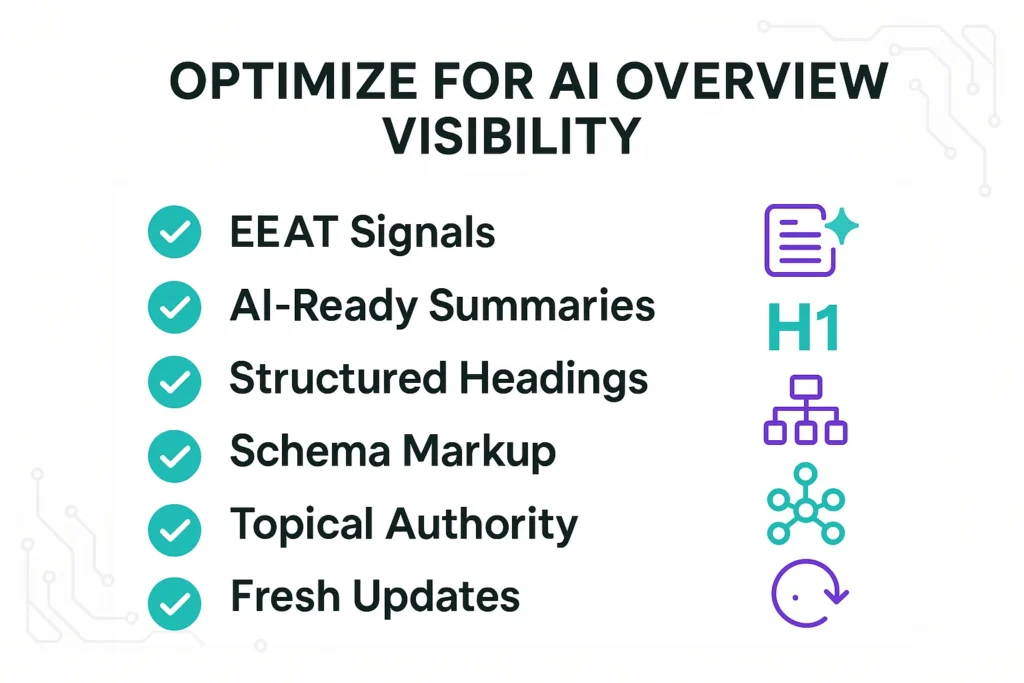
Appearing in Google’s AI Overviews requires aligning your content with the signals AI models prioritize: expertise, clarity, trust, and relevance. While no method guarantees inclusion, implementing these strategies significantly increases your chances of being cited.
Practical ways to boost AI citation visibility:
- Strengthen your EEAT across every post: Use expert bios, cite trusted sources, and add real experience to support credibility.
- Add a concise “AI-ready” summary at the top: Provide a 40–60 word answer that AI can easily extract into its overview.
- Improve on-page structure: Use descriptive headings, short paragraphs, and clearly separated sections.
- Publish deeper, more comprehensive content: AI favors pages that offer full context, not surface-level explanations.
- Refresh your content regularly: Updated posts send stronger freshness signals, improving the chances of selection.
- Use schema markup: Add FAQ, How-To, and Article schema to help AI understand your content layout.
- Build topical authority with content clusters: Create pillar pages and multiple supporting articles to show expertise in your niche.
- Optimize for semantic search: Use related questions, synonyms, and contextual keywords that match AI’s natural language understanding.
- Include real-world insights or experience: Unique value makes your content harder for AI to replace with generic summaries.
Bonus strategy:
- Identify queries where Google already uses AI Overview and optimize those pages first, these provide the fastest wins.
Following these steps helps position your content as a reliable source that AI is more likely to include in its summaries.
Measuring Whether AI Overview Is Picking Up Your Content
Google does not currently provide a direct report or label for AI Overview citations, so tracking inclusion requires indirect measurement. By monitoring specific metrics across GA4, Search Console, and SERP behavior, you can estimate whether AI is using or referencing your content.
7 Ways to measure AI Overview visibility:
- Check Search Console impressions vs. clicks: If impressions rise but clicks drop, your content may be appearing on SERPs through AI Overview but attracting fewer clicks.
- Watch for CTR drops on stable rankings: When rankings stay the same but CTR decreases, AI is likely occupying the top of the page.
- Monitor landing pages commonly cited by AI: Posts with how-to instructions, definitions, or comprehensive guides tend to gain AI visibility first.
- Track unusual increases in direct or unassigned traffic in GA4: AI clicks often pass incomplete referrer data, causing misclassification in GA4.
- Analyze query patterns in Search Console: If your content appears for more question-based or conversational queries, it may be referenced by AI Overview.
- Use SERP tracking tools: Tools that capture AI Overview results can show whether your content is included in the summary or citation cards.
- Conduct manual SERP checks: Search target keywords in incognito mode and observe if your content appears within AI Overview panels.
These signals provide a realistic, data-backed approach for assessing whether Google’s AI systems are surfacing your content.
Future Expectations for AI Overview SEO Optimization
As Google continues shifting toward AI-driven search, the strategies required to appear in AI Overviews will evolve. Over time, AI citation signals may become more transparent, ranking behavior will change, and high-value content will increasingly come from expert-driven sources rather than broad informational blogs.
What to expect in the coming months and years:
- AI-specific ranking signals will emerge: Google may introduce new criteria tailored specifically to AI Overview selection.
- Search Console may add AI Overview reporting: Early experiments suggest Google is testing AI impression and click tracking.
- EEAT will grow even more important: Expertise and trust will become central to AI visibility, especially for sensitive or YMYL topics.
- Content originality will matter more: AI will prioritize unique insights over generic or rewritten information.
- Query types will shift: More users will search with conversational queries, requiring content that aligns with natural language.
- AI models will improve citation consistency: Over time, AI Overview will become better at identifying and linking to high-quality sources.
- Traditional SEO and AI SEO will merge: Future optimization will combine classic SEO fundamentals with AI-focused structure and authority-building.
Overall, AI Overview will reward blogs that provide depth, expertise, and real value, not those relying on surface-level information.
Why Choose SEO Specialist USA for AI Overview Optimization
AI-driven search is changing SEO faster than ever, and most websites are not prepared for the shift. SEO Specialist USA helps you optimize your content, structure, and authority signals so your pages have the highest chance of appearing in AI Overviews.
Our team analyzes your content for EEAT, fixes structural issues that prevent AI extraction, builds topic clusters to boost authority, and updates your on-page SEO to match AI ranking preferences.
We also audit GA4 and Search Console data to reveal hidden AI-driven patterns that most bloggers miss. If you want your content to remain visible in the era of AI search, we provide the strategy, structure, and support to stay ahead of Google’s changes.
Final Thoughts on Showing Up in AI Overviews
Appearing in AI Overviews requires more than traditional SEO. Google’s AI now prioritizes content that demonstrates real expertise, clear structure, and strong topical authority.
Blogs and websites that focus on EEAT, update their content regularly, use structured formatting, and provide genuinely helpful insights have the highest chance of being cited in AI-generated summaries.
While AI Overview continues to evolve, the long-term winners will be creators who produce original, trustworthy, and deeply valuable content that stands out in an increasingly AI-shaped search environment.
FAQs: How to Show Up in AI Overviews
How do I get my content to appear in Google’s AI Overview?
You need strong EEAT, structured formatting, fresh updates, and clearly written answers. Google’s AI selects pages that provide accurate, trustworthy, and easy-to-extract information.
Does ranking #1 guarantee being cited in AI Overview?
No. Traditional rankings help, but AI Overview chooses sources based on relevance, trust, structure, and clarity—not just ranking position. Lower-ranked pages can still be cited if they better match AI criteria.
Why is my website not showing up in AI Overviews?
Common reasons include weak EEAT, outdated content, poor structure, low topical authority, or unclear formatting. AI also prefers niche experts over generalist blogs.
How often should I update content for AI Overview?
Refreshing content every few months helps maintain freshness signals. Update stats, examples, screenshots, and internal links to keep your page relevant for AI extraction.