

The honest answer is: you can never fully stop doing local SEO. You can reduce the intensity once you hold strong rankings, but stopping altogether leads to ranking drops, outdated citations, lost reviews momentum, and competitors overtaking your position. Local SEO is an ongoing maintenance and growth discipline, not a one-time project.
Key Takeaways
-
 Local SEO rankings are not permanent, competitors are always working to displace you
-
Google’s algorithm updates regularly, and your rankings can shift without any action on your part
-
Citation data changes over time as directories update, expire, or pull in new data from other sources
-
Review velocity matters — a business that stops generating new reviews looks stale to both Google and customers
-
You can reduce local SEO intensity at a maintenance level, but you cannot stop without eventually losing ground
Why People Ask This Question
It is a fair question. Local SEO takes time, money, and consistent effort. Once a business is ranking well, it is natural to wonder whether the investment can stop or at least slow down significantly. The logic seems reasonable: the work is done, so why keep doing it?
The problem is that local search rankings do not behave like a completed task. They behave more like a competitive position that requires active defense. The moment you stop paying attention, something will change. A competitor will optimize their GBP more aggressively. Google will update an algorithm. A directory will push old data and create a NAP inconsistency. Your review velocity will stall and your rating will start looking outdated compared to a newer competitor.
Understanding why you cannot stop requires understanding what local SEO rankings actually depend on.
What Keeps Local Rankings in Place
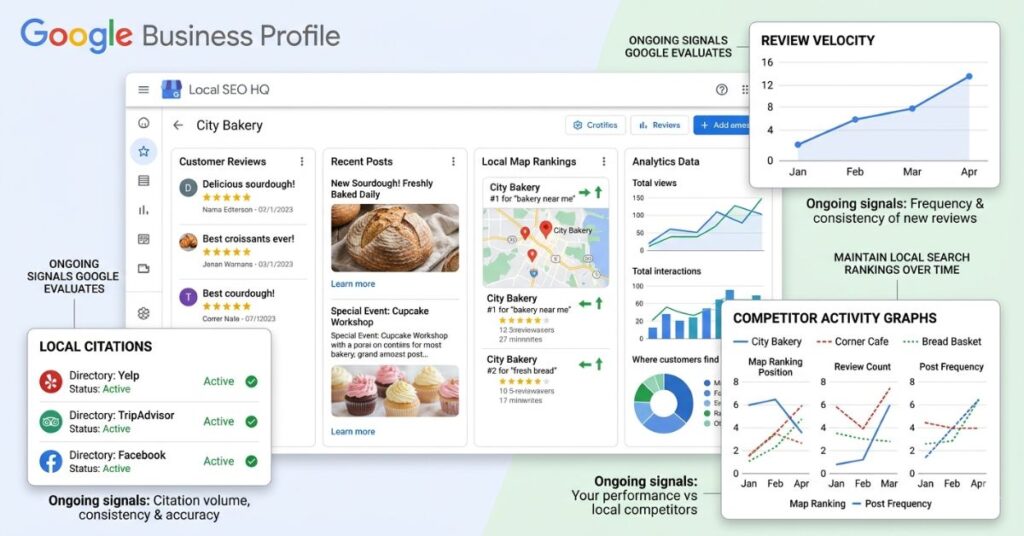
Local search rankings are not locked in once achieved. They are maintained by a combination of ongoing signals that Google continuously re-evaluates:
Active Google Business Profile
Google pays attention to how active your GBP is. Businesses that post regularly, respond to reviews, update their information, and keep their photos fresh signal to Google that they are operational and engaged. Profiles that go quiet over time tend to drift downward in rankings as more active competitors catch Google’s attention.
Review Freshness and Velocity
A business with 80 reviews, all from three years ago, looks different to Google than a business with 80 reviews and five new ones this month. Google values recency. Customers also value it. Most people scanning review profiles pay attention to when the most recent reviews were posted. A stale review profile slowly erodes both rankings and conversion rates.
NAP Consistency Across the Web
Directories don’t stay static. Platforms update their data, sometimes pulling information from aggregators that have old records. If you stop monitoring your citations, a directory may quietly update your phone number to an old one, or create a new duplicate listing with wrong information. These changes accumulate silently and drag rankings down.
Competitor Activity
Local SEO is relative. Your ranking is not just a measure of your performance. It is a measure of your performance compared to everyone else in your market. If you hold steady while a competitor optimizes their GBP, builds new citations, earns 30 new reviews, and publishes six local blog posts, they will overtake you, not because you did anything wrong, but because they did more.
Algorithm Updates
Google updates its local search algorithm regularly. Changes to how it weighs GBP signals, review quality, proximity, or content relevance can shift rankings without any change in your own activity. Staying current with updates and adjusting strategy accordingly is an ongoing requirement for any business that wants to hold strong local positions.
What Happens When You Stop Local SEO

The impact of stopping is not immediate. Rankings do not collapse overnight. But the decline is predictable and follows a fairly consistent pattern:
Months 1 to 3: Minimal Visible Change
If your foundations are strong, rankings tend to hold in the short term. The accumulated authority from previous work buffers against immediate decline. You may not notice anything wrong.
Months 3 to 6: Soft Signals Start Weakening
Review velocity has dropped off. Your GBP has not been posted in months. A competitor has been steadily building citations and adding new photos. Rankings begin to soften on less competitive keywords first. You might drop from position two to position five or six for some terms.
Months 6 to 12: Measurable Ranking Declines
More competitive keywords start slipping. NAP inconsistencies may have crept back in from directory data updates. Your review count, once impressive, now looks dated relative to more active competitors. Calls and website traffic from local search start declining noticeably.
Beyond 12 Months: Significant Erosion
A business that has not done any local SEO for over a year in a competitive market will typically find itself significantly displaced. Recovering rankings at this point requires more work than maintaining them would have.
What Maintenance-Level Local SEO Looks Like
The good news is that once strong rankings are established, the ongoing effort to maintain them is significantly less than the effort to achieve them. There is a meaningful difference between active campaign mode and maintenance mode.
Maintenance Tasks: Monthly
- Respond to all new Google reviews within 24 to 48 hours
- Post to your Google Business Profile at least two to four times per month
- Check your GBP Insights for unusual drops in calls or views
- Monitor for any new negative reviews on other platforms like Yelp or Facebook
- Check Google Search Console for any new crawl errors or indexing issues
Maintenance Tasks: Quarterly
- Run a citation audit to check for any new inconsistencies or duplicate listings
- Review your keyword rankings and compare against key competitors
- Update any outdated content on your main service pages
- Add at least one new piece of locally relevant content to your blog or website
- Check that your GBP information is still accurate, including hours, services, and photos
Maintenance Tasks: Annually
- Full local SEO audit to identify any new gaps or opportunities
- Review your review profile across all platforms for overall health and freshness
- Assess new competitors who may have entered your market
- Evaluate whether to expand your local SEO to new service areas or keywords
Maintenance mode is much lighter than campaign mode. For many small businesses, this translates to a few hours per month internally, or a reduced retainer with an SEO agency. But it cannot go to zero without consequences.
When Can You Genuinely Reduce Local SEO Intensity?
There are legitimate situations where reducing your local SEO investment makes sense, even if stopping entirely does not:
- You hold stable top-three positions for all major target keywords and have been maintaining them for six or more months
- Your review velocity is strong and customers are generating reviews organically without active prompting
- Your GBP is fully optimized and your citation profile is clean and consistent
- Your main competitors are not actively investing in local SEO, giving you a buffer
- You are in a low-competition local market where your authority significantly outpaces all competitors
Even in these scenarios, maintenance activities should continue. The reduction is in active growth work, not in the basic monitoring and engagement that keeps rankings stable.
To understand how local SEO scales from active to maintenance phases, speak with the team at SEO Specialist USA.
6 Signs You Need to Re-Accelerate Local SEO
If you have pulled back on local SEO and notice any of these signals, it is time to reinvest:
- Rankings have dropped for one or more target keywords
- GBP calls and direction requests have declined month over month
- A new competitor has appeared in the Local 3-Pack for your main service terms
- Your review count is being overtaken by a competitor
- Website traffic from organic local searches has declined in Google Analytics
- You have received customer complaints about wrong information in your directory listings
If you have noticed any of these warning signs, get a SEO audit to assess where the issues are and what it will take to recover.
How SEO Specialist USA Helps Businesses Transition to Maintenance Mode
SEO Specialist USA helps clients move from active campaign mode to cost-effective maintenance once strong rankings are achieved. The agency designs maintenance plans that protect rankings without the full investment of an active build phase, monitoring the key signals that matter most and stepping up activity when competitive threats emerge.
Clients get peace of mind knowing their local rankings are being watched by specialists who will flag issues before they become ranking problems, not after.
Frequently Asked Questions