

NAP consistency in local SEO means your business Name, Address, and Phone number are identical across every online platform where your business is listed. Inconsistent NAP data confuses search engines and hurts your local rankings. Moz research identifies NAP consistency as one of the top local ranking signals, directly affecting how Google verifies and ranks your business.
Key Takeaways
-
 NAP stands for Name, Address, and Phone number, the three core data points search engines use to verify your business
-
Even small inconsistencies like St. vs Street or missing suite numbers can cause ranking issues
-
Moz’s Local Search Ranking Factors survey consistently lists citation signals among the top factors for local pack rankings
-
NAP inconsistencies confuse Google, reduce your chances of appearing in the Local 3-Pack, and send customers to wrong locations
-
Fixing NAP inconsistencies is one of the fastest ways to improve local search performance
Understanding NAP Consistency
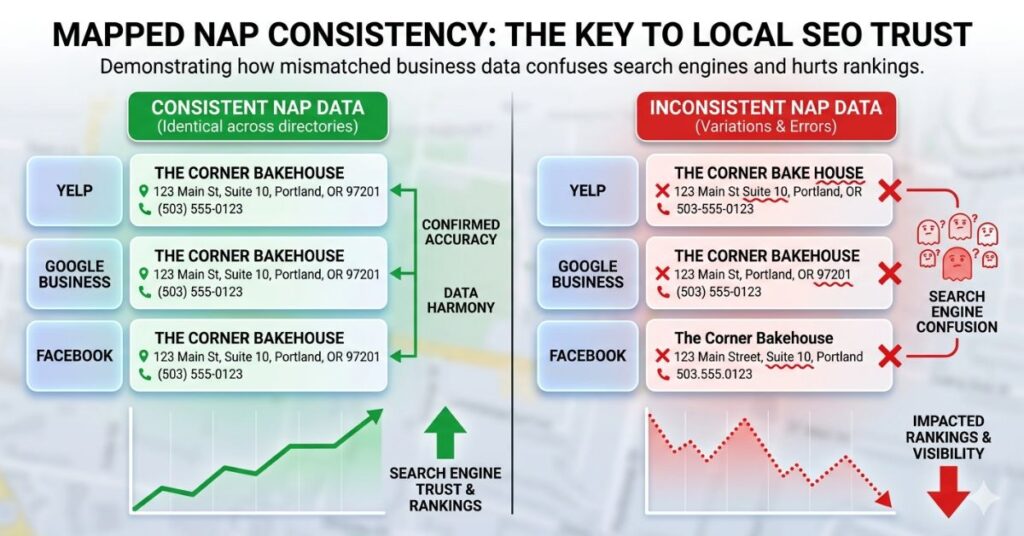
NAP stands for Name, Address, and Phone number. In local SEO, these three pieces of information need to match exactly across every platform where your business appears. This includes your Google Business Profile, Yelp, Bing Places, Apple Maps, Facebook, local directories, your own website, and any other site that mentions your business.
The reason this matters is simple. When Google crawls the web and finds your business mentioned in dozens of places, it compares those mentions to understand if they all refer to the same business. If it finds your address listed as ‘123 Main St’ in one place and ‘123 Main Street, Suite 4’ in another, it cannot be fully confident those are the same location. That uncertainty lowers the trust score Google assigns to your business data.
What Moz Says About NAP Consistency
Moz publishes one of the most referenced annual studies in local SEO: the Local Search Ranking Factors survey. The survey collects insights from top local SEO practitioners across the industry to identify what actually drives rankings in local search and the Google Local Pack.
According to Moz, citation signals, including NAP consistency, are among the top five factors influencing local pack rankings. Specifically, the quality and consistency of structured citations on authoritative platforms, along with the accuracy of your NAP data, contributes significantly to how well a business ranks for local search queries.
Moz also developed Moz Local, a tool specifically designed to help businesses audit and fix their NAP data across the web. The fact that one of the world’s leading SEO companies built an entire product around this issue tells you how important NAP consistency really is.
Common NAP Inconsistencies That Hurt Local Rankings
Most business owners are surprised by how many inconsistencies exist in their data. Some of the most common include:
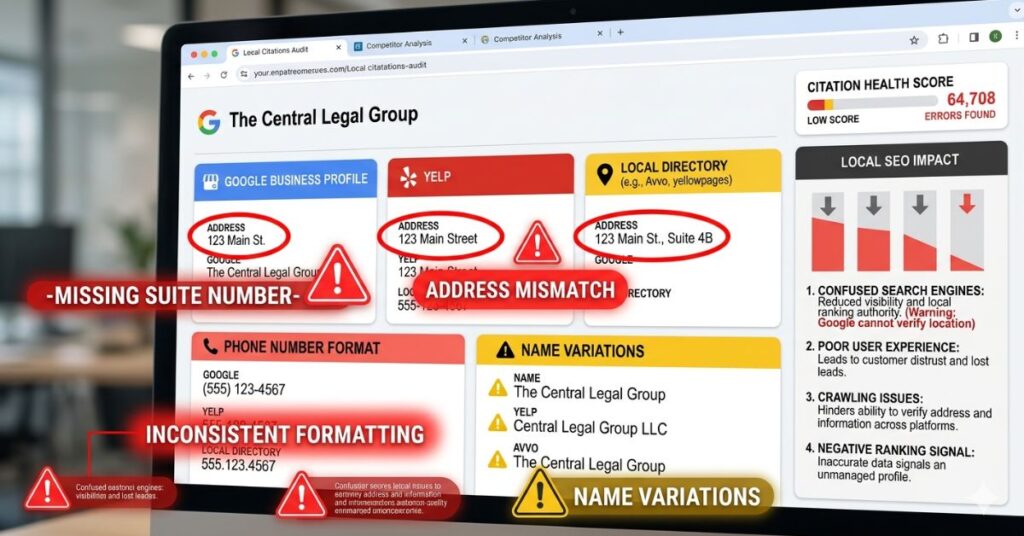
Business Name Variations
- Using ‘LLC’ in some listings but not others
- Using abbreviations in some places (Co. vs Company)
- Adding keywords to your name on some platforms (e.g., ‘Bob’s Plumbing Services’ vs ‘Bob’s Plumbing’)
- Old business names still active on outdated directories
Address Variations
- ‘Street’ vs ‘St’ vs ‘St.’
- Missing apartment, suite, or unit numbers
- Old addresses from a previous location still live on directories
- Different zip code formats (5-digit vs 5+4)
- Using a PO Box on some listings and a physical address on others
Phone Number Variations
- Different formats: (555) 123-4567 vs 555-123-4567 vs 5551234567
- Old phone numbers from previous business setups
- Using a tracking number on some platforms instead of the main business number
Any of these variations signals uncertainty to Google. Multiply them across dozens of directories and the cumulative impact on your local rankings can be significant.
How NAP Inconsistency Affects Your Local Rankings
Google’s local algorithm is built on trust. When Google encounters your business in search results, it wants to present accurate information to searchers. If your NAP data across the web is inconsistent, Google faces a confidence problem: it can’t be sure what your correct information is, so it may rank you lower than a competitor whose data is perfectly consistent.
The impact shows up most clearly in Google Local Pack rankings. The Local Pack, those top three local business listings at the top of search results, is heavily influenced by citation signals. Businesses with clean, consistent NAP data across authoritative platforms are far more likely to earn and hold a spot in those top three positions.
How to Check Your NAP Consistency
The first step is finding out where your data is inconsistent. Here are the most effective ways to audit your NAP:
Manual Search Method
Search for your exact business name, address, and phone number in Google. Check the top results. Look for any listings with different data. Also search for your old address and old phone number if you have ever moved or changed numbers.
Use Moz Local
Moz Local scans major directories and data aggregators to find your existing listings and flag inconsistencies. It shows you where you appear, what data is being displayed, and where there are conflicts. It also lets you push corrected data to multiple platforms.
BrightLocal Citation Tracker
BrightLocal’s Citation Tracker is another widely used tool that audits your existing citations, finds duplicates, and identifies where your NAP data does not match your canonical business information.
Yext
Yext scans over 100 directories and platforms and lets you update your information across all of them from a single dashboard. It is a faster option for businesses with widespread inconsistencies.
How to Fix NAP Inconsistencies
Once you have identified the problems, here is a practical process for fixing them:
- Step 1: Define your canonical NAP. Write down the exact business name, address, and phone number format you want to use everywhere. This is your reference standard.
- Step 2: Fix your own website first. Check your contact page, footer, and any other places your NAP appears on your site.
- Step 3: Fix your Google Business Profile. This is the most important listing to get right.
- Step 4: Fix core data aggregators. Update Data Axle, Neustar Localeze, and Foursquare. These feed data to many other directories automatically.
- Step 5: Go platform by platform. Log into each major directory, claim the listing if needed, and update the data to match your canonical NAP.
- Step 6: Request removal of duplicate listings. If you find duplicate listings for the same business, request to have the extra ones removed or merged.
- Step 7: Monitor regularly. NAP data can change without your knowledge. Directories sometimes pull in new data from aggregators or other sources.
How Long Does It Take to See Results
After fixing your NAP inconsistencies, improvements in local rankings typically start to appear within four to twelve weeks. The timeline depends on how many directories were affected, how quickly they update after you make changes, and how competitive your local market is.
Core data aggregators can take two to six weeks to push updated information to downstream directories. Google may take several weeks after that to re-crawl and process the corrected data. Patience is important here. The results are real, but they do not happen overnight.
NAP Consistency: Key Statistics
- Citation signals including NAP consistency are in the top five local pack ranking factors (Moz Local Search Ranking Factors)
- Businesses with incorrect NAP data online lose 22% of customers who encounter the wrong information (Yext)
- 73% of consumers lose trust in a brand when its online listings contain incorrect information (Yext)
- Businesses with consistent citations across the web see significantly higher local pack visibility (BrightLocal)
- Only 30% of small businesses have fully consistent NAP data across major directories (BrightLocal)
How SEO Specialist USA Fixes NAP Consistency
SEO Specialist USA provides full citation auditing and NAP correction as part of its local SEO services. The team identifies every inconsistency across your current citation profile, establishes your canonical NAP, and systematically corrects your data across all major platforms and directories.
The agency also monitors your citation data on an ongoing basis to catch any new inconsistencies before they impact rankings. For businesses that have moved, changed phone numbers, or rebranded, the cleanup process is especially important, and it is something the team handles completely.
Frequently Asked Questions