
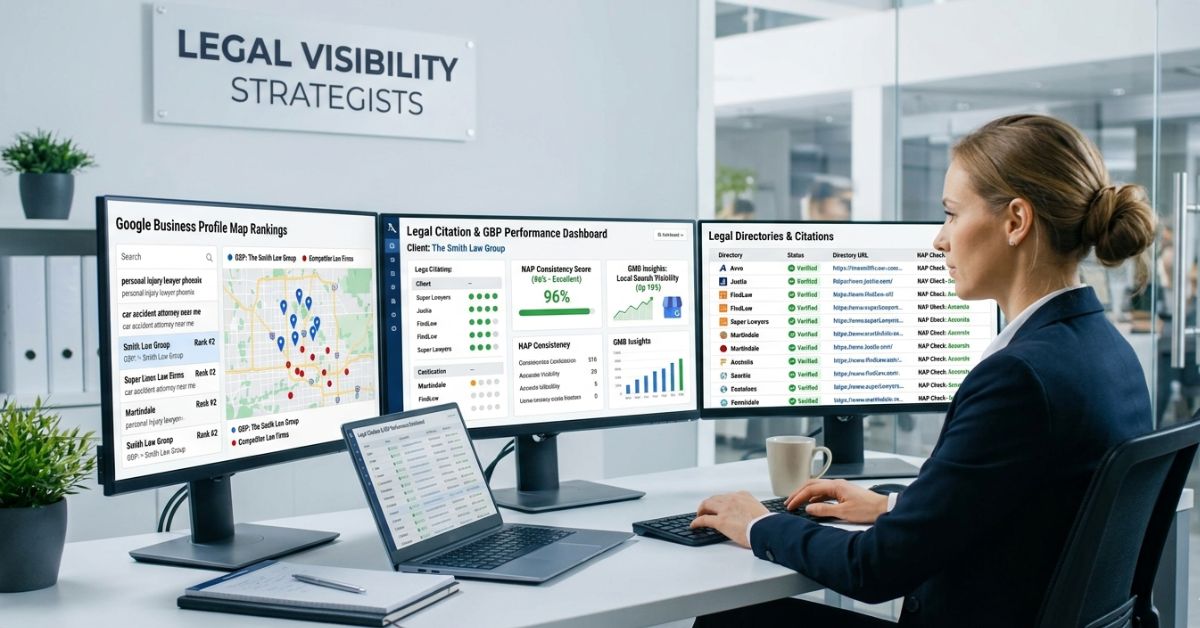
To build local citations for law firm SEO, start by claiming your Google Business Profile and major legal directories like Avvo, Justia, FindLaw, and Martindale-Hubbell. Then submit your law firm’s NAP to core data aggregators and local business directories. Consistent, accurate listings on authoritative legal and local platforms directly improve your law firm’s visibility in local search results.
Key Takeaways
-
 Legal-specific directories like Avvo, Justia, and FindLaw carry significant authority for law firm local SEO
-
NAP consistency across all platforms is critical for appearing in the Google Local Pack
-
Citations from local bar associations and chamber of commerce websites carry strong local relevance
-
Building citations in the right order, starting with high-authority platforms, produces the fastest ranking gains
-
Law firm citation building requires ongoing monitoring to maintain accuracy as data can change over time
Why Citation Building Matters for Law Firm SEO
When someone searches ‘family law attorney near me’ or ‘personal injury lawyer in [city],’ Google looks at dozens of signals to decide which law firms to show in the results. One of the most important signals is how consistently and prominently a law firm’s information appears across the web.
Citations, meaning mentions of your firm’s name, address, and phone number on other websites, are one of the top ranking signals for local search. Law firms that appear consistently across legal directories, local directories, and community sites signal credibility and authority to Google. That credibility translates directly into higher rankings, more calls, and more cases.
For a foundational understanding of citations and how they work, read what is local SEO citation.
Step 1: Establish Your Canonical NAP
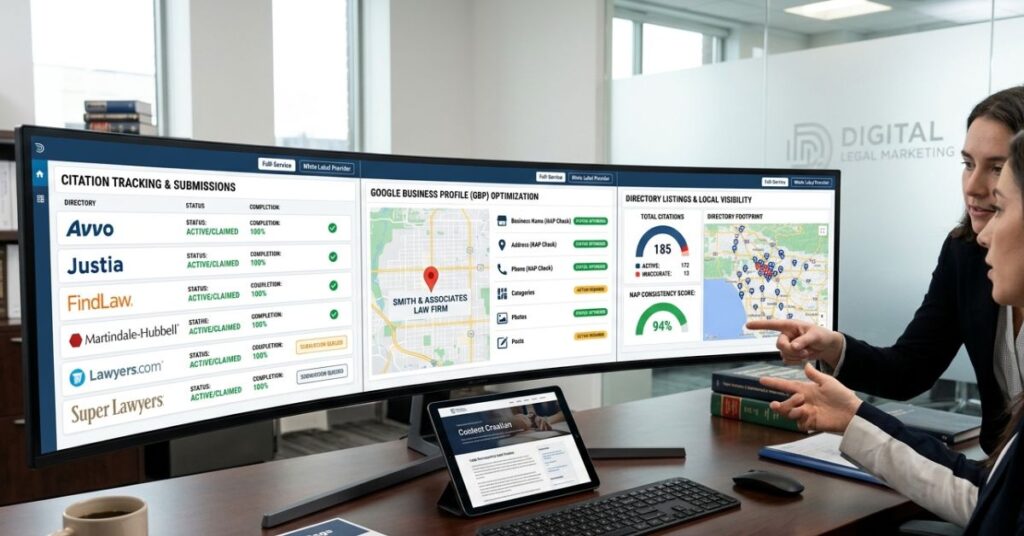
Before building any new citations, define the exact format of your law firm’s Name, Address, and Phone number that you will use everywhere. This is called your canonical NAP.
For law firms, this step has some specific considerations:
- Business name: Decide whether to list as ‘Smith & Associates, LLC,’ ‘Smith and Associates Law Firm,’ or simply ‘Smith Associates.’ Choose one and use it identically everywhere.
- Address: Include suite number if applicable. Write it the same way every time, including how you abbreviate Street, Avenue, Boulevard, and so on.
- Phone number: Use your main intake line. Pick one format and stick to it.
- Website URL: Use your primary domain consistently, including whether it uses www or not.
Write this canonical NAP down and refer to it every time you claim or update a listing.
Step 2: Claim and Optimize Google Business Profile
Google Business Profile is the most important citation for any law firm. It determines whether and where your firm appears in the Local 3-Pack, the three business listings at the top of local search results.
Optimizing Your Law Firm GBP
- Choose the most accurate primary category, such as Personal Injury Attorney, Family Law Attorney, or Criminal Justice Attorney
- Add secondary categories for other practice areas you handle
- Write a detailed business description that includes your practice areas, location, and key value propositions
- Add all office locations and service areas if you serve clients in multiple cities or counties
- Upload professional photos of your office, team, and firm logo
- List your consultation process under Services
- Collect and respond to Google reviews consistently
To understand what drives Local Pack rankings for local service businesses, read what is the local SEO 3-Pack.
Step 3: Submit to Core Legal Directories
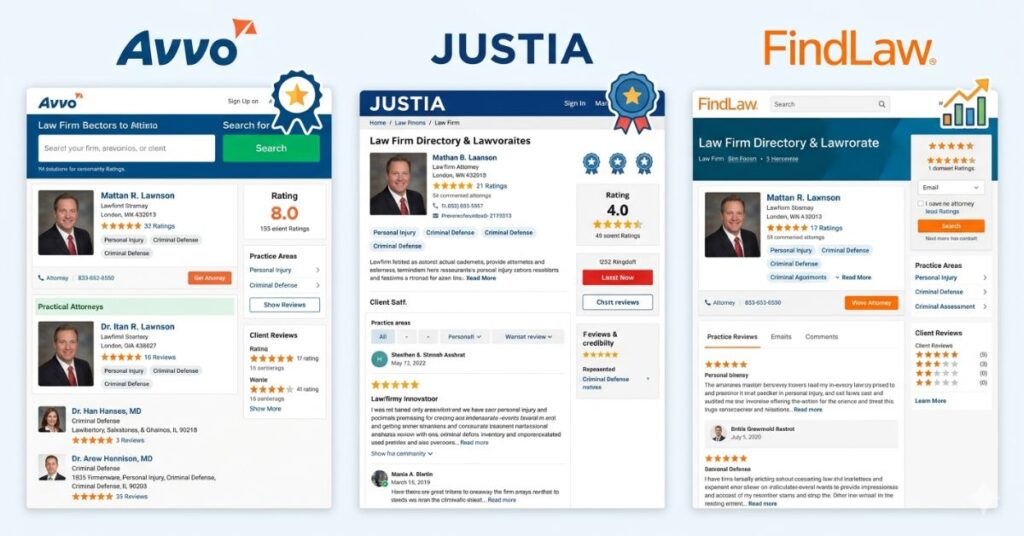
Legal directories are the highest-authority citation sources for law firms. They are trusted by both Google and potential clients. Getting listed on these platforms is non-negotiable for law firm local SEO.
Primary Legal Directories
- Avvo: One of the most visited legal directories in the US. Claim your profile, complete your attorney bio, and list all practice areas.
- Justia: A highly trusted legal directory with strong domain authority. Justia profiles rank well in Google for attorney-related searches.
- FindLaw: Another major legal directory owned by Thomson Reuters. Widely used by people searching for attorneys.
- Martindale-Hubbell: One of the oldest and most respected legal directories. Peer review ratings here carry significant credibility.
- Lawyers.com: Part of the Martindale-Hubbell network, with high visibility for legal queries.
- Super Lawyers: Provides attorney ratings and profiles with strong local search visibility.
- Nolo: A well-known legal resource site with attorney profiles and high domain authority.
- HG.org: A comprehensive legal directory with listings for attorneys and law firms worldwide.
Complete each profile fully. Include your practice areas, bar admissions, education, a professional bio, office address, and phone number. Partial profiles are worse than none in some cases because they suggest inactivity.
Step 4: Submit to Core Data Aggregators
Data aggregators are companies that collect business information and distribute it to hundreds of other directories and platforms automatically. Getting your law firm listed accurately on these aggregators ensures your correct NAP data propagates across the web.
The main US aggregators are Data Axle (formerly Infogroup), Neustar Localeze, and Foursquare. Submitting to these costs a small fee per year but can fix inconsistencies across dozens of downstream directories without having to update each one individually.
Step 5: Build Local and Business Directories
Beyond legal-specific directories, law firms benefit from being listed on general local business platforms. These citations build local relevance in your specific geographic market.
General Business Directories
- Google Business Profile (already covered in Step 2)
- Yelp Business: Widely used for law firm research, especially in major cities
- Bing Places: Covers the Microsoft search ecosystem
- Apple Maps: Important for iOS users searching for attorneys
- Facebook Business Page: Also functions as a citation and helps with social trust signals
- Better Business Bureau: Carries strong trust signals, especially for client-facing service businesses
- Foursquare: Beyond aggregating, Foursquare has its own directory with direct local search value
Local and Community Directories
- Your state and local bar association websites: These often include member directories with citations
- Local chamber of commerce: A citation and potential community link
- City and county business directories: Many local government sites maintain business resource pages
- Local news websites: If your firm is mentioned in a local story, that is a high-value unstructured citation
- Community legal aid and resource pages: Relevant sites in the legal space often include attorney referrals
Step 6: Target Practice Area-Specific Citations
Beyond general legal directories, some practice areas have their own specialized platforms. Getting listed on practice-area specific directories strengthens your relevance for those specific searches.
- Personal injury: ATLA (American Association for Justice) directory, local trial lawyer association directories
- Family law: Local mediation centers, family court resource pages, divorce support sites
- Immigration law: AILA (American Immigration Lawyers Association) directory, immigration resource hubs
- Criminal defense: NACDL (National Association of Criminal Defense Lawyers) directory
- Estate planning and probate: Estate planning council directories, local probate court resource pages
- Real estate law: Local realtor association directories, title company resource pages
Step 7: Monitor and Maintain Your Citations
Citation building is not a one-time task. Directory data changes. Listings expire. New platforms emerge. Competitors claim listings on platforms you have not yet used. Monitoring your citations regularly ensures your data stays accurate and your advantage holds.
Set a quarterly reminder to audit your top 20 citation sources using a tool like BrightLocal or Moz Local. Update any listings that have become inaccurate. Check for new duplicate listings. Respond to any new review requests on legal platforms.
For a broader view of local SEO maintenance and strategy, read why local SEO helps attract local customers.
Law Firm Local SEO Citation: Key Statistics
- 96% of people seeking legal advice use a search engine (Google Consumer Survey)
- 74% of potential legal clients visit a law firm’s website before taking action (Clio Legal Trends Report)
- Legal keywords have some of the highest cost-per-click rates in paid search, making organic citation-driven rankings extremely valuable (WordStream)
- Businesses in the Google Local 3-Pack receive up to 700% more clicks than those ranked below it (Moz)
- 72% of people searching for a local service visit a business within 5 miles of their location (WordStream)
- Law firms with complete GBP profiles receive 7 times more clicks than those with incomplete profiles (Google)
How SEO Specialist USA Builds Citations for Law Firms
SEO Specialist USA provides specialized local SEO and citation building services for law firms across the US. The agency builds citations on the most authoritative legal directories, ensures NAP consistency across all platforms, and monitors your citation profile on an ongoing basis.
The team understands that law firms have unique credibility requirements. Every citation is built accurately, professionally, and in full compliance with bar association guidelines around online legal advertising. The result is a stronger local presence that brings more prospective clients to your intake line.
[ BUTTON ] Contact Us → https://www.seospecialistusa.com/contact/
[ BUTTON ] Message Us on WhatsApp → https://wa.me/16469165108
Frequently Asked Questions