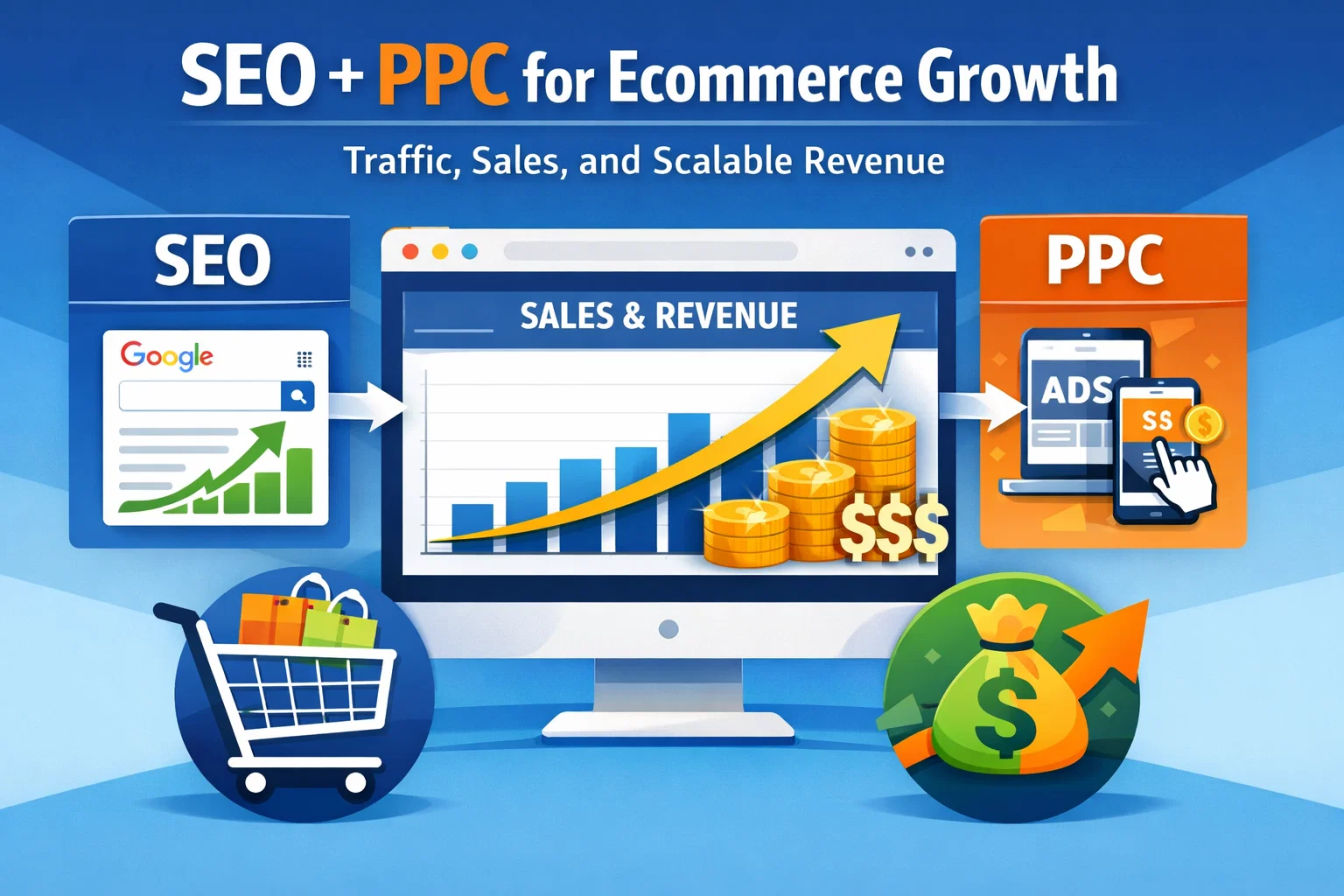
Yes, most ecommerce sites need both SEO and PPC to grow sustainably and compete effectively. SEO builds long-term organic traffic and brand authority, while PPC delivers immediate visibility and sales. When combined strategically, SEO and PPC maximize revenue, reduce customer acquisition costs, and strengthen overall ecommerce performance.
Need expert help with SEO, PPC, or both? SEO Specialist USA builds customized ecommerce growth strategies that increase traffic, conversions, and revenue.
CTA Button: Set Your Ecommerce Strategy Meetup
Key Takeaways
- SEO drives long-term, compounding organic traffic.
- PPC generates immediate traffic and fast sales.
- Ecommerce brands that use both channels dominate search results.
- Relying on only one increases risk and limits growth.
- A combined strategy delivers stronger ROI and scalability.
- SEO Specialist USA helps ecommerce businesses integrate SEO and PPC for maximum performance.
Why SEO Is Essential for Ecommerce Websites
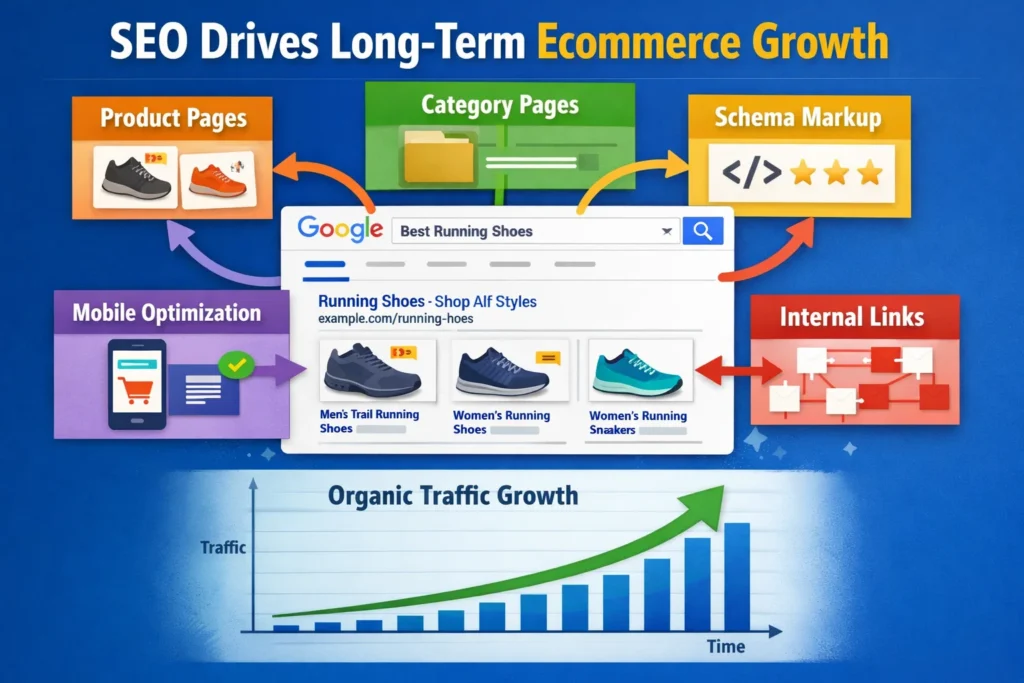
Search engine optimization (SEO) is the foundation of long-term ecommerce growth. While paid ads can generate immediate traffic, SEO builds a sustainable traffic engine that continuously attracts high-intent buyers without ongoing ad spend for every click.
For ecommerce brands that want consistent sales, visibility, and scalability, SEO isn’t optional, it’s essential.
How Ecommerce SEO Drives Organic Sales
Ecommerce SEO focuses on optimizing your entire online store, not just your homepage.
Key areas include:
- Product page optimization (titles, descriptions, schema markup)
- Category page SEO for high-volume keywords
- Technical SEO (site speed, crawlability, indexing)
- Internal linking structure
- Mobile optimization
- Structured data for rich snippets
When done correctly, SEO allows your store to rank for buyer-intent keywords like:
- “buy running shoes online”
- “best organic skincare products”
- “affordable gaming laptops”
Unlike paid ads, organic clicks don’t cost you per visit, making long-term ROI significantly higher.
At SEO Specialist USA, ecommerce SEO strategies are built around revenue-driving keywords, not just traffic metrics.
The Long-Term ROI of SEO for Online Stores
SEO is a long-term asset.
Here’s why:
- Organic traffic compounds over time.
- Rankings improve brand authority.
- Cost per acquisition decreases as traffic grows.
- You reduce dependency on paid ads.
For established ecommerce brands, organic traffic often becomes the #1 revenue channel.
While SEO may take 3–6 months to show strong results, the payoff can last for years.
What Happens If Ecommerce Sites Ignore SEO?
Relying only on PPC can be risky.
Without SEO:
- Customer acquisition costs remain high.
- You pay for every single click.
- Profit margins shrink as ad costs increase.
- Competitors dominate organic results.
In competitive industries, ignoring SEO means giving away long-term market share.
That’s why successful ecommerce brands work with companies like SEO Specialist USA to build both immediate and sustainable traffic channels.
Why PPC Is Important for Ecommerce Growth
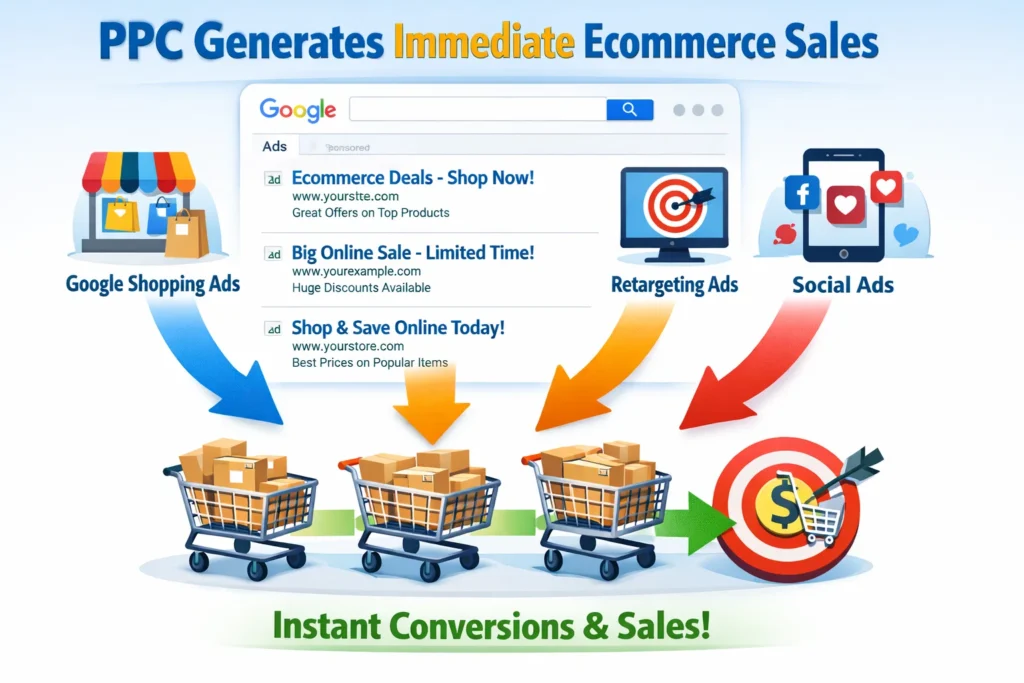
While SEO builds long-term visibility, PPC (Pay-Per-Click advertising) delivers immediate traffic and instant sales. For ecommerce businesses operating in competitive markets, PPC is often the fastest way to generate revenue and test new products.
If you need traffic now, PPC is the accelerator.
How PPC Delivers Immediate Sales
SEO requires time to build authority, but PPC enables your ecommerce store to appear at the top of search results immediately.
5 Key PPC channels for ecommerce include:
- Google Search Ads
- Google Shopping Ads
- Display & Retargeting Ads
- Performance Max campaigns
- Social media paid ads (Meta, TikTok, etc.)
With properly optimized campaigns, ecommerce businesses can:
- Target high-intent buyers
- Control budget and scaling
- Test offers quickly
- Launch new products with immediate exposure
When PPC Is Critical for Ecommerce Businesses
There are specific situations where PPC becomes essential:
1. New Ecommerce Store Launch
SEO takes time. PPC generates early traction and sales while SEO builds momentum.
2. Seasonal Promotions
Black Friday, holiday sales, and product launches require instant visibility.
3 Highly Competitive Niches
In saturated markets, paid ads help secure top-of-page presence.
4. Retargeting Abandoned Visitors
PPC allows you to re-engage users who didn’t purchase on their first visit.
For ecommerce businesses seeking fast scalability, PPC is often the most controllable growth lever.
The Risks of Relying Only on PPC
Although PPC delivers fast results, it has limitations:
- Rising ad costs reduce profit margins.
- Traffic stops when the budget stops.
- Increased competition drives CPC higher.
- Platform algorithm changes can impact performance.
Without SEO supporting your store, PPC can become an expensive dependency.
That’s why the most successful ecommerce brands combine both strategies, creating short-term wins and long-term stability.
SEO vs PPC for Ecommerce – Which Is Better?
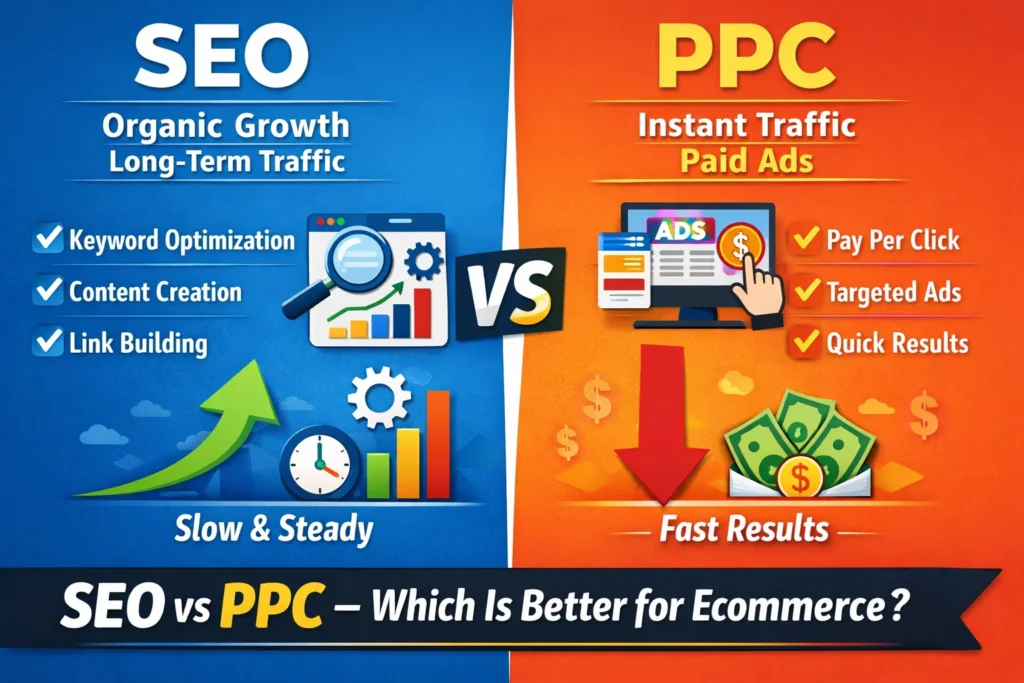
The real question isn’t whether SEO or PPC is better, it’s which one fits your current growth stage and revenue goals. Both channels serve different purposes, and understanding their strengths helps ecommerce businesses allocate budget strategically.
Let’s break it down clearly.
SEO vs PPC Comparison for Ecommerce
Factor | SEO | PPC |
Speed of Results | Slow build (3–6 months) | Immediate visibility |
Cost Structure | Investment-based | Pay per click |
Long-Term ROI | Compounding growth | Stops when budget stops |
Scalability | Organic scaling | Budget-controlled scaling |
Sustainability | High | Medium–Low |
Data & Testing | Slower testing | Fast A/B testing |
When SEO Is the Better Choice
SEO is ideal when:
- You want sustainable growth.
- You aim to reduce long-term acquisition costs.
- You’re building brand authority.
- You plan to compete in the market long-term.
For established ecommerce brands, SEO often becomes the highest-margin traffic source over time.
When PPC Is the Better Choice
PPC works best when:
- You need immediate traffic.
- You’re launching new products.
- You want to test offers quickly.
- You’re running limited-time promotions.
PPC gives you control and speed, but it requires ongoing investment.
The Smart Answer: SEO And PPC Together
Here’s what most successful ecommerce brands do:
- Use PPC to drive immediate sales and collect keyword data.
- Use SEO to build long-term organic dominance.
- Dominate search results with both paid and organic listings.
- Reduce risk by diversifying traffic sources.
This integrated strategy creates:
- Higher visibility
- More clicks
- Stronger brand trust
- Increased conversion rates
At SEO Specialist USA, ecommerce growth strategies are built around combining SEO and PPC intelligently, not choosing one over the other.
Should Ecommerce Businesses Use Both SEO and PPC?
For most ecommerce businesses, the answer is yes, using both SEO and PPC together creates a stronger, more stable, and more profitable growth strategy.
SEO builds long-term organic visibility, while PPC drives immediate traffic and sales. When combined strategically, they create a full-funnel marketing system that maximizes revenue and reduces risk.
Budget Allocation Strategy for Ecommerce
Budget distribution depends on business stage:
Startup Ecommerce Store
- 60–70% PPC
- 30–40% SEO
Focus: Immediate traction while building a long-term foundation.
Growing Ecommerce Brand
- 50% PPC
- 50% SEO
Focus: Balanced growth and margin improvement.
Established Ecommerce Business
- 60–70% SEO
- 30–40% PPC
Focus: Profitability and brand authority.
At SEO Specialist USA, we don’t apply generic formulas. We analyze your revenue goals, margins, and competition before building a custom strategy.
Proven Ecommerce Results That Drive Real Revenue

At SEO Specialist USA, results are built around measurable growth, not vanity metrics. Our ecommerce campaigns consistently deliver scalable traffic and revenue performance.
Organic SEO Performance
- 602K total impressions
- 6.9K organic clicks
- Strong upward traffic trend
- Improved keyword rankings and visibility
This reflects sustainable, long-term organic growth designed to compound over time.
PPC Campaign Performance

- 64.6K clicks generated
- 3.57K conversions achieved
- $290 average cost per conversion
- $1.03M in managed ad spend
These results demonstrate structured campaign management, optimized targeting, and a clear focus on return on investment. When SEO and PPC are aligned correctly, ecommerce brands experience stronger visibility, higher conversion rates, and more predictable revenue growth.
If you’re ready to achieve similar results, SEO Specialist USA can build a customized strategy tailored to your store’s goals and market.
CTA Button:: Start Growing Your Ecommerce Revenue Today
Frequently Asked Questions
Discover More Helpful Guides with SEO Specialist USA