
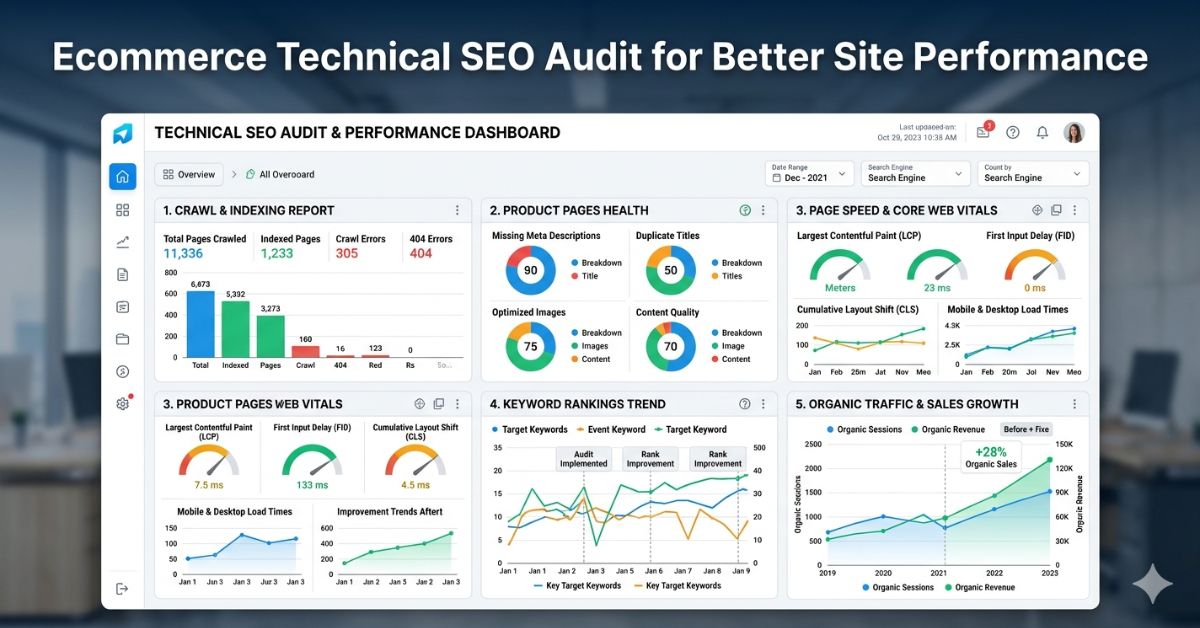
Technical SEO audits improve ecommerce site performance by identifying the structural, crawl, speed, and indexation issues that silently suppress rankings and revenue. For ecommerce stores, these problems are more complex and more costly than on most websites, large product catalogs generate duplicate content, faceted navigation creates URL proliferation that wastes crawl budget, and heavy JavaScript can prevent Google from indexing products entirely. A technical audit surfaces these issues so they can be fixed in priority order, directly improving search visibility and organic sales.
Key Takeaways
-
 Ecommerce sites face technical SEO problems at a scale that standard websites do not, product catalog size multiplies every issue
-
Crawl budget waste from faceted navigation is the single most common cause of poor organic performance in large ecommerce stores
-
Fixing Core Web Vitals on ecommerce pages directly improves both Google rankings and on-site conversion rates
-
Duplicate content from product variants and pagination can suppress rankings across the entire catalog
-
A technical audit creates a prioritised action plan, not just a list of problems, that produces measurable improvements in organic traffic and revenue
Why Ecommerce Sites Need Technical SEO Audits More Than Other Websites
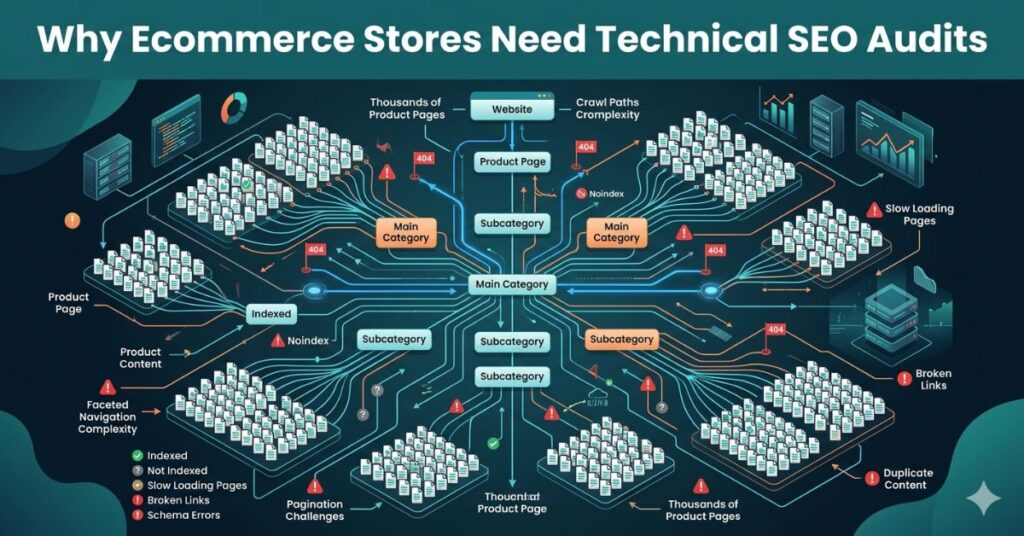
A standard blog or service website might have 50 to 200 pages. An ecommerce store might have 50,000. Every technical problem that exists on a small site exists at ten to a hundred times the scale on a large ecommerce store. One missing canonical tag on a service site is a minor issue. The same misconfiguration on an ecommerce platform generating thousands of filter URL variants is a major ranking problem affecting a significant portion of the catalog.
Beyond scale, ecommerce sites have unique technical challenges that simply do not exist elsewhere: product variant pages, faceted navigation systems, out-of-stock inventory management, dynamic pricing that affects structured data, and complex JavaScript-rendered product grids that may never be indexed. A technical SEO audit specifically designed for ecommerce addresses all of these.
For a comprehensive technical review of your ecommerce store, explore technical SEO audit services.
Performance Improvement 1: Crawl Budget Recovery
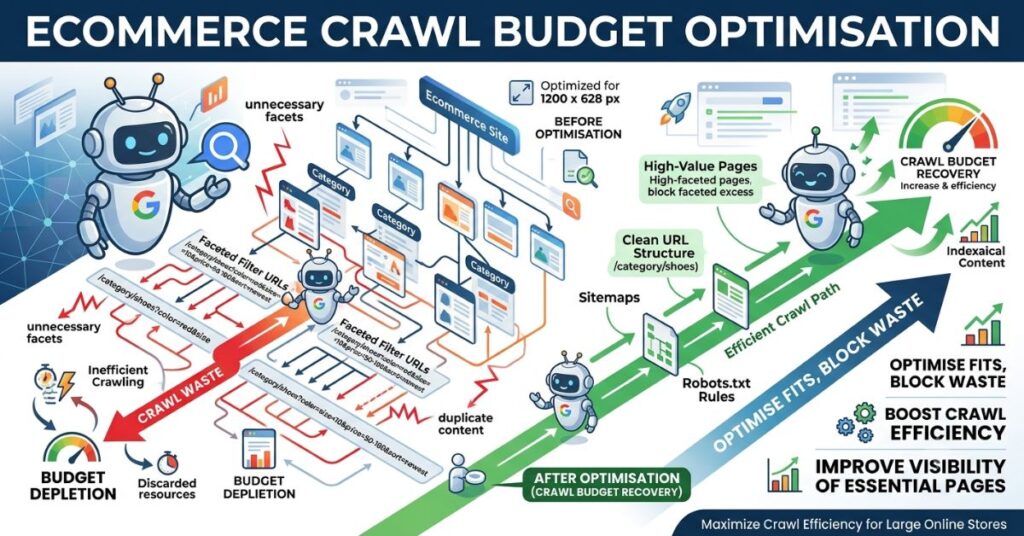
Crawl budget is the number of pages Googlebot will crawl on your site within a given period. Google allocates this based on its assessment of your site’s authority and activity. When a large portion of that budget is consumed by low-value URLs, filtered category variants, session ID parameters, tracking parameters, empty search result pages, Google crawls fewer of your actual product and category pages.
What a Technical Audit Does
- Analyses log files to show exactly which URLs Googlebot is visiting and which are being ignored
- Identifies URL parameter patterns (colour, size, sorting) that generate thousands of near-duplicate URLs
- Audits robots.txt configuration to identify what is currently blocked and what should be
- Reviews XML sitemaps to ensure only canonical, indexable pages are submitted
After fixing crawl budget waste, stores commonly see Google begin indexing product pages that were previously being ignored entirely. Products that had never ranked start appearing in search results. This is one of the fastest-impact improvements a technical audit produces for large stores.
Performance Improvement 2: Duplicate Content Resolution
Ecommerce stores generate duplicate or near-duplicate content through multiple mechanisms: product variant pages (the same product in different sizes or colours appearing at separate URLs), paginated category pages where page two and three share overlapping content with page one, and manufacturer product descriptions used across hundreds of stores selling the same products.
What a Technical Audit Does
- Identifies duplicate title tags and meta descriptions at scale across the catalog
- Finds product variant pages that are unnecessarily indexed as separate URLs
- Audits canonical tag implementation to ensure filtered and paginated pages correctly defer to the primary URL
- Flags manufacturer description content that is shared across competing retailer websites
Resolving duplicate content issues consolidates ranking signals onto the intended canonical URLs, improves index coverage efficiency, and prevents Google from choosing an unintended URL as the canonical, which happens when canonical tags are absent or incorrectly configured.
Performance Improvement 3: Core Web Vitals and Page Speed
Ecommerce sites are disproportionately represented among poor-performing sites in Google’s Core Web Vitals dataset. Large product image libraries, third-party scripts from cart systems, analytics platforms, and remarketing tools, and complex theme frameworks combine to produce slow, layout-unstable pages that damage both rankings and conversion rates.
The Three Metrics and Ecommerce-Specific Targets
- Largest Contentful Paint (LCP), target under 2.5 seconds: Hero product images on category and product pages are typically the LCP element. Poor image compression and no lazy loading are the most common causes.
- Cumulative Layout Shift (CLS), target under 0.1: Banner carousels, dynamically loaded reviews, and promotional messages that load after the initial page are the most common CLS sources on ecommerce sites.
- Interaction to Next Paint (INP), target under 200ms: This replaced First Input Delay (FID) as a Core Web Vitals metric in March 2024. Add-to-cart buttons, filter interactions, and checkout flows with synchronous JavaScript frequently fail INP on ecommerce sites.
What a Technical Audit Does
- Measures Core Web Vitals across product, category, and checkout page types using both lab (Google Lighthouse) and field data (Chrome User Experience Report)
- Identifies the specific elements causing LCP delays, CLS, and INP failures
- Audits third-party script loading behaviour and flags scripts that block render or delay interactivity
- Assesses image format (WebP vs JPEG/PNG), compression levels, and lazy loading implementation across the product catalog
Improving Core Web Vitals produces a dual benefit: improved Google rankings from the page experience signal, and improved on-site conversion rates from faster, more stable page loading. Deloitte research commissioned by Google found that a one-second improvement in mobile load speed increases ecommerce conversion rates by up to 27%.
Performance Improvement 4: Schema Markup and Rich Results
Product schema markup enables Google to display rich results, star ratings, price, availability, and product details directly in search results. These enhanced listings consistently achieve higher click-through rates than standard blue links. Despite this, the majority of ecommerce stores have incomplete or incorrectly implemented product schema.
What a Technical Audit Does
- Validates Product schema implementation across product page templates, checking for required fields (name, image, description) and recommended fields (price, priceCurrency, availability, brand, GTIN, SKU)
- Tests rich results eligibility using Google’s Rich Results Test tool
- Identifies AggregateRating schema errors that prevent star ratings from appearing in results
- Audits BreadcrumbList schema on category and product pages for navigation rich results
- Checks Offer schema for accuracy, incorrect availability or outdated pricing data in schema can trigger manual quality flags
Correct schema implementation is one of the most reliably measurable quick wins from a technical audit because the impact on click-through rates is often visible within weeks of fixing schema errors.
Performance Improvement 5: Indexation Health Across the Catalog
Not all product pages should be indexed. Pages for discontinued products, out-of-stock items with no restock date, internal search result pages, empty category pages, and account or checkout pages should typically be excluded from the index to focus Google’s attention on the pages that matter.
What a Technical Audit Does
- Reviews Google Search Console Coverage report to identify pages excluded from the index and diagnose whether exclusions are intentional or accidental
- Checks for noindex tags applied to pages that should be indexed, and missing noindex tags on pages that should be excluded
- Audits pages currently indexed in Google that receive no organic traffic and provide no search value, thin pages, faceted filter pages, internal search results
- Identifies orphaned product pages that are not linked from anywhere in the site structure and therefore cannot be effectively crawled or indexed
Performance Improvement 6: Internal Linking and Site Architecture
Ecommerce site architecture determines how authority flows from high-authority pages (homepage, top category pages) through to product pages. Poor internal linking leaves many product pages with negligible authority, while well-structured internal linking distributes equity efficiently and improves crawl coverage.
What a Technical Audit Does
- Maps the internal link structure to identify how many internal links each page type receives
- Identifies products that are buried three or more clicks from the homepage, limiting their crawl frequency and authority accumulation
- Audits breadcrumb navigation implementation for both usability and schema markup accuracy
- Flags broken internal links that waste link equity and deliver poor user experiences
- Reviews anchor text of internal links for descriptiveness and keyword relevance
The Revenue Connection: What Improved Technical SEO Delivers
Technical SEO improvements are not abstract ranking metrics, they translate directly to revenue outcomes for ecommerce stores:
- More products indexed = more organic entry points = more potential customers
- Better crawl budget use = faster indexation of new products and price changes
- Improved Core Web Vitals = higher conversion rates from organic traffic
- Rich results from correct schema = higher click-through rates on existing rankings
- Resolved duplicate content = stronger ranking signals on primary product pages
A study by Deloitte found that reducing mobile load time by 0.1 seconds increased retail conversion rates by 8.4% on average. Technical SEO improvements that result in even modest traffic increases, multiplied across tens of thousands of products, compound into significant additional revenue.
For ecommerce-specific SEO beyond technical audits, explore ecommerce SEO services.
How SEO Specialist USA Delivers Ecommerce Technical SEO Audits
SEO Specialist USA conducts technical SEO audits specifically designed for ecommerce stores. The process covers crawl budget analysis, duplicate content identification, Core Web Vitals measurement and improvement planning, schema validation, indexation health review, and internal link architecture assessment, with a prioritised action plan ordered by revenue impact.
Every audit produces clear, actionable recommendations tied to specific outcomes. Clients understand exactly what is being fixed, why, and what improvement in organic performance they can expect.
Frequently Asked Questions
Article Metadata
Primary Keyword: how technical seo audits improve ecommerce site performance
Secondary Keywords: ecommerce technical seo audit, technical seo for ecommerce, ecommerce seo performance, crawl budget ecommerce, core web vitals ecommerce, product schema seo