
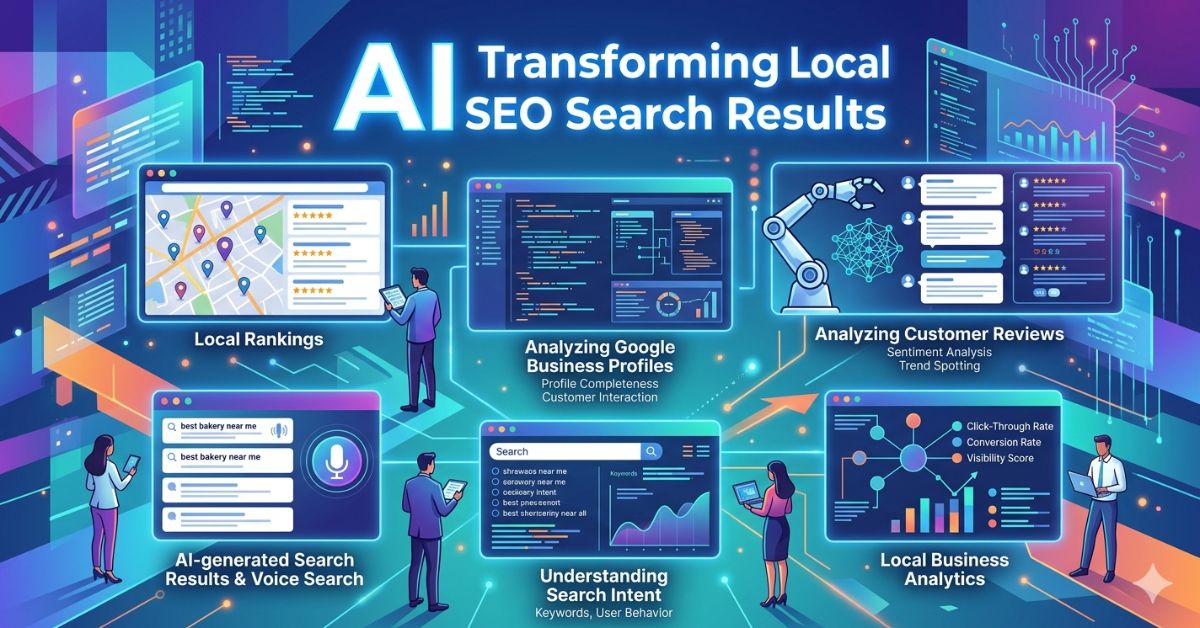
AI is changing local SEO by making search smarter, faster, and more intent-driven. Google’s AI systems now interpret what a searcher actually wants, not just what words they typed. For local businesses, this means ranking factors like genuine relevance, comprehensive Google Business Profiles, conversational content, and real customer trust signals matter more than ever. Businesses that optimize for real user needs win. Those gaming the algorithm with thin tactics lose ground faster.
Key Takeaways
-
 Google’s AI, including RankBrain, BERT, and the Search Generative Experience, has fundamentally changed how local search results are assembled
-
Near-me and conversational voice searches are growing rapidly, driven by AI-powered assistants and mobile search
-
AI tools are helping local businesses do keyword research, content creation, and competitor analysis faster and more accurately
-
Google Business Profile signals have become more important as AI uses them to answer local queries directly in search results
-
Thin, keyword-stuffed local pages are being filtered out faster by AI-enhanced ranking systems
-
The businesses adapting to AI-driven local search now will hold a significant advantage over those that wait
Understanding AI’s Role in Local Search
When most people hear AI and SEO in the same sentence, they think about ChatGPT writing blog posts. That is only a small part of the picture. The more significant shift is happening inside Google itself. Google has been integrating AI into its ranking systems for years, and each iteration has changed what it means to rank well in local search.
The result is a smarter search engine that does a much better job of understanding what a searcher actually needs rather than just pattern-matching keywords. For local businesses, this creates both new opportunities and new risks.
To see how a local SEO strategy adapts to AI-driven search, explore SEO Specialist USA’s local SEO services.
How Google’s AI Systems Are Reshaping Local Rankings
RankBrain: Understanding Ambiguous Queries
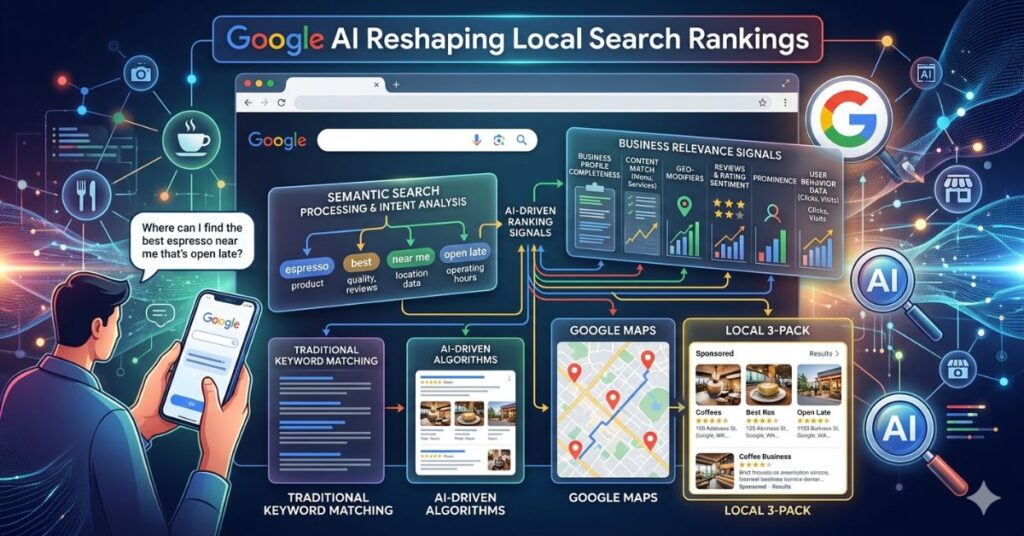
RankBrain was Google’s first major AI integration into its ranking algorithm. It helps Google interpret search queries it has never seen before by connecting them to related concepts it understands. For local SEO, this means a search for ‘fix my leaky faucet tonight’ gets interpreted as a plumber search even though no plumbing keyword was used. Businesses with clear, locally relevant service content rank for a much wider range of queries than before, including conversational and intent-based searches that never mention the technical keyword.
BERT: Reading Full Sentences the Way Humans Do
BERT (Bidirectional Encoder Representations from Transformers) helped Google understand the full context and nuance of search queries rather than reading them word by word.
For local businesses, this means content that reads naturally and answers real questions performs better than content built around awkward keyword phrases.
A page that says ‘If your air conditioner stopped working in the middle of a Phoenix summer, here is who to call’ is now more rankable than a page that says ‘Phoenix AC repair Phoenix HVAC Phoenix air conditioning service.’
The Search Generative Experience (SGE) and AI Overviews
Google’s Search Generative Experience and AI Overviews now surface AI-generated answers directly in search results before the organic listings.
For local queries, this often pulls information directly from Google Business Profiles, local content pages, and cited sources. Businesses that appear in AI Overviews gain visibility even before a user clicks.
The key to being cited in these answers is having comprehensive, accurate, well-structured local content and a fully optimized GBP.
For how AI tools assist local SEO strategy, read how AI can help with local SEO.
How Voice Search and Conversational AI Are Changing Local Search Behavior
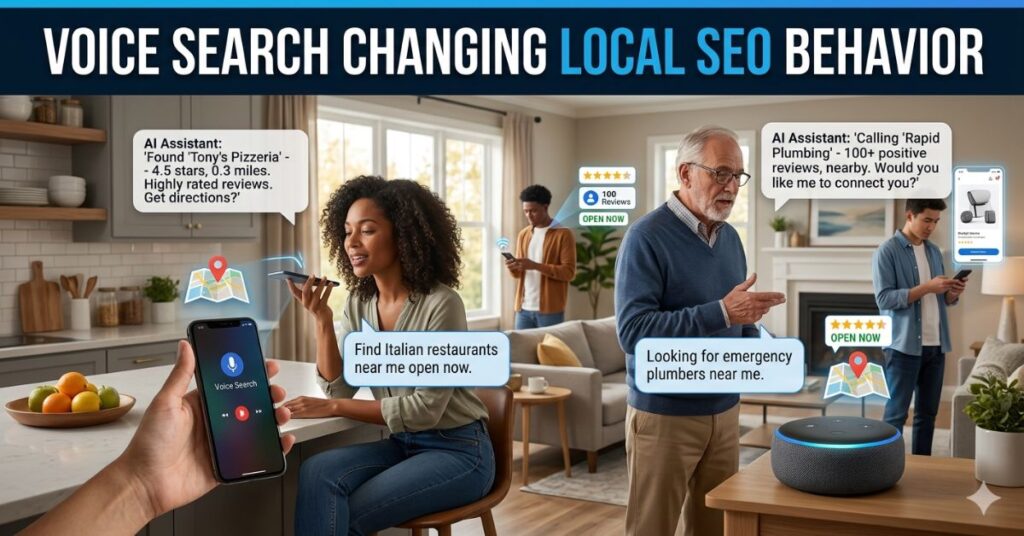
Voice search through Siri, Google Assistant, and Alexa is fundamentally conversational. People do not say ‘HVAC repair Chicago.’ They say ‘Who is the best HVAC company near me?’ or ‘Is there an emergency plumber open right now?’ These are longer, more natural, question-based queries.
For local businesses, this shift has practical implications for content:
- FAQ pages that answer specific local questions are now a major ranking opportunity
- Conversational page content performs better than tightly formatted keyword paragraphs
- Accurate business hours, service availability, and contact information in your GBP are what voice assistants pull when answering ‘open now’ queries
- Position zero and featured snippets are the primary target for voice search visibility
A local plumbing company with a blog post titled ‘What to Do If Your Pipe Bursts in Denver at Night’ that answers the question clearly in the first paragraph is far more likely to be read aloud by a voice assistant than a generic services page.
AI Tools Local Businesses Are Using for Local SEO
Beyond what Google is doing with AI, local businesses are using AI-powered tools to execute local SEO more efficiently. This is where AI becomes a practical advantage for smaller businesses that cannot afford large in-house marketing teams.
AI for Local Keyword Research
Tools like Semrush, Ahrefs, and dedicated AI keyword tools can now analyze thousands of local keyword variations in minutes, cluster them by intent, identify which local terms are underserved, and compare a business’s keyword coverage against its competitors.
What used to take an experienced analyst a full day of manual research now produces a draft output in an hour that the analyst reviews and refines.
AI for Local Content Creation
AI writing assistants can produce first drafts of location-specific service pages, blog posts, FAQ sections, and Google Business Profile descriptions quickly. This makes it feasible for local businesses to build a content library at a pace that was previously only possible for large organizations with dedicated content teams.
The critical point is that AI drafts require human review and local expertise before publishing. Raw AI output lacks the genuine local knowledge that Google increasingly rewards.
AI for Review Monitoring and Sentiment Analysis
AI-powered review management tools monitor multiple platforms simultaneously, analyze sentiment patterns across hundreds of reviews, flag urgent negative feedback for fast response, and suggest response templates based on review tone.
For local businesses managing reviews across Google, Yelp, Facebook, and industry directories, this kind of automation dramatically reduces the time burden while improving response consistency.
AI for Competitor Analysis
AI tools can analyze competitor websites, GBP profiles, and ranking data to surface specific gaps between what a competitor is doing and what a local business is doing. This turns competitor research from a periodic deep dive into a continuous intelligence feed, allowing businesses to respond to competitor moves faster.
For a more detailed breakdown of AI’s role in local strategy, read how AI can help with local SEO: 4 ways.
What AI Means for Google Business Profile Optimization
Google’s AI systems draw heavily on Google Business Profile data when assembling local search results, map listings, and AI Overviews. A sparse or outdated GBP is now more of a liability than it was before AI integration, because the AI has less reliable data to work with and is less likely to surface your business confidently.
A comprehensive GBP, with complete service listings, fresh photos, regular posts, and recent reviews, gives Google’s AI more accurate signals about who you are, what you offer, and how trustworthy your business is. The more complete and current your profile, the more confidently Google’s systems can recommend you for relevant local queries.
- Services section: AI uses this to match your GBP to specific service-related queries
- Reviews and responses: Sentiment and recency signals inform AI-driven trust scoring
- Posts: Recent posts signal an active, operational business
- Photos: Visual content is now analyzed by AI for relevance and quality, not just logged as a count
The Content Shift: From Keyword Pages to Genuinely Helpful Local Content
Perhaps the most important change AI has brought to local SEO is a higher bar for content quality. Google’s Helpful Content system, which uses AI to evaluate whether content is genuinely useful for people rather than written for search engines, has devalued thin, keyword-stuffed local pages across the board.
For local businesses, this means the classic tactic of creating dozens of nearly identical city pages with only the location name changed no longer works the way it once did. What does work is content that reflects real local knowledge: specifics about local regulations, common local problems, seasonal considerations, and practical advice that someone in that specific area would genuinely find useful.
A roofing company in Dallas writing about how the specific weather patterns in North Texas, including hail in spring and intense summer heat, affect roof longevity is producing genuinely helpful local content. A page that says ‘Dallas roof repair is something we do. Contact our Dallas roofing team for Dallas roof services’ is exactly what AI-driven ranking systems filter out.
How SEO Specialist USA Builds AI-Ready Local SEO Strategies
SEO Specialist USA builds local SEO strategies that are optimized for AI-driven search, not just traditional keyword ranking. The agency creates genuinely helpful, locally relevant content, maintains comprehensive and accurate Google Business Profiles, and uses AI-assisted tools for keyword research, competitor analysis, and review management, all reviewed and refined by experienced local SEO specialists.
The goal is not to game AI systems but to build the kind of genuine local authority that AI ranking systems are specifically designed to reward.
Frequently Asked Questions