
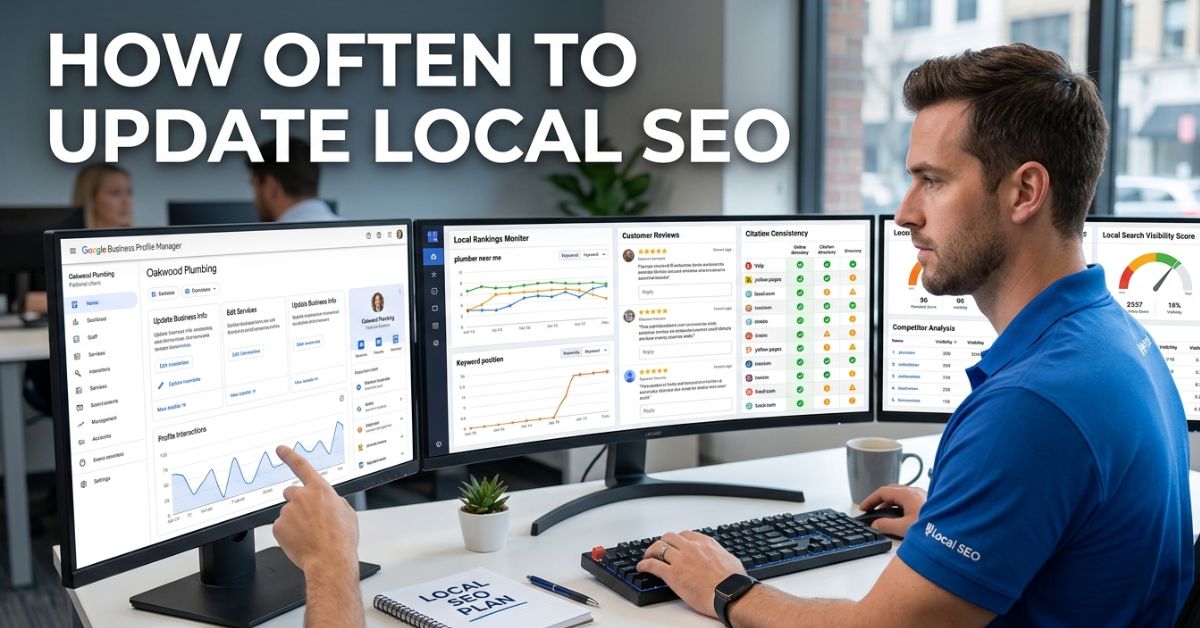
Local SEO requires updates at different frequencies depending on the task. Your Google Business Profile needs attention weekly. Reviews need responses within 24 to 48 hours. Citations should be audited quarterly. Website content should be refreshed every three to six months. Keyword rankings should be reviewed monthly. There is no single update schedule, each element of local SEO has its own maintenance rhythm.
Key Takeaways
-
 Local SEO is not a one-time task, it requires ongoing updates to maintain and improve rankings
-
Google Business Profile activity, including posts and review responses, needs weekly attention
-
Citation data should be audited at least quarterly because directories update independently and can introduce new errors
-
Website content refreshes every three to six months keep pages competitive as search behavior evolves
-
Monthly ranking checks allow you to catch and respond to competitive shifts before they become serious ranking losses
-
The update frequency that is right for your business scales with market competitiveness
Why Local SEO Requires Ongoing Updates
One of the most persistent misunderstandings about local SEO is that it can be done once and left alone. Business owners go through a setup phase, get their Google Business Profile in shape, fix their citations, and then assume the rankings will hold indefinitely with no further effort.
That is not how it works. Local search is a competitive environment. Your competitors are not standing still. Google’s algorithm changes regularly. Directory data updates without warning. Review profiles grow stale if nothing new comes in. Each of these forces, left unaddressed, gradually erodes the rankings you worked to build.
The good news is that the update frequency required decreases significantly once a strong foundation is in place. The heaviest work happens in the first three to six months. After that, ongoing updates are much lighter, but they cannot go to zero.
Weekly Updates: Google Business Profile Activity
Your Google Business Profile is the element of local SEO that needs the most frequent attention. Google’s algorithm evaluates profile activity as a signal of how engaged and operational your business is. Profiles that are frequently updated, posted to, and actively managed perform better than those that go quiet.
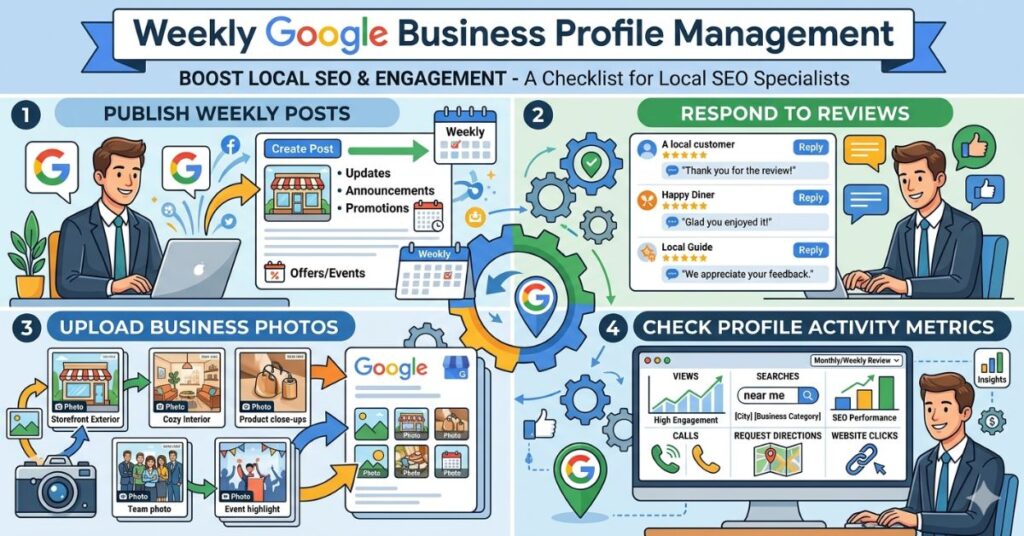
What to Do Weekly on Your GBP
- Publish one to two Google Posts per week: Mix offer posts, update posts, and event posts. Each post takes 10 to 20 minutes to write and upload with an image.
- Check for and respond to new reviews: Review responses should go out within 24 to 48 hours. Unanswered reviews signal neglect to both Google and potential customers.
- Monitor the Q&A section: Users can post questions on your GBP and other users can answer them. Check weekly to make sure no misleading answers have appeared.
- Check for suggested edits: Anyone can suggest edits to your GBP listing. Google sometimes accepts these automatically. Check your profile for any unauthorized changes.
- Respond to messages if GBP messaging is enabled: A fast response rate on GBP messaging is tracked by Google and shown on your profile.
Total weekly GBP time: 30 to 60 minutes per week, or two to four hours per month. This is one of the highest-ROI time investments in local SEO.
Monthly Updates: Rankings, Traffic, and Performance Review
Once per month, you should review your local SEO performance data to understand what is working, what is slipping, and where adjustments are needed. This review does not have to be exhaustive, but skipping it for months at a time means small problems grow into significant ranking declines before they are noticed.
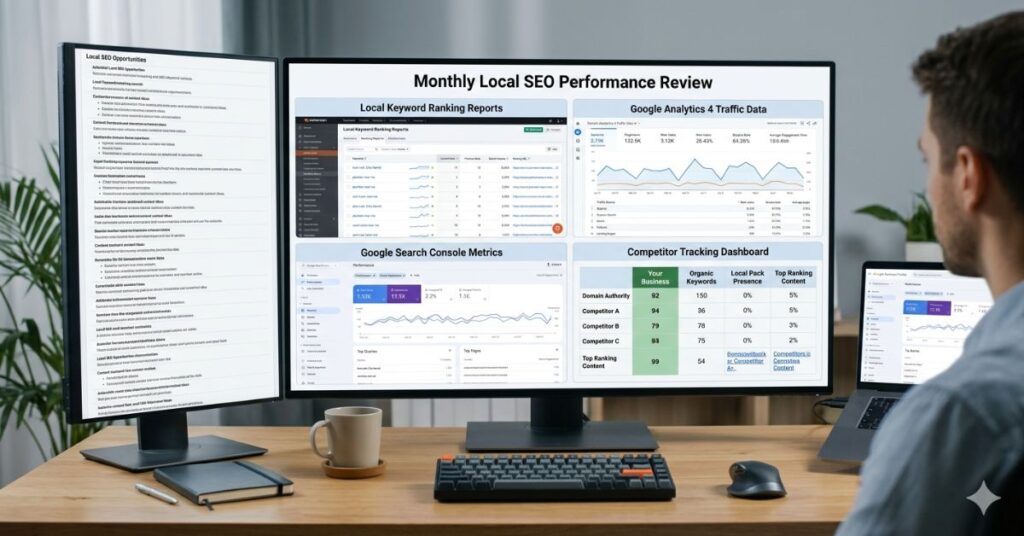
What to Review Monthly
- Keyword rankings: Track positions for your primary and secondary local keywords. Note any drops of two or more positions and investigate the cause.
- Google Business Profile Insights: Review total searches, profile views, calls, direction requests, and website clicks. Look for any month-over-month drops that signal a problem.
- Google Search Console: Check for new crawl errors, coverage issues, or drops in impressions for local keyword clusters.
- Google Analytics: Review organic traffic from local searches, page engagement, and conversion rates on key service pages.
- Competitor snapshot: Quickly check where your top two or three competitors rank for your primary keywords. Note any new competitors appearing in the Local Pack.
- Review velocity check: How many new reviews did your business receive this month? How does that compare to your main competitors?
Total monthly review time: 45 to 90 minutes. This investment prevents you from operating blind and reacting to problems only after they have damaged your rankings significantly.
Quarterly Updates: Citation Audits and Content Review
Every quarter, run a more thorough review of your citation profile and website content. These do not need weekly attention, but ignoring them for six months or more creates problems that take significant time to unwind.
Quarterly Citation Audit
Directory data is not static. Platforms update their data independently, sometimes pulling from aggregators that have old information about your business. A quarterly audit catches:
- New NAP inconsistencies that appeared since the last audit
- Duplicate listings created by directory platforms automatically
- Outdated information on platforms you may have missed during initial cleanup
- New authoritative directories that have launched or become relevant to your industry
Tools like BrightLocal or Moz Local make this audit faster by scanning multiple platforms automatically and flagging inconsistencies. A quarterly citation audit takes one to two hours and prevents the kind of silent data drift that gradually weakens local rankings.
Quarterly Content Review
Review your main service pages and top-performing blog posts once per quarter. Identify:
- Pages with declining traffic or ranking that may need a content refresh
- Outdated pricing, service details, or information that no longer reflects what you offer
- New questions your customers are asking that should be added to FAQ sections
- Opportunities to add new internal links between recently published content and older pages
To understand how content updates fit into a larger local strategy, explore local SEO services for small businesses.
Every 3 to 6 Months: Content Production and Backlink Review
New Local Content
Publishing new locally targeted content every one to three months keeps your website growing in relevance and provides fresh pages for Google to index and rank. The exact cadence depends on your competitive market and resources. In highly competitive markets, monthly or bi-monthly content production is necessary. In lower-competition markets, quarterly content additions are sufficient to maintain and grow organic traffic.
Backlink Profile Review
Check your backlink profile every three to six months using a tool like Ahrefs or Semrush. Look for:
- New links earned from community involvement, press mentions, or partnerships
- Lost links that previously pointed to your site and may need to be recovered
- Competitor link growth that is outpacing yours in key topic areas
- Any low-quality or spammy links that should be disavowed
Annually: Full Local SEO Audit and Strategy Reset
Once per year, conduct a thorough local SEO audit that covers every element of your local presence. This annual review is more comprehensive than the monthly check-ins and serves as a strategic reset for the next 12 months.
- Full citation audit across all platforms, not just the top 20
- Comprehensive keyword ranking review across all target terms and comparisons to competitors
- Website technical audit for new crawl issues, speed regressions, and mobile usability
- Content gap analysis comparing your content library to competitors and customer search behavior
- GBP performance trend analysis over the full year
- Review profile health assessment: volume, recency, rating, response rate
- Strategy update based on new competitive threats, new Google features, and evolving business goals
The annual audit takes two to four hours to complete but provides the strategic clarity to ensure the next year’s local SEO investment is focused on the highest-value opportunities.
Not sure where to start with a full audit? Request a local SEO audit from SEO Specialist USA and get a comprehensive picture of your current local SEO health.
Local SEO Update Frequency: Quick Reference Summary
- Daily: Respond to any new GBP messages if messaging is enabled
- 24 to 48 hours: Respond to every new review as it arrives
- Weekly: Publish 1 to 2 GBP posts, check Q&A and suggested edits
- Monthly: Review rankings, GBP Insights, Search Console, Analytics, and competitor standings
- Quarterly: Run citation audit, review and refresh key content pages, check backlink profile
- Every 3 to 6 months: Publish new local content, run deeper content gap analysis
- Annually: Full local SEO audit, strategy reset, comprehensive competitor benchmarking
How Update Frequency Scales With Competition
Not every local business needs the same update intensity. The general principle is that the more competitive your market, the more frequently you need to update each element:
- Low competition markets: Weekly GBP posts can drop to twice monthly. Content production quarterly is sufficient. Citations need attention twice per year.
- Medium competition markets: Follow the standard schedule above for most businesses.
- High competition markets: GBP posts may need to increase to daily or near-daily. Content production monthly. Reviews need aggressive generation and fast responses. Citation monitoring near-monthly.
If you are in a high-competition market and not meeting the higher-frequency update requirements, your competitors who are consistently active will take your rankings over time.
How SEO Specialist USA Keeps Local SEO Updated for Clients
SEO Specialist USA manages the complete local SEO update cycle for clients on a consistent, professional schedule. Weekly GBP posting and review management, monthly performance reporting, quarterly citation audits, and ongoing content production are all handled without the business owner needing to track or execute any of it.
Clients receive regular reports showing what was updated, what changed in performance, and what adjustments are being made for the following month. The result is a local SEO presence that stays current, competitive, and growing without taking time away from running the business.
Frequently Asked Questions