

Yes, an average position of 5 in Google Search Console is generally a good sign. It suggests your website is appearing relatively high in Google results, often within the first page. However, position 5 is an impression-weighted average, not a fixed rank. Check clicks, click-through rate, relevant queries, and conversions before judging performance.
Key Takeaways
- An average position of 5 is generally positive, but it doesn’t mean you rank fifth for every search.
- Google calculates average position using the topmost result for your property or page across impressions.
- A position of 5 can drive valuable clicks, but a good position alone cannot guarantee traffic or leads.
- Compare CTR, clicks, impressions, queries, devices, and countries before deciding what to optimize.
- If your most important non-branded keyword averages position 5, improving relevance and the search result’s appeal may create an opportunity to earn more clicks.
- Prioritize qualified traffic and conversions over making a dashboard number look better.
What Does an Average Position of 5 Mean in Google Search Console?
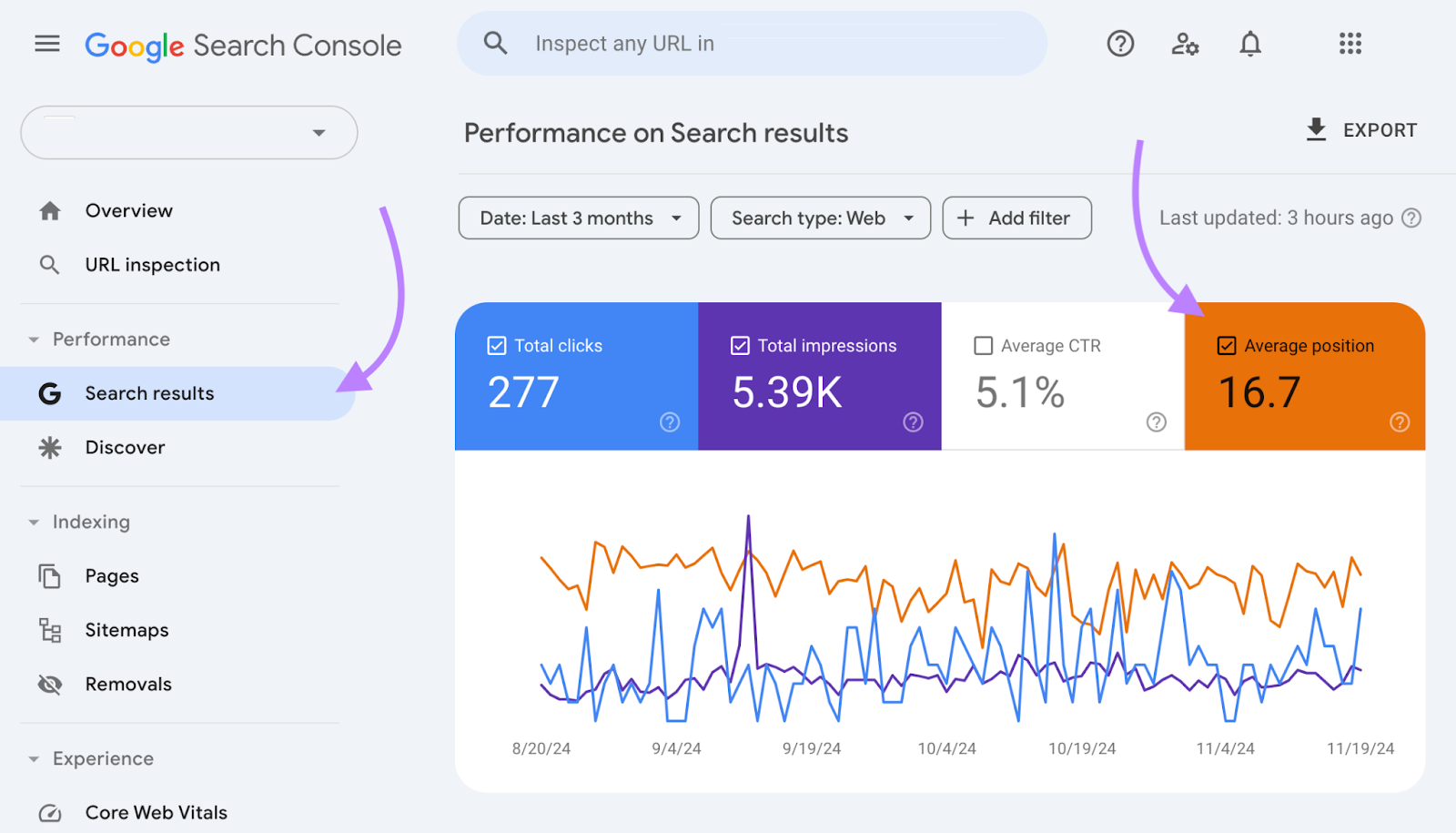
In Google Search Console (GSC), an average position of 5 means the mean position recorded for your topmost eligible result across the impressions included in the report is 5. Google’s position metric is relative: position 1 is the highest-ranked result in the relevant result layout, followed by position 2, position 3, and so on.
It doesn’t mean that every visitor saw your result as the fifth traditional blue link. Search layouts can include different features, and the result’s position can change by query, device, location, and time.
Suppose a page gets one impression when its highest result is at position 3 and another when it is at position 7. Its average over those two impressions is (3 + 7) ÷ 2 = 5. Neither impression was actually in position 5.
Google explains the measurement in its official documentation on impressions, position, and clicks.
Is Position 5 Good for SEO?
Usually, yes. It means your page or property has already achieved meaningful visibility for the searches included in that view. If the queries are relevant to your business, position 5 is a strong foundation that may be improved further. But there are two very different situations:
Google’s Performance report guidance recommends inspecting search data through the appropriate filters and dimensions, not relying on the overall number alone.
Position 5 vs positions 1 to 3
Ranking nearer the top can increase the opportunity to earn clicks, but there is no universal click-through rate attached to position 5. A keyword with ads, an AI Overview, a map pack, shopping results, or a featured snippet may behave very differently from a simple organic results page.
| Average position | Practical interpretation | What to check |
|---|---|---|
| 1–3 | High organic visibility for relevant searches | CTR, conversions, SERP features |
| Around 5 | Good visibility with possible room to improve | Important queries, CTR, competitors above you |
| 6–10 | Often a useful first-page opportunity | Content fit, titles, internal links |
| 11–20 | Visibility exists, but many users may not reach the result | Content quality, intent match, technical barriers |
These ranges are practical guidelines, not Google-defined quality grades. Google does not publish a universal “good position” threshold that applies to every business.
How Many Clicks Does Google Position 5 Get?
There is no reliable fixed percentage for every keyword. Instead, calculate your actual CTR in Search Console:
Here is a hypothetical example of a keyword with an average position of 5:
The 4% CTR is illustrative, not a benchmark or prediction. Another keyword at position 5 could receive fewer or more clicks because its users behave differently and its results page contains different features.
To decide whether 400 clicks are good, ask whether those visitors are the right people and whether they take valuable actions. A service business receiving 40 qualified inquiry visits can benefit more than one receiving 400 visits from irrelevant informational searches.
Why Can an Average Position of 5 Still Produce Low Traffic?
An apparently strong ranking with weak clicks is not necessarily a measurement error. Common explanations include:
- Low impressions: The keyword or page simply does not appear often enough to generate much traffic.
- Low CTR: Users see your result but choose a competitor, another result type, or no result at all.
- Branded-query distortion: Brand queries help the website average while valuable non-branded queries rank lower.
- Different search appearances: Ads, local packs, shopping results, AI Overviews, and other features change user attention.
- Irrelevant queries: The page earns impressions for terms that are not aligned with your target audience.
- Geographic mismatch: An apparently good countrywide average may hide poor visibility in the locations that matter to your business.
Before rewriting a page, inspect the queries that contribute to its average. In some cases, low traffic is caused by limited search demand, not weak optimization.
How to Check Whether Your Average Position of 5 Is Actually Good
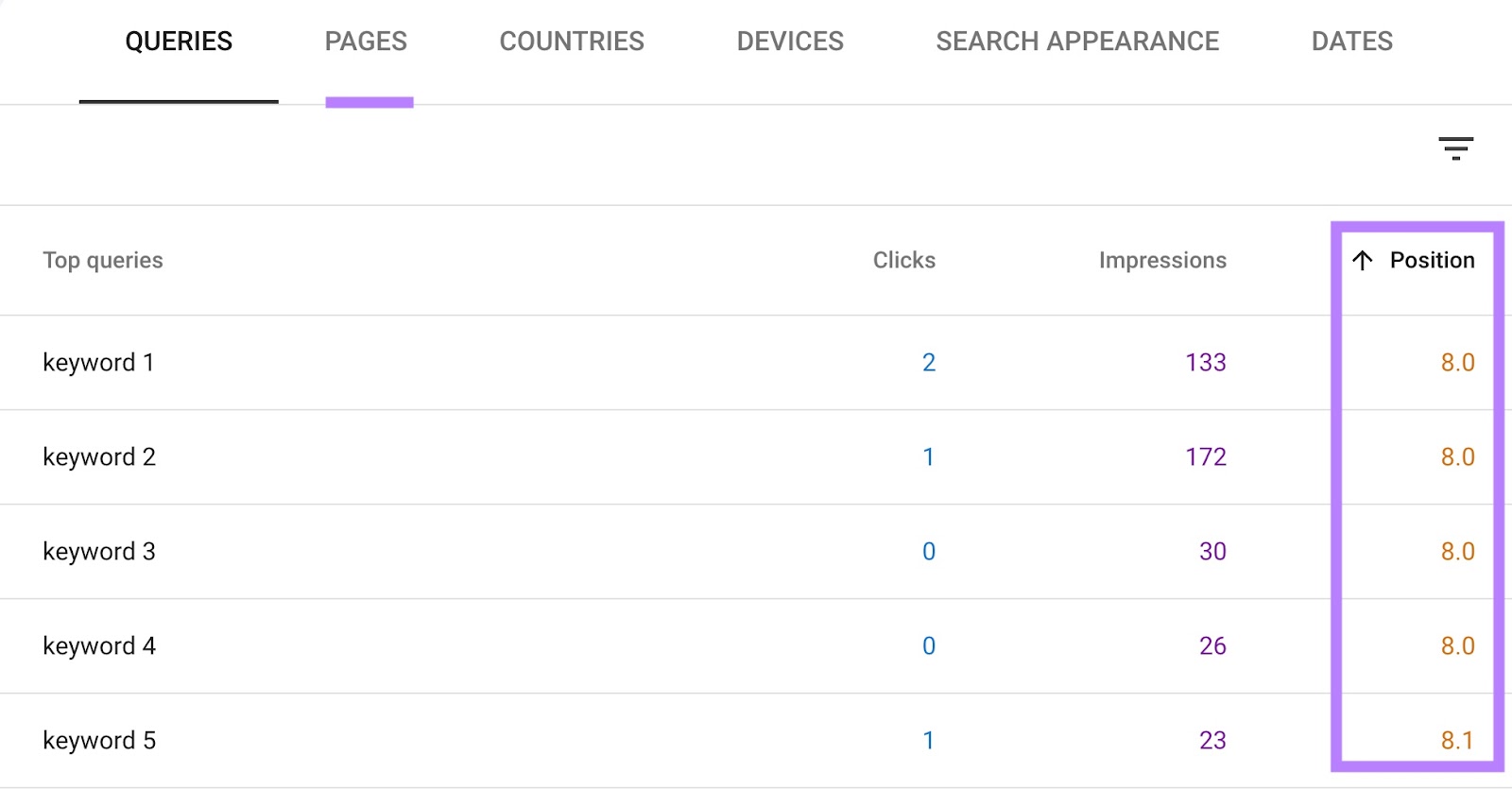
Open Google Search Console → Performance → Search results, and use this sequence:
Select a meaningful date range. Start with the last three months and compare with the previous period when the data is sufficient.
Select the target page. Use the Pages tab or a page filter so unrelated pages do not dominate the number.
Open the Queries tab. Identify the primary keyword, secondary keywords, and questions that produce impressions and clicks.
Filter by country and device. Compare mobile and desktop and focus on your actual service area.
Read four metrics together. Compare impressions, clicks, CTR, and average position rather than one figure in isolation.
Review business outcomes. Check relevant contact form submissions, calls, purchases, or other conversions in your analytics setup.
If you are new to interpreting these numbers, our wider guide on what a good average position is in Google Search Console explains the full metric and common reporting mistakes.
Should You Try to Improve an Average Position of 5?
Yes, when the keyword is important to your business and there is evidence that improvement could add valuable traffic. An average position of 5 may be perfectly satisfactory for a low-volume informational query but worth prioritizing for a high-intent service or product query. Use these checks before making changes:
Confirm that the right page is ranking
If Google’s result points to a general blog when a service page better satisfies the query, review search intent and site structure. Don’t create a second near-identical page simply to target the same keyword.
Improve the answer to the searcher’s question
Review the current top results. Are users looking for a price, a step-by-step guide, a service provider, or a product comparison? Add genuinely useful missing details, examples, and clear answers. Avoid unnecessary keyword repetition.
Refine the title and description for relevance
A clear, accurate page title can help people understand why your result deserves attention. A meta description may influence the snippet Google displays, though Google can generate a different one. Don’t promise a ranking improvement from changing metadata alone.
Strengthen related internal links
Link relevant pages with natural anchor text. For example, useful articles about Search Console, on-page optimization, and SEO audits can support a focused page when they genuinely help readers navigate the subject.
Address underlying technical issues
Inspect indexing, canonicalization, internal link accessibility, page experience, and mobile rendering if there is reason to believe those issues affect the target page. Our technical SEO services cover these foundations.
Measure again, without overreacting
Track the target query and page for several weeks after meaningful changes. Check whether qualified clicks and conversions improve. Search Console averages fluctuate as the mix of impressions changes, even if an important keyword stays stable.
When Is It Better to Keep a Ranking at Position 5?
Sometimes the best action is to leave a well-performing page alone. If it already attracts qualified visitors, earns conversions, and matches the query well, changing its structure or headline without a clear reason can introduce risk. Before editing, ask:
- Is the ranking stable for the important query?
- Is organic traffic trending upward or holding steady?
- Does the page meet the visitor’s needs?
- Are conversions healthy relative to traffic?
- Is there a more urgent SEO issue elsewhere on the site?
For a practical way to prioritize issues rather than chase small metrics, read what we look at in the first 30 minutes of an SEO audit.
Move Beyond Position 5
At SEO Specialist USA, we look beyond average ranking numbers. Our SEO team reviews the queries behind your impressions, the pages earning clicks, search intent, technical issues, and the opportunities most likely to produce qualified inquiries or sales. If your website averages position 5 but does not generate the results you expect, we can help identify whether the problem is search demand, low CTR, content relevance, conversion performance, or a technical barrier.
Get Your SEO AuditFrequently Asked Questions
Is average position 5 good in Google Search Console?
Yes, position 5 is generally a positive visibility signal, especially for a relevant non-branded keyword. However, Google averages positions across impressions, so the metric does not guarantee a fifth-place rank each time. Consider CTR, clicks, impressions, and conversions before deciding whether the page is successful.
Does an average position of 5 mean I am on page one?
Not necessarily for every impression. A position near 5 often corresponds to prominent placement, but Google Search has different result layouts and can include many result features. Because average position is calculated across impressions, your URL might appear above or below fifth in individual searches.
What is a good CTR for average position 5?
There is no universal CTR target for position 5. It depends on the query, device, search intent, competing results, and Google features shown on the page. Review your own CTR against similar queries and previous periods rather than treating an industry chart as a guaranteed benchmark.
Is position 5 better than position 10?
All else equal, position 5 generally offers better visibility than position 10. However, a position 10 query with strong buying intent and more impressions could generate more valuable leads than a low-volume informational query at position 5. Compare business outcomes as well as ranking positions.
Why is my average position 5 but my CTR is low?
The query may have low search demand, a search results page crowded with other features, or a title that does not address what people want. It is also possible that a favorable sitewide average hides weaker rankings for your target keywords. Filter Search Console by page and query to investigate.
Can average position improve while clicks decrease?
Yes. The average may improve if lower-ranked queries stop generating impressions, even as total search traffic falls. Demand can also decline seasonally. Review clicks, impressions, CTR, and your most important queries together so a better average does not conceal weaker business performance.
How do I improve average position 5 to position 3?
There is no guaranteed method. Check whether the right page satisfies the query, compare top-ranking competitors, improve useful content and internal links, address relevant technical problems, and measure results over time. Prioritize meaningful improvements that serve users rather than trying to manipulate a dashboard figure.
Final Thoughts
An average position of 5 on Google Search is typically a good starting point, but it is not the final measure of success. A strong SEO result is a page that appears for valuable searches, earns clicks, satisfies visitors, and contributes to real business outcomes.
Focus on useful traffic and conversions, not the average position number alone.
If you are already around position 5, your next step is to inspect the exact queries and determine whether improving them is worth the effort.
Get Your SEO Audit