
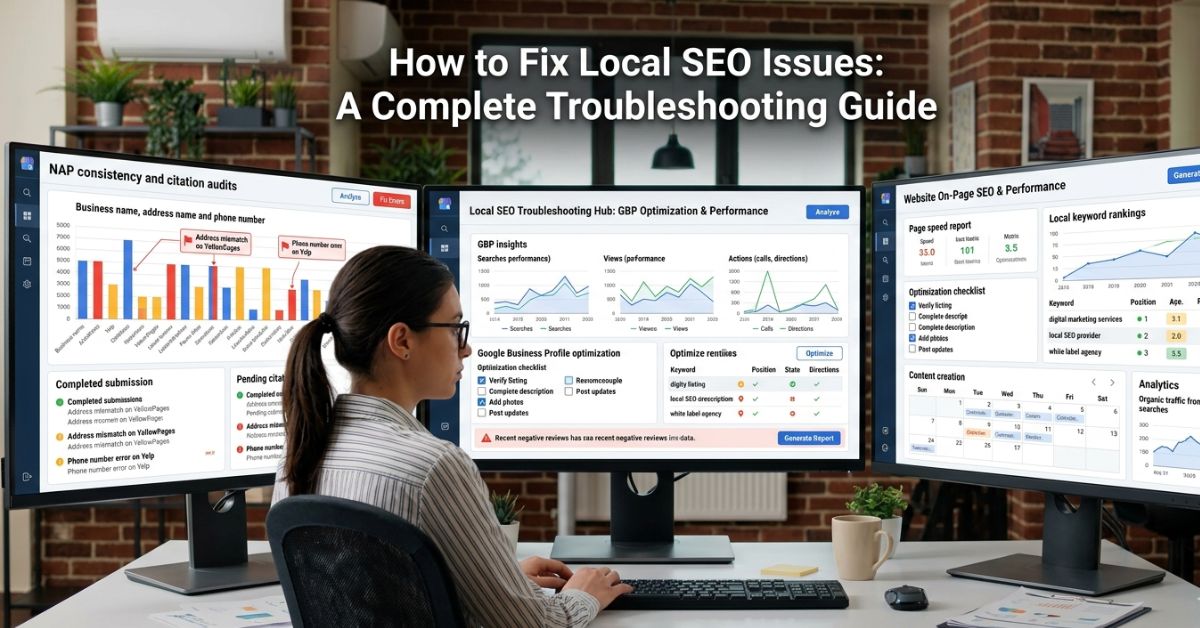
To fix local SEO issues, start by auditing your Google Business Profile for accuracy and completeness, then check NAP consistency across all directories. Next, resolve technical website problems like slow load speed and missing schema markup. Finally, build consistent citations, generate more reviews, and create locally optimized content. Fixing these areas in order produces the fastest results.
Key Takeaways
-
 Most local SEO problems fall into four categories: GBP issues, NAP inconsistencies, website technical issues, and weak content
-
Google Business Profile problems are the most common cause of poor Local Pack rankings
-
NAP inconsistency across directories confuses Google and suppresses visibility
-
Thin or missing local content is a major reason local pages fail to rank
-
Fixing local SEO is a systematic process, not a one-time task
Why Local SEO Issues Are Common
Most local businesses set up their online presence once and never revisit it. Over time, directories pull in outdated data, Google Business Profiles become incomplete, and websites go without technical updates. The result is a local SEO profile full of small problems that, together, have a big impact on rankings and leads.
The good news is that local SEO issues are fixable. Most of them are not technical mysteries. They are the result of neglect or lack of awareness. Going through them systematically and correcting each one builds a strong foundation that improves rankings, increases calls, and drives real business results.
Issue 1: Google Business Profile Problems
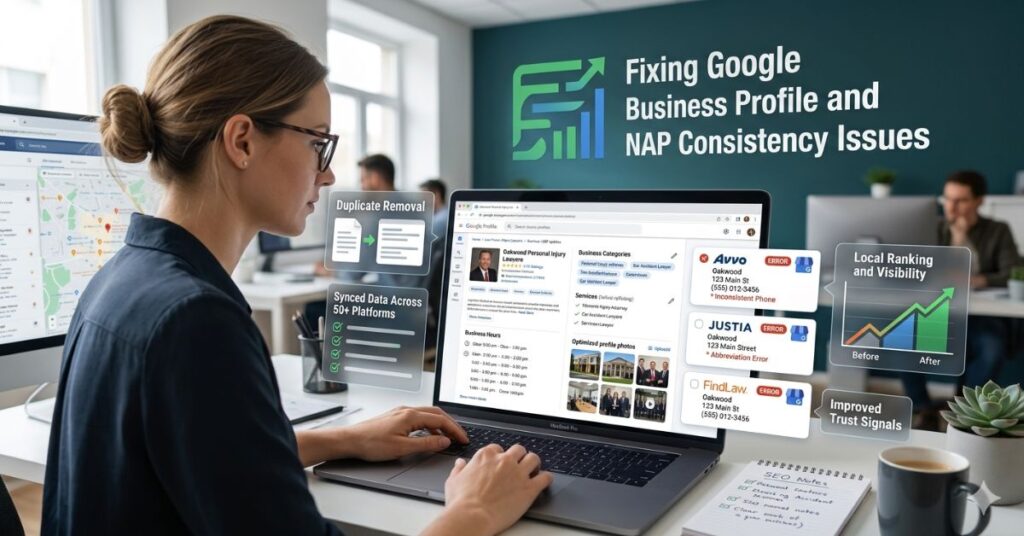
Your Google Business Profile (GBP) is the most influential local SEO asset you have. Most businesses either have not fully completed it or have let it fall out of date.
Common GBP Issues and How to Fix Them
- Unclaimed profile: If you have not claimed your GBP, claim it immediately at business.google.com. Unclaimed profiles are managed by Google and often have incomplete or wrong information.
- Wrong or incomplete business category: Your primary category must match your core service. Use the most specific category available, for example ‘Roofing Contractor’ rather than just ‘Contractor.’ Add secondary categories for additional services.
- Missing or incomplete service list: Add every service you offer with a description. Google uses this data to determine relevance for search queries.
- No photos: Businesses with photos receive significantly more clicks. Upload at least 10 to 20 high-quality photos of your location, team, completed work, and products.
- Outdated hours: Incorrect hours are one of the most damaging GBP issues. Update them seasonally and mark special holiday hours.
- No posts: Use Google Posts to share updates, offers, and news at least once per week. Posts signal to Google that your profile is active.
- Unanswered Q&A: Monitor the Questions and Answers section and respond to every question. Also add your own frequently asked questions proactively.
Issue 2: NAP Inconsistency Across Directories
NAP stands for Name, Address, and Phone number. When this data is inconsistent across directories, Google cannot fully trust your business information, which directly hurts your local rankings.
How to Fix NAP Inconsistencies
- Step 1: Define your canonical NAP. Write the exact format of your business name, address, and phone number that you want everywhere. Stick to it precisely.
- Step 2: Audit your existing citations. Use tools like BrightLocal, Moz Local, or Yext to find every directory where your business is listed and flag inconsistencies.
- Step 3: Fix the most important platforms first. Start with Google Business Profile, Yelp, Bing Places, and Apple Maps. Then move to core data aggregators like Data Axle and Neustar Localeze, which feed data to many other directories.
- Step 4: Clean up duplicates. If you find multiple listings for your business on any platform, claim and delete or merge the extras.
- Step 5: Update and monitor. After fixing, set a reminder to re-audit every six months. Directory data can change without your knowledge.
For a full breakdown of what citations are and why they matter, read local SEO citation explained.
[ BUTTON ] Get a Local SEO Audit → https://www.seospecialistusa.com/seo-audit/
Issue 3: Weak or Incorrect Website Optimization
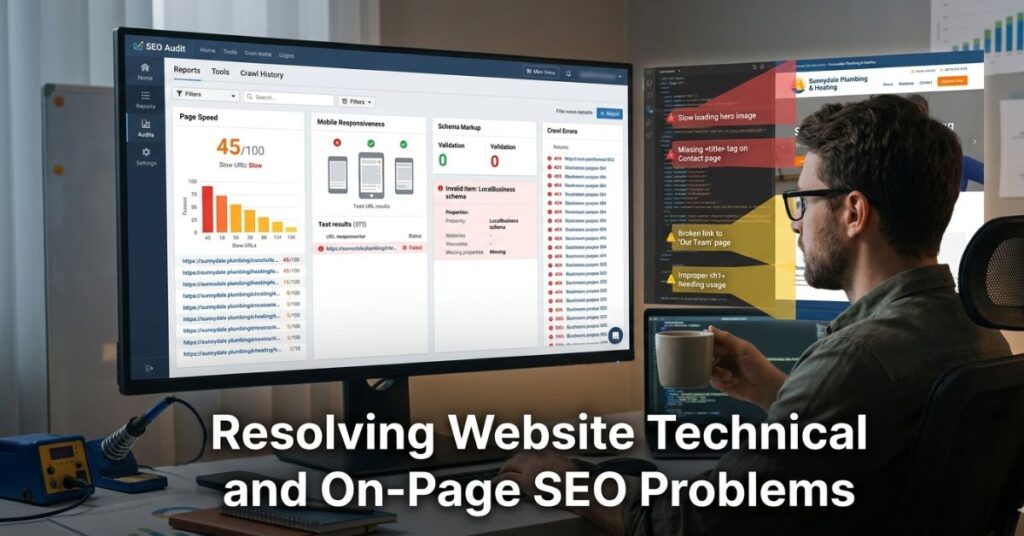
Your website is the foundation that supports your GBP and citations. If your website is poorly optimized for local search, even a great GBP will struggle to rank.
On-Page SEO Fixes
- Add city and service to your page title tag and H1 heading. For example: ‘Plumbing Services in Austin, TX | Company Name’ not just ‘Our Services.’
- Include your NAP on every page of your website, typically in the footer. Make sure it matches your GBP exactly.
- Create a dedicated service area page or individual city pages if you serve multiple locations. Do not try to rank one page for five different cities.
- Add LocalBusiness schema markup to your homepage and contact page. Schema markup helps Google understand your business type, location, hours, and services.
- Embed a Google Map on your contact page. It reinforces your location signal.
Technical SEO Fixes
- Page speed: A slow website hurts both rankings and conversions. Run your site through Google PageSpeed Insights and fix any issues flagged there.
- Mobile friendliness: Over 60% of local searches happen on mobile. Your site must be fully responsive and fast on mobile devices.
- HTTPS: Ensure your site has a valid SSL certificate. Non-HTTPS sites are flagged as insecure by browsers and are disadvantaged in rankings.
- Crawl errors: Check Google Search Console for crawl errors, broken links, or indexing issues. Fix any pages that are not being indexed correctly.
Need a technical review of your site’s current state?
Issue 4: Thin Local Content
Many local websites have service pages with just a few sentences. This kind of thin content rarely ranks for competitive local keywords. Google needs substance to understand what your page covers and whether it is worth showing to searchers.
How to Fix Thin Local Content
- Each service page should have at least 500 to 800 words of unique, useful content about that specific service in your specific area.
- Address local specifics: mention your city, common local problems you solve, local customer testimonials, and area-specific pricing context.
- Add an FAQ section to each service page using real questions customers ask. These improve rankings and capture voice search queries.
- Create blog content around local questions and topics your customers search for, not just generic industry articles.
- Update old thin pages rather than creating new ones. Improving existing pages often produces faster ranking gains than publishing fresh content.
Issue 5: No Review Strategy
Reviews are both a trust signal for customers and a ranking factor for Google. Businesses that actively build reviews consistently outrank those that do not, even when other SEO factors are equal.
How to Fix Your Review Profile
- Ask every satisfied customer for a Google review immediately after a job is complete. A direct text message or email with a review link gets the highest response rate.
- Respond to every review, positive and negative. Never ignore a review. Your responses show Google and potential customers that you are engaged.
- Do not incentivize reviews. Google’s guidelines prohibit offering discounts or gifts in exchange for reviews. Build them organically.
- Diversify across platforms. Google reviews matter most, but Yelp, Facebook, and industry-specific review sites also contribute to your overall local SEO authority.
- Monitor your review velocity. A sudden drop in new reviews after a period of consistent activity can signal a problem worth investigating.
Issue 6: Zero or Weak Backlink Profile
For local SEO, you do not need hundreds of backlinks. But you do need some, particularly from local sources. A business with zero local backlinks is at a disadvantage compared to competitors with links from local news sites, community organizations, and industry associations.
How to Build Local Backlinks
- Get listed in local business associations and chambers of commerce
- Sponsor local events, sports teams, or community initiatives, which often include a link on event websites
- Write guest posts for local blogs or publications in your industry
- Reach out to local news sites with genuinely newsworthy content about your business
- Partner with complementary local businesses for cross-referral links
For more on link building strategy, explore off-page SEO services.
Local SEO Issues: Key Statistics
- 56% of local businesses have not yet claimed their Google Business Profile (BrightLocal)
- Only 44% of businesses respond to Google reviews (BrightLocal Consumer Review Survey)
- 73% of consumers lose trust in a brand because of incorrect local listings (Yext)
- Businesses with photos on their GBP receive 42% more direction requests and 35% more website clicks (Google)
- Page speed improvements of 1 second can increase mobile conversions by up to 27% (Deloitte study for Google)
How SEO Specialist USA Fixes Local SEO Issues
SEO Specialist USA conducts thorough local SEO audits that identify every issue across your GBP, citations, website, content, and backlink profile. The team then builds a prioritized action plan, starting with the fixes that will have the biggest immediate impact on your rankings and leads.
Clients do not have to figure out what to fix first or how to do it. The agency handles everything, from technical corrections to citation cleanup to review strategy, and reports on measurable results throughout the process.
Frequently Asked Questions