

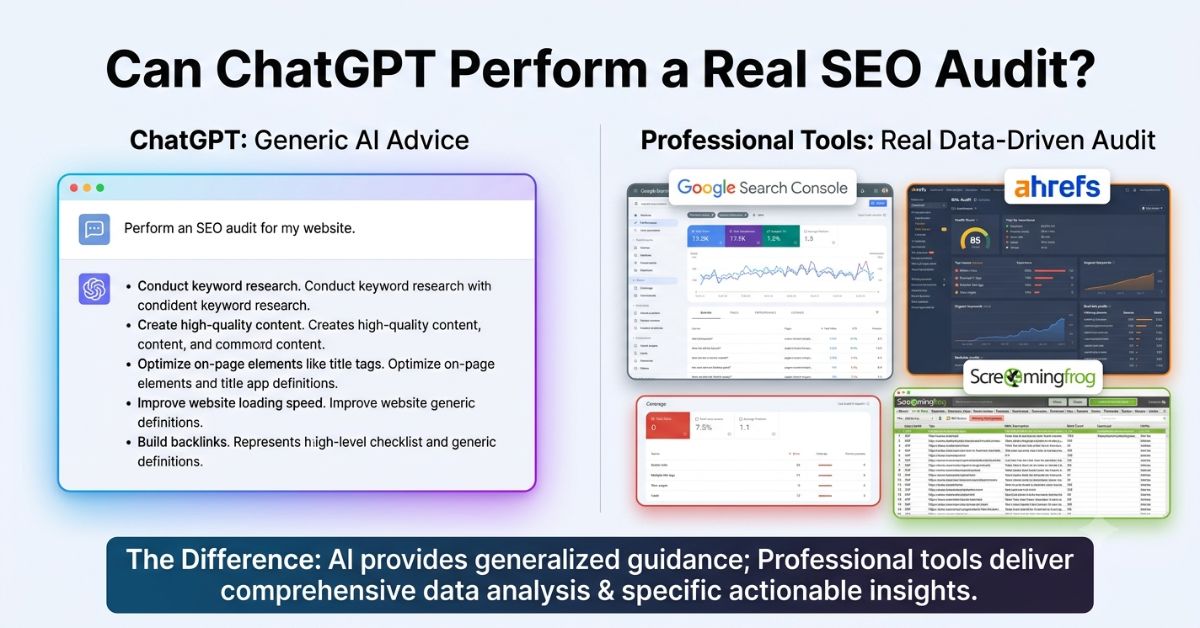
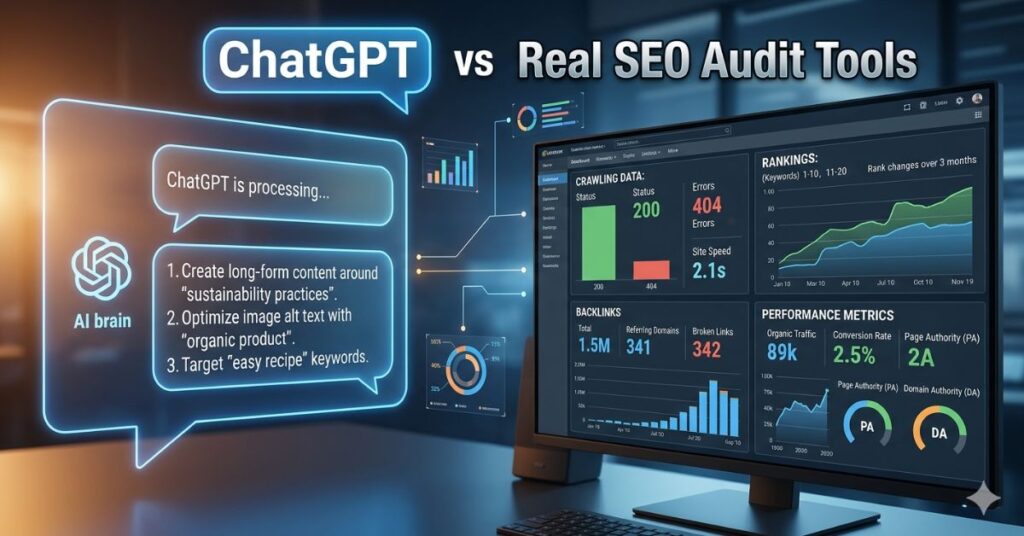
No, ChatGPT can’t perform a real SEO audit. An SEO audit requires crawling your website, accessing real-time ranking data, reading Google Search Console reports, analysing your backlink profile, and measuring page performance metrics. ChatGPT has no access to any of these. What it can do is help you understand SEO concepts, generate content ideas, write metadata drafts, and assist with keyword brainstorming. It is a useful SEO writing and ideation assistant, not an audit tool.
Key Takeaways
-
 ChatGPT cannot crawl websites, access Google Search Console, check live rankings, or analyse backlinks
-
Any ‘audit’ output from ChatGPT is based on generic SEO knowledge, not analysis of your actual site
-
ChatGPT is genuinely useful for SEO content tasks: meta description drafts, keyword clustering, content outlines, FAQ generation, and topic research
-
A real SEO audit requires dedicated tools: Screaming Frog, Google Search Console, Ahrefs or Semrush, and Google Lighthouse
-
Using ChatGPT alongside proper SEO tools is a productive workflow, using it instead of proper tools produces generic advice that may not apply to your site’s specific situation
What ChatGPT Can and Cannot Do in SEO
What ChatGPT Can’t Do
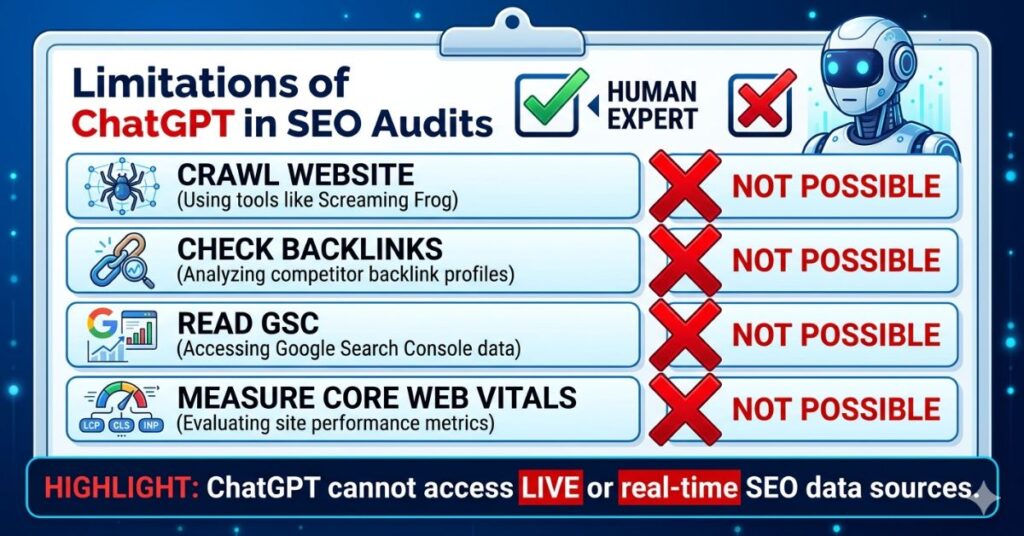
These are the tasks that define a genuine SEO audit and that ChatGPT has no ability to perform:
- Crawl your website: ChatGPT cannot access any live URL. It has no browsing capability integrated into a standard SEO workflow that would let it analyse your site’s page structure, internal linking, or content.
- Read your Google Search Console data: It has no access to your indexation status, search query data, crawl error reports, Core Web Vitals field data, or coverage reports.
- Check your actual keyword rankings: It cannot query search engines for current positions and has no access to rank tracking data.
- Analyse your backlink profile: It cannot see who links to your site, what your domain authority is, or what your competitors’ link profiles look like.
- Measure page speed or Core Web Vitals: It cannot access real-time performance data for any URL.
- Identify technical issues specific to your site: Without access to your site’s code, server configuration, or crawl data, any ‘technical SEO recommendations’ from ChatGPT are generic best practices, not findings specific to your website.
What ChatGPT Can Do to Support SEO
Despite its limitations for auditing, ChatGPT is genuinely useful for several SEO-adjacent tasks:
- Keyword brainstorming: Generate lists of potential keyword variations, question-based queries, and long-tail ideas from a seed term, though volumes still need to be validated in a real keyword tool
- Meta description and title tag drafts: Given a target keyword and page topic, ChatGPT can draft multiple title tag and meta description variants for review and testing
- Content outline creation: Produce logical structures for blog posts, service pages, and FAQ sections based on a topic brief
- FAQ generation: Create frequently asked questions for a given topic that can be validated against real People Also Ask data
- Schema markup templates: Generate JSON-LD schema markup templates for common types (FAQPage, LocalBusiness, Product) that still need to be validated in the Rich Results Test
- Content improvement suggestions: If you paste a piece of content and ask for suggestions, ChatGPT can identify readability improvements, missing topic areas, or structural recommendations, based on the content provided, not live SEO data
- Competitor content analysis: If you share competitor content manually, ChatGPT can help you identify gaps or angle differences, again, based on what you share, not autonomous research
Why Generic Advice Is Not the Same as an Audit
When you ask ChatGPT ‘how do I improve my website’s SEO?’ It produces a list of standard best practices: improve title tags, build backlinks, improve site speed, and create quality content. This is accurate general knowledge. It is not an audit.
An audit answers a completely different question: ‘What specific issues exist on this specific website that are preventing it from ranking, and in what order should they be fixed?’ That answer requires actual data, your crawl output, your Search Console coverage report, your current keyword positions, your backlink profile, and your Core Web Vitals scores.
The difference matters because generic advice may point a business toward work that is not actually the bottleneck for its specific site. A business with a technically clean, well-linked site and no local content needs to hear that its problem is content, not generic advice to ‘improve its title tags.’ Only a real audit produces that specific answer.
Plugins and AI Tools That Can Actually Interface with SEO Data
ChatGPT with certain plugins or integrations can do more than the base model, but it is important to understand what is actually happening:
- ChatGPT with web browsing enabled can read publicly accessible pages, so it could read the content of your homepage and provide feedback on what it sees. This is still not a technical SEO audit, but it is more useful than generic advice.
- ChatGPT with Semrush or Ahrefs integrations (available through some third-party setups) can retrieve live keyword and backlink data from those tools’ APIs. This is valuable, but if you are using Semrush or Ahrefs data through a ChatGPT interface, the SEO data comes from the tools, not from ChatGPT itself.
- Purpose-built AI SEO tools like Surfer SEO, Frase, and Alli AI are different from ChatGPT, they connect directly to live SEO data sources and perform genuine analysis within their specific scope.
Understanding which tool is providing which data prevents over-reliance on conversational AI outputs as substitutes for tool-based analysis.
The Right Role for ChatGPT in an SEO Workflow
Used correctly, ChatGPT genuinely saves time on SEO content tasks. Here is a practical workflow:
- Step 1: Use real SEO tools (Google Search Console, Screaming Frog, Ahrefs) to identify issues and opportunities, this is where the actual SEO data lives
- Step 2: Use ChatGPT to accelerate content production, drafting meta descriptions, generating content outlines, creating FAQ sections, or writing first drafts of blog posts
- Step 3: Validate ChatGPT outputs against real data, verify that suggested keywords have actual search volume, check that schema markup is error-free in the Rich Results Test, and edit content with human SEO knowledge
ChatGPT is a productivity multiplier for the content and communication tasks around SEO. It is not a replacement for the data tools that make SEO decisions defensible.
How SEO Specialist USA Conducts Real SEO Audits
SEO Specialist USA uses a professional audit process combining Google Search Console, Screaming Frog, Sitebulb, Ahrefs, Google Lighthouse, and GA4 to produce a comprehensive, data-driven picture of a website’s technical health, content performance, and off-page authority. Every finding is tied to real site data, not generic recommendations.
The audit output is a prioritised action plan specific to the website being audited, ordered by revenue impact, not by generic SEO best-practice checklists.