

To choose a reliable SEO company for your contracting business, ask for relevant client evidence, an audit of your website and Google Business Profile, a clear plan for your services and market, and reporting that connects search visibility with qualified inquiries. Confirm who will do the work, what it costs, and how you retain control of your accounts before signing.
A roofer taking emergency calls and a remodeler booking consultations may need different priorities. The agency should explain those differences using your business, rather than treating every contractor as the same customer. This guide gives you practical questions to compare proposals and spot claims that need evidence. For an overview of the work itself, read our guide to SEO services for general contractors.
The Contractor SEO Company Checklist
- Evidence: a relevant case study with dates, work completed, and measurement limits.
- Diagnosis: an audit that identifies your actual priorities.
- Local expertise: accurate Business Profile management and realistic service-area coverage.
- Useful pages: service and location content that helps customers evaluate your work.
- Measurement: qualified calls, quote requests, and booked work alongside search data.
- Control: access, ownership, fees, and exit terms documented in writing.
1. Ask for Relevant Results You Can Evaluate
Experience with contractors or home services can help an agency understand your sales process. It is useful evidence, but a specialist label alone proves little. A capable agency should explain why its previous work is relevant to your trade, market, and business model.
Ask for a starting point, a timeframe, the changes made, and the outcome measured. A screenshot of a number-one ranking leaves out the searcher’s location, the query, and whether the business received useful inquiries. Redacted reporting can still show the method without revealing another client’s private information.
- Was the client a residential contractor, commercial contractor, or emergency service business?
- Did calls increase, and how were duplicate callers, spam, and existing customers handled?
- Were paid ads, a new website, seasonal demand, or expanded staffing involved?
- Can the agency explain what it would do differently for your business?
A useful case study supports a conversation about decisions. It should not be presented as a guarantee that your business will get the same result.
2. Expect an Audit Before a Detailed Strategy
An initial price range can help you decide whether an agency fits your budget. A detailed plan, however, should follow a review of your website, local presence, competition, and lead handling. Ask which findings justify the proposed work.
- Business Profile: eligibility, ownership, accurate categories, address visibility, services, and reviews.
- Website: indexing, mobile usability, broken pages, navigation, service information, and working quote forms.
- Market: the services and locations you can profitably serve, supported by search and competitor research.
- Measurement: whether calls and forms are tracked correctly and whether your team can follow up.
The audit should distinguish urgent fixes from optional improvements. Confirm who implements changes and whether development, content, tracking tools, or listing fees cost extra.
Start With Your Contractor Website
Share your website, trade, service area, and goals with SEO Specialist USA. Ask what the free audit covers and which findings should be addressed first.
Request a Free SEO Audit3. Test Their Google Business Profile Expertise
Google Business Profile can be an important source of local discovery for eligible contractors. Its contribution varies by trade, market, query, and business. Do not assume Maps always produces more calls than your website, referrals, or other channels.
Ask the agency how it will keep your listing accurate. Categories should describe the business you actually operate, rather than act as a list of keywords. A contractor who visits customers and does not receive them at the business address should hide that address. Fake offices and extra profiles created solely to target nearby cities are warning signs.
Google’s Business Profile guidelines explain eligibility and representation. Its service-area guidance also distinguishes service-area and hybrid businesses. The proposal should reflect your actual operations.
Local ranking depends mainly on relevance, distance, and prominence. An agency can improve information and address issues, but it cannot remove the distance factor or buy better local placement. See Google’s explanation of local ranking.
Ask for a review process that invites genuine feedback without incentives or filtering requests to only happy customers. Photos and updates should show real work with permission, rather than fabricated projects.
4. Match Search Intent to Your Services
Useful keyword research begins with the work you want to win. A kitchen remodeler may need consultation inquiries, while a plumber may need urgent calls. An agency should connect query intent to a suitable page and a useful next step.
- Service searches: “kitchen remodeling contractor Austin” could lead to a page explaining the service, process, project examples, and consultation options.
- Budget research: “kitchen remodel cost” calls for a guide that explains scope, assumptions, and why estimates vary.
- Trust questions: license, insurance, and review queries need accurate credentials and verifiable evidence.
- Comparison searches: customers should be able to understand your specialties, coverage, and suitability for their project.
These are examples, not a fixed sequence every homeowner follows. Ask the agency to validate demand and inspect the actual search results. Avoid a plan built around high-volume terms for jobs you do not offer.
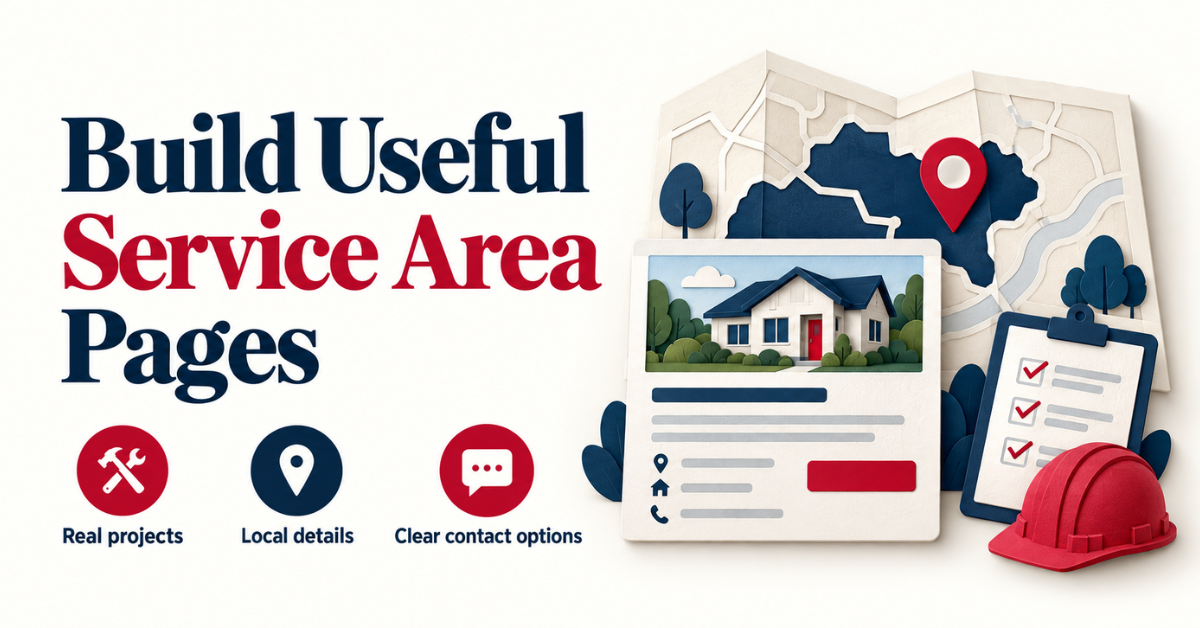
5. Build Service Area Coverage Without Duplicate Pages
A contractor serving several cities does not automatically need a page for every city-and-service combination. Start with your main services and priority markets. A separate location page makes sense when it gives visitors useful, distinct information.
For example, a remodeler could build a page for a city where it has completed projects. The page could explain the kinds of work offered there, show approved project photos, describe the consultation process, and clarify coverage. Local permitting information should be checked against the relevant authority and updated when needed.
Swapping city names across otherwise identical copy adds little value. Google’s spam policies identify doorway pages and low-value content created at scale as potential violations. Ask why each proposed page deserves to exist and how it fits the site’s navigation.
Location pages can support relevant website searches, but they do not guarantee Map Pack visibility throughout your territory. Listing a city in your Business Profile also does not guarantee rankings there. Evaluate the provider’s plan for your local SEO using customer usefulness and evidence, rather than a promised page count.
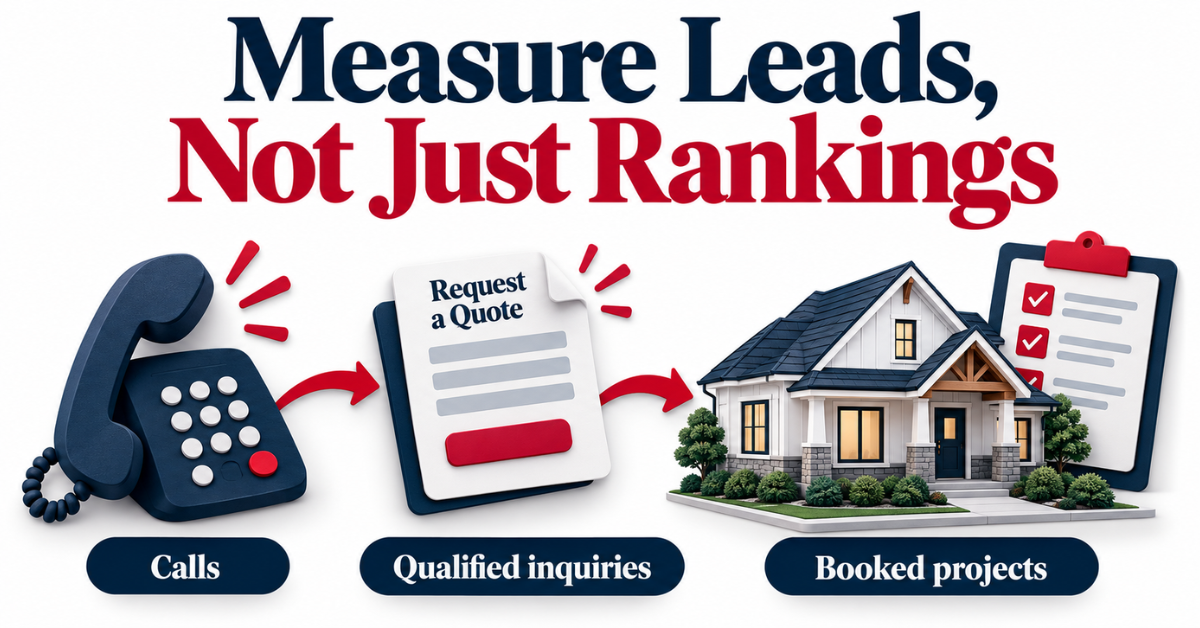
6. Separate Clicks, Calls, Qualified Leads, and Booked Work
Traffic and rankings help explain visibility, but they do not show whether the campaign is bringing suitable jobs. Ask for a reporting plan that follows the inquiry through your sales process.
- Search performance: relevant queries, impressions, clicks, and the pages customers reach.
- Contact actions: phone-link clicks, connected calls where available, and successfully submitted forms.
- Lead quality: the requested service, location, new versus existing customer, and whether the inquiry is qualified.
- Business outcomes: estimates issued, projects booked, and revenue where your records support it.
- Work completed: changes made, problems found, and next priorities.
A key distinction: Google Business Profile’s “Calls” metric counts clicks on its call button. It does not establish that a conversation happened or a project was booked. Profile performance may also include interactions related to Google Ads, so it should not automatically be labelled organic-only.
Call tracking can improve measurement, but one number alone does not identify every channel exactly. Ask how website sessions, profile calls, repeat callers, and attribution gaps are handled. Confirm costs and keep any tracking number under the business’s control. If recording is proposed, establish the appropriate consent and privacy process before enabling it.
Have the agency test your forms and explain what counts as a successful inquiry. A button click should not be counted as a completed quote request when the form failed. Your office’s missed calls and response times also affect the number of projects won.
7. Agree on Deliverables Without Ranking Guarantees
Ask for dates on work the agency can control: the audit, tracking checks, agreed fixes, page drafts, and reporting meetings. Separate those commitments from forecasts about rankings and lead volume.
There is no universal schedule for a contractor to receive more calls from SEO. Competition, the starting website, profile eligibility, seasonality, and implementation delays can all affect progress. A credible provider explains those assumptions and revises priorities when the evidence changes.
- Initial review: document the baseline, account access, main issues, and measurement gaps.
- Implementation: prioritize fixes and content based on impact, effort, and customer needs.
- Performance reviews: assess completed work and trends, account for seasonality, and decide the next priorities.
This is a planning framework, not a promise of results in a set number of weeks. Treat guaranteed number-one rankings or a guaranteed increase in calls as claims requiring close scrutiny.
8. Keep Account Control and Document the Handover
Your business should retain ownership and reliable access to its domain, website, Business Profile, Search Console, analytics, and other essential accounts. Give the agency the access needed for agreed work, without handing over your only route into those systems.
Keep primary ownership of the Business Profile. An agency will often be able to work as a manager; ask it to justify any broader role. Review content ownership, licenses, editable files, hosting arrangements, and number portability in the contract. Paid tools and licensed assets may have separate terms.
Changing managers does not inherently erase a profile’s reviews. The practical risk is losing access or facing a difficult handover. Agree on who removes access, exports reports, transfers files, and maintains the website when the engagement ends.
9. Ask for Content That Shows Your Actual Work
Useful contractor content answers the questions your customers ask. Project examples, clear service explanations, realistic budget guidance, and practical FAQs can help people decide whether to request an estimate.
- Project showcases: approved photos, the scope, challenges, and what your team actually delivered.
- Cost guides: dated estimates with assumptions, exclusions, and the factors that change the price.
- Service information: what is included, what is outside your scope, and how consultations work.
- Local guidance: verified information relevant to the areas you genuinely serve.
The agency should have a way to collect information from your team and get factual approval before publication. Avoid invented testimonials, credentials, project photos presented as real work, and generic claims that you are the best contractor in every city.
10. Compare Scope, Costs, and Communication
Ask who manages the account, who implements changes, and who writes or reviews content. Outsourcing is not automatically a problem; unclear responsibility is. Agree on response times, reporting frequency, and how urgent profile or website issues are handled.
Compare proposals using the same scope. Separate setup fees, monthly work, tracking software, development, paid advertising, and optional content. A low fee is not proof of poor work, and a high fee is not proof of expertise.
Review the commitment period, renewal terms, notice requirements, cancellation fees, and handover obligations. A longer agreement can be reasonable when the scope and exit terms are clear. The important question is whether you understand what you are buying and how accountability works.
What Review Statistics Can Tell You
BrightLocal’s 2026 Local Consumer Review Survey found that 97% of respondents read reviews for local businesses. The survey used a representative panel of 1,002 US adult consumers. This is evidence about local business review behavior, not a finding that 97% of homeowners search online before hiring a contractor.
Use research to inform your approach, but avoid turning broad consumer statistics into contractor-specific promises. There is no verified universal review count that guarantees a better ranking. Nor does a click-share percentage tell you how many qualified projects your business will win.
Red Flags That Deserve a Closer Look
- Ranking guarantees: ask how the agency can promise an outcome it does not control.
- Unexplained link packages: purchased links intended to manipulate rankings can violate Google’s link-spam policies.
- Mass-produced city pages: ask what distinct information each page provides and which genuine customer need it serves.
- Fake reviews or addresses: decline tactics that misrepresent your business or customer experiences.
- Unclear responsibilities: vague “optimization” fees leave you unable to judge what was delivered.
- Restricted account access: resolve ownership and handover before work starts.
Ask for explanations and evidence rather than rejecting an agency solely because it uses standard processes, subcontractors, or a longer contract. The concern is whether its work is useful, transparent, and consistent with the applicable guidelines.
Questions to Ask Before Signing
- Can you show a relevant case study and explain its measurement limits?
- What did you find in my website and Business Profile audit?
- Which services and markets would you prioritize, and why?
- What useful information would each proposed location page add?
- How will you distinguish contact clicks from qualified inquiries?
- Who implements the work, and what requires my approval?
- Which accounts and files will I control during and after the engagement?
- What is included in the fee, and what happens if I leave?
Write down the answers and compare them across providers. Specific explanations, documented responsibilities, and realistic expectations are more useful than a confident sales pitch.
Discuss Your Contractor SEO Needs With SEO Specialist USA
SEO Specialist USA offers local SEO services and a free SEO audit request. Share your trade, website, service area, and project goals so the team can discuss an appropriate scope.
Ask for relevant contractor examples and confirm whether Business Profile management, content, development, and call tracking are included in your proposal. Account ownership, fees, and contract terms should be confirmed in writing rather than assumed from a general service page.
You can contact the team or start a WhatsApp conversation to discuss your business.
Frequently Asked Questions
Should I choose a local agency or a national contractor SEO company?
Compare relevant experience, market research, responsibilities, and communication. Being nearby can help, but neither location nor a specialist label guarantees better results.
What should I pay for contractor SEO?
There is no single fee that fits every contractor. Request itemized proposals based on your services, market, website condition, and implementation needs. Compare included work and additional charges before comparing headline prices.
How long does it take to get calls from SEO?
There is no guaranteed timeframe. Agree on delivery milestones and review dates, then evaluate visibility and lead quality against a documented baseline. Ask what could slow implementation or affect results.
Do I need a page for every city I serve?
No. Create separate pages when they offer distinct, useful information for customers. Repeated city-name swaps are a poor substitute for genuine service coverage and project evidence.
Can I handle contractor SEO myself?
You can maintain accurate business information, collect genuine reviews, publish approved project examples, and improve service descriptions. More complex tracking or technical issues may justify specialist help. Decide based on your time, skills, and the work required.
Does a Business Profile call count prove someone called?
No. Google’s profile metric counts call-button clicks. Use appropriate call records and lead qualification to understand connected conversations and booked projects.
Compare a Plan Built Around Your Business
Start with your website, services, and goals. Request an audit and ask for a clear scope, practical priorities, and reporting you can use.
Request Your Free SEO Audit