

The most useful SEO services for general contractors usually combine an accurate Google Business Profile, strong service pages, genuine customer reviews, and a website that makes requesting an estimate easy. Add service-area content, project showcases, and relevant local links where they help customers evaluate your business.
The starting point should be your current bottleneck. If customers cannot find you, investigate local visibility and indexing. If they find you but do not contact you, review the page content, trust signals, and inquiry process. If the calls are for jobs you do not accept, improve service and territory information before chasing more traffic.
This guide explains what each contractor SEO service should deliver, which claims to question, and how to measure progress using suitable project inquiries rather than rankings alone.
Contractor SEO Priorities at a Glance
Technical and inquiry audit: Indexing checks, mobile usability, working calls/forms, and measurement. Pages are missing from search or inquiries cannot be tracked.
Google Business Profile: Accurate categories, contact details, services, and eligible address setup. Your local business information is incomplete or incorrect.
Core service pages: Clear scope, process, real project evidence, and estimate CTA. Visitors cannot tell whether you handle their project.
Review process: Consistent requests for honest reviews and professional responses. Completed projects rarely produce useful public feedback.
Service-area content: Relevant local information and genuine evidence of work. Customers need clarity about an important area you actually serve.
Project and planning content: Case studies and useful answers to buying questions. Customers need help assessing scope, budget, or project fit.
Relevant listings and links: Accurate profiles and legitimate professional relationships. Important business information or credible references are missing.
This is a decision framework, not a universal ranking of tactics. A broken contact form deserves attention before another blog post. An inaccessible service page deserves attention before an outreach campaign. Ask your SEO provider to explain the evidence behind its priorities.
Why General Contractors Need Specific SEO Content
A homeowner looking for a kitchen remodel has different questions from a property manager planning a commercial renovation. Your website should make the service, project type, working area, and next step clear.
Potential customers may search for a contractor by trade, project, location, or planning question. A practical strategy connects those needs to useful pages. It also helps visitors decide whether your company can take on their job, rather than attracting every possible construction-related search.
Trust deserves attention throughout the site. Show real completed work with permission, explain who manages projects, and display credentials that are current and applicable. Avoid inventing client stories, project values, or guarantees just to make the copy sound impressive.
1. Google Business Profile Optimization
For an eligible contracting business, a well-maintained Google Business Profile helps customers find accurate information in Search and Maps. It should reflect how the business actually operates.
- Choose the most accurate primary category and relevant additional categories for services you genuinely provide.
- Keep the business name, phone, website, hours, and service details accurate. Do not add keywords to the business name unless they are part of its real-world name.
- Use your actual service area. If customers are not served at your business address, follow Google’s requirements for hiding that address.
- Upload genuine project and team photos with appropriate permission. Use posts for useful updates, not as a promised ranking shortcut.
- Respond professionally to reviews and correct inaccurate profile information.
Google’s service-area guidance currently allows up to 20 areas and recommends an overall territory within about two hours of driving time from the business base. Do not create a separate profile for every city you serve or use a virtual office to imply a staffed location.
Google says local results are mainly influenced by relevance, distance, and prominence. Listing another city in your service area is not a guarantee that you will rank there. Similarly, a posting schedule should not be sold as a guaranteed boost to local positions.
2. Core Service Page Optimization
Give major, distinct services enough space to answer the questions a prospective customer needs answered. A kitchen-remodeling page, for example, can explain the types of projects accepted, the planning process, examples of finished work, and how to request an estimate.
- Scope: what you do, what is excluded, and the types of properties or projects you handle.
- Process: how consultation, planning, scheduling, and communication work. Explain what affects timelines instead of promising one duration for every project.
- Evidence: genuine project photos, relevant testimonials, and verifiable credentials.
- Location: the actual working area and any practical service limitations.
- Next step: a clear call button or inquiry form that explains what information to provide.
Use descriptive titles and headings that sound natural. There is no required 600- or 800-word minimum for a service page. Google’s people-first content guidance emphasizes usefulness rather than writing to an assumed preferred word count.
Photographs should describe work you actually completed. Write alt text that explains the image, such as a finished kitchen with custom cabinets, rather than repeating a city and keyword in every image. Clearly label illustrations so they are not confused with a real project portfolio.
Frequently asked questions can help visitors compare options, but FAQ markup does not guarantee a featured snippet. Google’s documentation updates state that FAQ rich results stopped appearing in Search in May 2026. Keep FAQs because the answers help readers.
3. Service-Area Pages That Offer Real Value
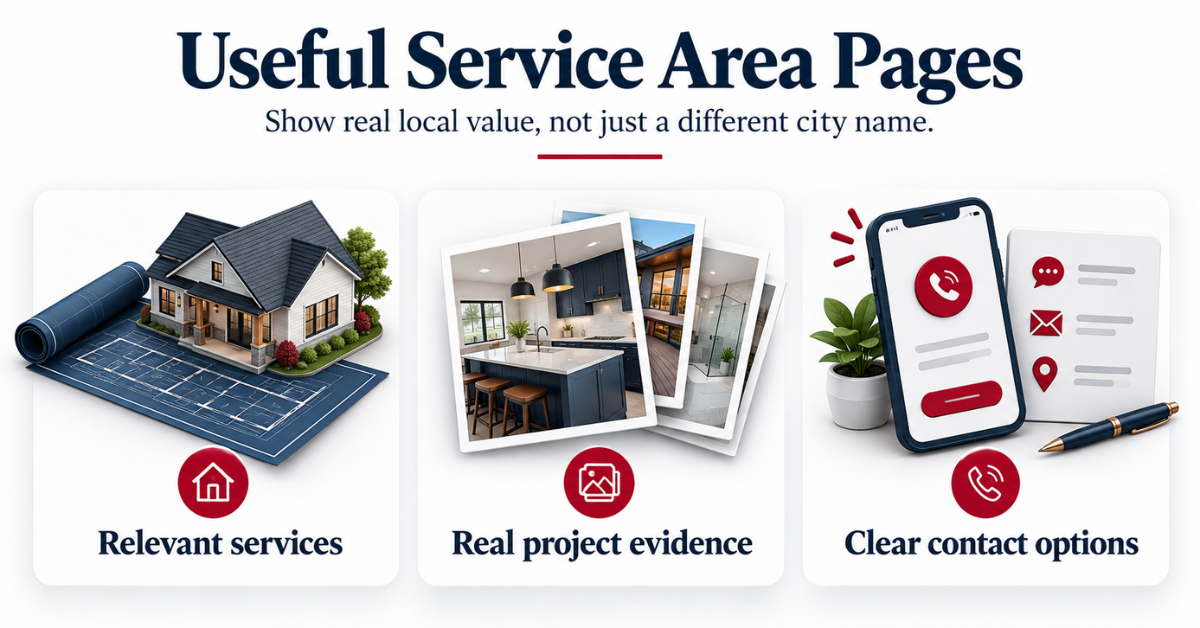
A separate area page is useful when it helps customers understand your service in that location. It should not exist simply to replace one city name with another. A clear service page and an honest coverage page may be sufficient when you do not have meaningful local information to add.
Prioritize important areas that you actually serve and can discuss with useful detail. That might include genuine nearby projects, the service scope available there, travel or scheduling constraints, and questions customers from the area ask. Verify any local permit or building-code information with the relevant authority before publishing it.
- Explain which services you provide in the area and who the page is for.
- Show relevant completed projects where available, without inventing locations or customer details.
- Add real local considerations when they affect the project. Listing landmarks alone does not make a page useful.
- Provide a direct inquiry route and link to the relevant service and project pages.
- Use a clear navigation structure so customers can browse the content.
Do not multiply the number of cities by the number of services and treat the result as a page target. Google’s doorway and scaled-content policies address pages created primarily to manipulate search rankings with little value. Useful coverage should determine the page count.
4. A Genuine Review Request and Response Process
Reviews help customers evaluate a contractor’s communication, reliability, and finished work. Google says more reviews and positive ratings can help local ranking, but there is no universal review count that guarantees a position.
- Invite customers consistently to share an honest account of their experience.
- Provide a simple direct review link where the platform permits requests.
- Do not offer discounts, gifts, or payment in exchange for reviews.
- Do not ask only happy customers to post publicly while routing unhappy customers elsewhere.
- Reply calmly and professionally. Avoid revealing private project or customer information.
- Report suspected policy violations through the platform’s reporting process.
Google’s Maps content policy prohibits incentivized reviews and selective solicitation of positive reviews. Requests should also follow each platform’s own rules; a process suitable for Google is not automatically suitable for every directory.
Testimonials displayed on your site should remain accurate and be used with permission. Do not assume that adding review markup to your own business testimonials will produce stars in Google results.
5. Technical SEO and a Working Inquiry Experience
Technical SEO should remove barriers to finding and using the website. It is most useful when paired with checks of the actions a customer needs to take.
- Confirm that important service pages are accessible, indexable, and linked from the site.
- Check broken links, redirects, canonical tags, and accidental noindex settings.
- Resize and compress large project images and use suitable formats without making the work hard to see.
- Review mobile navigation, readable text, and easy-to-tap call buttons.
- Test inquiry forms, confirmation messages, and delivery to the intended recipient.
- Use HTTPS consistently and fix mixed-content problems.
- Check structured data against visible business information.
Relevant LocalBusiness structured data can help describe the business. It is not a substitute for accurate pages and an eligible Business Profile. Do not invent an office, address, reviews, or geographic coordinates to make the markup look more complete.
A useful audit ends with priorities, owners, and a way to verify completed fixes. Ask whether the SEO proposal includes implementation or only recommendations, especially when development and form changes are needed.
Find the Gaps Before Adding More SEO Work
Request a free SEO audit from SEO Specialist USA and discuss your website, Business Profile, services, and territory. Ask what the review will cover and which fixes require implementation.
Request Your Free SEO Audit6. Accurate Listings and Relevant Local Links
Maintain the business information customers need on relevant platforms. Start with profiles your prospects actually use, then consider appropriate trade associations, supplier directories, and local business organizations. Check eligibility, fees, and lead-generation terms before joining.
Correct meaningful errors such as an old phone number, outdated address, wrong business name, or broken website link. Do not assume that harmless formatting differences such as Street versus St. automatically cause a ranking penalty. Consistency should make it easy to identify and contact the same business.
Links from genuine supplier relationships, association memberships, and editorial coverage can help people discover your work. Focus on relevance and legitimacy. Avoid purchased ranking links, low-quality directory packages, and excessive reciprocal link schemes. Paid sponsorship links should be appropriately qualified.
7. Project Showcases and Helpful Planning Content
The best content gives prospective customers information they cannot get from a generic service list. A project showcase can explain the original problem, agreed scope, constraints, materials, and result, using actual facts and approved photographs.
Planning guides can address budgeting, preparation, disruption, and how to compare estimates. If you publish costs, say what the figures cover, where they apply, when they were updated, and what changes them. Use documented project information or credible current sources; do not turn a national average into a promised local quote.
Content need not follow a rigid publishing quota. Improve important existing pages first when they leave customer questions unanswered. Publish a new guide when you have a useful answer and a sensible place for it in the site.
Map Contractor Keywords to the Right Pages
general contractor near me: Find a nearby contractor. Clear business and service information, supported by an accurate profile.
kitchen remodeling contractor [city]: Compare a service in a location. Relevant service page or useful area page.
home addition cost: Understand budgeting. Sourced guide explaining scope and cost drivers.
commercial renovation contractor: Find the right project capability. Commercial service page with genuine project evidence.
questions to ask a remodeling contractor: Evaluate providers. Practical checklist and clear process information.
These are keyword-pattern examples, not measured search volumes or guaranteed conversion rates. Use your Search Console data, customer questions, and relevant research to decide which topics deserve attention. You do not need to repeat near me awkwardly in page copy.
Measure Qualified Project Inquiries, Not Just Traffic
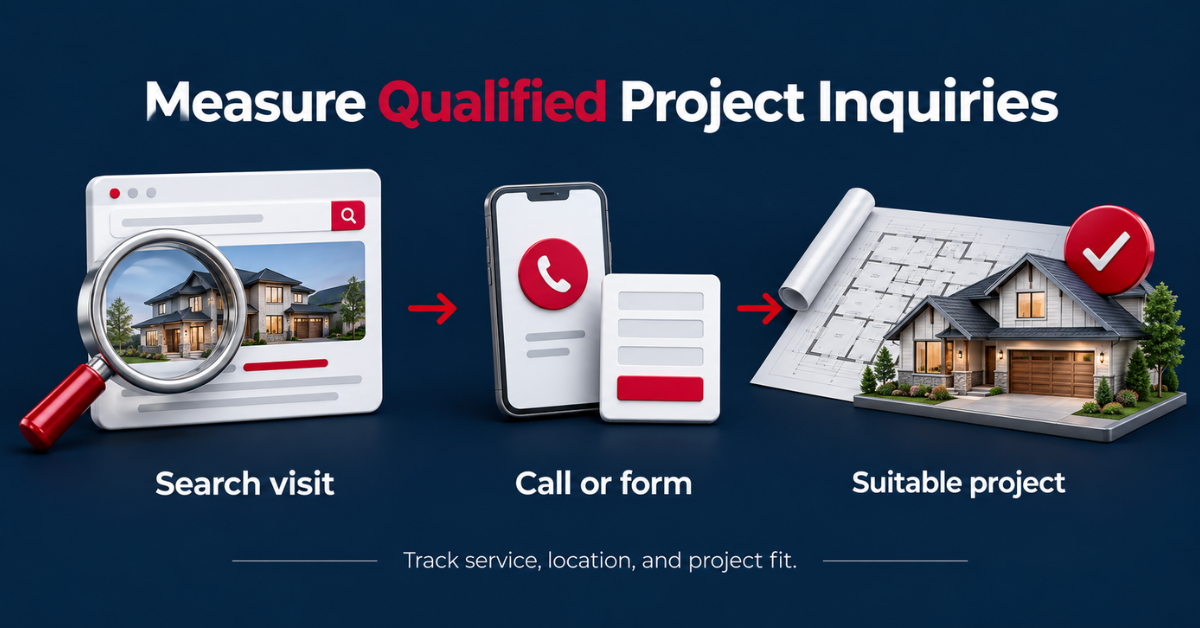
For a contractor, more visits are not automatically better. Track whether inquiries come from areas you serve and involve work you accept. Separate suitable project inquiries from spam, job applications, supplier calls, and requests outside your scope.
- Use Search Console to review relevant queries and page visibility.
- Review Business Profile interactions and website traffic without treating every interaction as a completed lead.
- Track completed inquiry forms and calls where the setup supports it. A click on a phone link is not proof of a completed conversation.
- Record the requested service, location, and project fit in your intake process.
- Review estimate opportunities and booked work alongside the marketing data, allowing for the sales cycle and seasonality.
For example, 12 inquiries with 8 suitable projects may be more useful than 30 inquiries with only 3 suitable projects. These are illustrative numbers, not client results. A useful report explains the completed work, the relevant outcomes, and the limits of attribution.
How to Choose Contractor SEO Services
Ask for a plan based on the site and market rather than a package of unexplained tasks. You should know what is included, who implements changes, what access is required, and how progress will be reviewed.
- What evidence supports the proposed priorities?
- Will you improve existing pages before creating new ones?
- How will area pages avoid duplicated or thin content?
- What review-request methods will you use?
- Are content, development, reporting, and call tracking included?
- Who owns the accounts and content, and what are the cancellation terms?
- How will you report qualified inquiries and distinguish them from raw clicks?
Question fixed ranking deadlines, guaranteed call volumes, and promises to rank across every city after changing service-area settings. The provider can commit to deliverables and communication; search positions and customer decisions remain outside its control.
How SEO Specialist USA Can Help
SEO Specialist USA offers local SEO services and SEO audits. A contractor can use an initial review to discuss visibility gaps, service-page content, technical issues, and the inquiry experience.
Share your website, Business Profile, working area, and the types of projects you want. Ask for a written scope with priorities, implementation responsibilities, reporting, and terms. Confirm any account ownership, automation, or content-production arrangements in the proposal rather than assuming every engagement includes the same services.
You can contact the team or start a WhatsApp conversation to discuss the next step.
Frequently Asked Questions
What is the best SEO service for a general contractor?
The best starting point depends on the main problem. An accurate Business Profile and useful service pages are often important, but indexing issues or a broken inquiry process may need attention first. Choose services based on an audit and your business goals.
How many service-area pages should a contractor create?
Create only the pages that provide meaningful information for customers in areas you actually serve. There is no city-by-service formula or required page count. A strong service page and coverage page may be better than many near-identical pages.
Does adding a city to my Business Profile make me rank there?
It describes your working territory; it does not guarantee a position. Google’s local results also consider relevance, distance, and prominence. Keep the service area accurate and avoid implying an office where you do not have one.
How long does contractor SEO take?
Timelines vary with the starting point, competition, and work required. A provider should give dates for agreed deliverables and performance reviews. It should not guarantee first-page rankings or a fixed number of inquiries by a particular month.
Do contractors need a blog?
Not necessarily. Service information, project evidence, and a working contact process may be the higher priorities. Publish planning guides and project stories when you have useful information that supports a real customer need.
Can a contractor improve SEO on a limited budget?
Yes. Start by correcting business details, clarifying important service pages, requesting honest feedback, and checking calls and forms. Prioritize the biggest gaps and confirm who can implement technical recommendations before buying more services.
Discuss SEO for Your Contracting Business
Start with a free audit request and a conversation about your services, territory, and website. A clear diagnosis helps you decide which SEO work belongs first.
Request Your Free SEO Audit