

When choosing an on-page SEO service, look for a page-specific audit, a written scope, useful content recommendations, safe implementation, and reporting that connects the work to search visibility and business results. Ask the provider to explain which pages need attention, why those pages matter, what they will change, and how you will judge progress.
A proposal that says “optimize titles and add keywords” leaves too much unanswered. A better proposal explains whether your pages help the right visitors, whether the site is comfortable to use, and who will fix the problems the audit finds. This guide gives you a practical checklist for comparing providers before you commit.
What to Check Before Hiring
- Evidence: relevant client examples with dates, page-level data, and limitations.
- Scope: a named set of pages, deliverables, revision limits, and implementation responsibilities.
- Content: recommendations based on customer needs and search intent, with a plan for factual review.
- Experience: checks for mobile usability, images, performance, and contact or checkout paths.
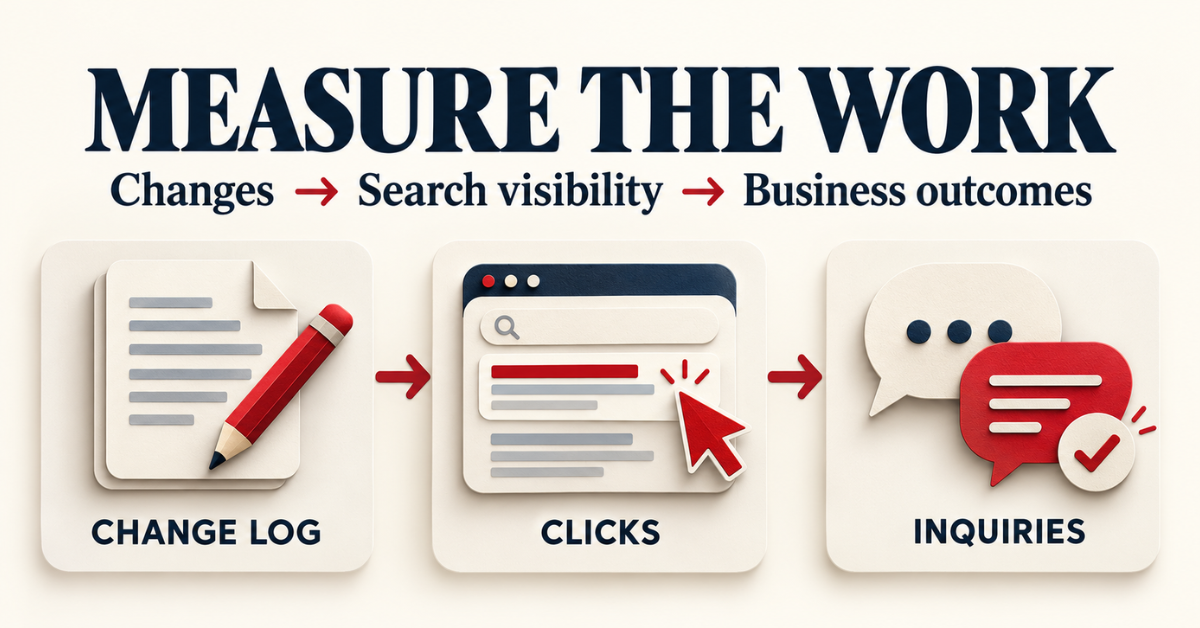
- Measurement: a baseline, a change log, and agreed measures such as clicks, qualified inquiries, or sales.
- Ownership: access to your accounts, copies of the work, and clear terms for ending the engagement.
What Does an On-Page SEO Service Include?
On-page SEO improves the content and elements of individual pages: titles, headings, descriptions, internal links, images, and relevant structured data. Services often overlap with technical SEO when they review loading performance, mobile behavior, indexing, or templates. The boundary varies between providers; the contract matters more than the label.
For example, an agency may identify a slow hero image but expect your developer to change the theme. Another may include that implementation. Neither arrangement is automatically wrong. You need to know whether you are buying recommendations, completed changes, or both.
1. Ask for an Audit and a Prioritized Page List
The provider should inspect your website before proposing a long list of edits. Ask for a sample finding that names a URL, describes the problem, explains its likely impact, and recommends a next step. “Improve content” is too vague to budget or review.
Priorities should reflect your business. A service page that gets relevant impressions but few inquiries may deserve attention before an old blog post with little commercial relevance. A broken contact form or an accidentally excluded page may need attention before a title rewrite. Ask how the provider distinguishes urgent issues from optional refinements.
- Which pages will you work on first, and why?
- What information do you need from our sales, product, or support team?
- What will you leave out of this project?
- Which findings need a developer, designer, or subject specialist?
For a starting point, request a free SEO audit from SEO Specialist USA. Confirm which pages the review covers and whether implementation is included before agreeing to a paid scope.
2. Compare Deliverables, Not Package Labels
Ask each provider to price the same page list and describe what will be delivered. A cheaper audit can cost more overall if writing, implementation, and follow-up are all separate. A larger package can be poor value if it spends time on pages that do not matter to your customers.
- Titles and descriptions: original and proposed versions for each agreed URL.
- Headings and content: recommended edits, reasons for them, and who writes and approves the copy.
- Internal links: relevant source and destination pages, with useful anchor text.
- Images: appropriate dimensions, compression, meaningful filenames, and suitable text alternatives.
- Structured data: the proposed type, current Google support, validation, and monitoring responsibilities.
- Performance and usability: documented issues, agreed fixes, and checks after deployment.
- Reporting: delivery dates, a change log, baseline data, and a follow-up review.
Also specify how many pages are included, how template changes count toward that total, how many revision rounds you receive, and what happens when the audit uncovers work outside the quote. These details make proposals comparable.
3. Check How They Match Content to Search Intent
Search intent is the task behind a query. Someone searching “how to tile a bathroom” needs instructions. Someone searching “bathroom tile installer near me” is likely looking for a local service. Someone comparing tile materials needs help weighing options. Those visitors need different information and next steps.
Ask the provider to explain the target audience and purpose of a page before recommending keywords. Reviewing current search results can help reveal common formats and competing answers, but copying the format of the top result is not a complete strategy. Your page still needs to represent what your business actually offers.
Example: a tile-installation service page may need a clear service area, project examples, preparation details, and an easy estimate request. Adding a long DIY tutorial could distract people who want to hire an installer. A separate guide may serve that educational need better.
Ask what a visitor should be able to understand or do before leaving the page. The answer should guide the content and CTA.

4. Look for Content Review Beyond Keyword Placement
Choose a provider who checks whether the copy is accurate, clear, and useful. Ask how they find unanswered customer questions, outdated specifications, unsupported claims, and unnecessary repetition. More text is not automatically better; the page needs enough detail to help its intended visitor.
Google’s helpful content guidance emphasizes trustworthy, useful information. E-E-A-T describes experience, expertise, authoritativeness, and trustworthiness; it is not a single ranking factor or a score an agency can switch on. Real examples and accurate author information can support trust, while invented credentials or client results undermine it.
Ask who checks facts before publication and who approves claims about your business. If the provider uses AI to assist writing, request human review for accuracy, originality, and usefulness. The deliverable should reflect your knowledge and customers, rather than repeat generic material from competing pages.
5. Expect Keyword Estimates and Sensible Page Mapping
Keyword research tools estimate demand; they do not reveal an exact, independently verified count of every search. Google Keyword Planner’s historical metrics, for example, use averages and depend on the selected location, period, and network. Ask the provider to name the tool, date, geography, and assumptions behind its recommendations.
A keyword-to-page map should explain which page serves each topic and why. Consider relevance, visitor intent, competition, and commercial value alongside estimated volume. A specific phrase with a small estimate can still attract valuable prospects. A large-volume phrase can be a poor target if your business cannot satisfy that search.
Similar topics on two pages do not automatically create a problem. Ask whether the pages serve distinct purposes or compete unnecessarily for the same task. Consolidation, rewriting, or clearer internal links may be appropriate, but deleting pages purely because keywords overlap is too simplistic.
6. Test Their Knowledge of Titles, Links, and Schema
An informed provider should explain what each change is for without presenting every recommendation as a guaranteed ranking boost. Use the following checks in your interview.
Titles and meta descriptions
Titles should describe the page clearly and avoid repeated keywords. Google has no fixed title character limit; displayed titles can be shortened to fit the device and may be generated from other page text. See its title-link guidance. Treat a 50–60-character target as an editorial aid, not a ranking requirement.
Meta descriptions help summarize a page for searchers. Google has stated that it does not use the description meta tag in ranking. Google can instead select text from the page to answer a particular query, as its snippet documentation explains. A well-written description is useful, but neither a CTR increase nor use of that exact description is guaranteed.
Headings and internal links
Headings should help readers scan and understand the page. A clear main heading and logical subheadings are good usability practices, not a formula that guarantees positions. Internal links should connect relevant pages and describe their destinations. Google’s link guidance recommends descriptive, natural anchor text; vary wording when it helps readers, rather than forcing an arbitrary anchor-text ratio.
Structured data
Structured data describes page information in a machine-readable form. Depending on the supported type and eligibility rules, it can enable rich-result features. It should match visible content and be validated; Google does not guarantee display even when markup is correct. Ask the provider to show the current documentation for the proposed feature.
Current availability matters: Google ended FAQ rich results in May 2026 and removed their documentation in June, according to its documentation changelog. Do not buy FAQ markup on the promise that it will expand your Google listing. You can still publish useful FAQs for readers.
7. Include Core Web Vitals and Real Usability Checks
Google confirms that Core Web Vitals are used by its ranking systems, but good scores do not guarantee high rankings. Its page experience guidance also recommends considering the overall experience instead of chasing a perfect score.
- LCP — loading: a good result is two and a half seconds or less.
- INP — responsiveness: a good result is 200 milliseconds or less.
- CLS — visual stability: a good result is one tenth or less.
These Core Web Vitals thresholds are assessed at the 75th percentile of real page experiences, separately for mobile and desktop. Ask whether the report uses field data, lab tests, or both. A single test cannot represent every visitor, and some pages do not have enough field data for a reliable result.
The provider should also check the page on a phone: can visitors read the text, use the navigation, and complete the intended action? Do overlays cover the content? Do images and buttons fit the screen? Performance metrics will not identify every frustrating interaction. Agree who will resolve theme or plugin issues and retest them after changes.
8. Evaluate Client Evidence Without Confusing Correlation With Cause
Ask for examples relevant to your website type and business goal. A useful case study identifies the pages, dates, changes, starting point, and observed results. With client permission, anonymized Search Console screenshots or a walkthrough can help you understand the work.
Before-and-after data does not prove that one title edit caused a ranking increase. Updates, seasonality, competitors, links, and other website changes may contribute. A credible provider explains those limitations and distinguishes observations from conclusions.
Be cautious with universal traffic statistics. Ahrefs reported that approximately 97% of pages in its Content Explorer index had no estimated Google search traffic in its 2023 study of roughly 14 billion pages. Ahrefs notes that the sample is not the entire web and its traffic figures are estimates. The finding does not establish that weak on-page SEO caused all those pages to receive no traffic.
9. Agree on Reporting and Business Outcomes
Start with baseline data for the pages in scope. Record when changes go live and compare suitable periods by page, query, device, and market where the data allows. Include relevant seasonal context. An average ranking alone can hide what is happening across different queries.
- Work delivered: changes, approvals, deployment dates, and outstanding dependencies.
- Search visibility: impressions, clicks, CTR, and average position for the relevant pages and queries.
- Visitor outcomes: qualified inquiries, purchases, bookings, or another agreed conversion.
- Experience: performance and usability findings, fixes, and remaining issues.
- Next steps: what the evidence suggests, what remains uncertain, and the next priority.
Check conversion tracking before relying on the numbers. A recorded form event is not always a qualified inquiry, and a phone-link click is not necessarily a connected call. Your sales or customer records can help connect website activity to actual outcomes.
Do not accept a guaranteed result within a fixed number of weeks. Google says recrawling can take days to weeks, and a crawl request does not guarantee indexing. Agree a review schedule, but distinguish the delivery deadline from the time needed to observe meaningful results.
10. Set Approval, Ownership, and Exit Terms
Keep control of your domain, website, Search Console, and analytics accounts. Give the provider the access needed for the work, and define who approves content, URL changes, redirects, or template edits. Ask for backups and a rollback plan before significant changes are deployed.
Your agreement should explain who owns new copy and media, where reports are stored, how additional work is approved, and what is handed over if you leave. Avoid arrangements that make your website dependent on an account you cannot access.
A one-time project can suit a defined set of pages with clear fixes and an internal team to maintain them. Ongoing work can suit a changing product catalog or regular publishing. Choose a retainer because there is a recurring task and a useful review process, not simply because every page supposedly needs rewriting every month.
A Shortlist Checklist You Can Use
- Can the provider explain one real issue on our website and how to address it?
- Does the proposal name the pages, deliverables, owner of each task, and exclusions?
- Can we review copy and technical changes before deployment?
- Do case studies include dates, context, and limitations?
- Will reports cover business outcomes as well as search metrics?
- Do we retain our accounts and receive a complete handover?
- Are they avoiding ranking guarantees, keyword stuffing, fabricated reviews, and bulk low-value pages?
Google’s guide to hiring an SEO is a useful reference when assessing proposals. Its spam policies describe practices such as keyword stuffing, link spam, and scaled content abuse. Ask a provider to explain its methods before work starts; “Google-approved agency” or a guaranteed number-one position should invite closer scrutiny.
Discuss Your On-Page SEO Priorities With SEO Specialist USA
You can review our on-page SEO services and, if you want help deciding which pages to improve first, request a free SEO audit. Share your website, priority products or services, target audience, and the action you want visitors to take.
Before starting a paid project, confirm the pages in scope, who implements the recommendations, the reporting arrangement, and any work requiring a developer. You can contact SEO Specialist USA or start a WhatsApp conversation to discuss those requirements.
Frequently Asked Questions
What should I consider when choosing an on-page SEO service?
Compare relevant evidence, a written page-level scope, content quality, implementation responsibilities, usability checks, reporting, and account ownership. Ask the provider to explain the first priorities for your website and how success will be measured.
Are meta descriptions a ranking factor?
Treat them as summaries for searchers, not a direct ranking lever. Google may use a description or generate a different snippet from page content. Clear descriptions can help visitors understand an offer, but a particular display or click-through rate is not guaranteed.
Does schema guarantee better rankings or rich results?
No. Relevant structured data can help Google understand the page and make it eligible for supported search features. Eligibility, policy compliance, and validation do not guarantee display or a ranking improvement.
Should an on-page SEO service fix Core Web Vitals?
It should explain whether assessment and implementation are included. Some fixes require development work beyond a content-focused package. Ask for a named owner, an estimate, and a retest rather than an unexplained performance score.
How long does on-page SEO take to work?
There is no universal timeline. Changes must be deployed and processed, and results depend on demand, competition, and other signals. Agree delivery dates and reporting intervals, and avoid treating a promised ranking deadline as evidence of quality.
Do I need ongoing work after a one-time audit?
That depends on what changes on your website and who maintains it. A stable set of pages may need periodic review rather than a monthly rewrite. Frequent publishing, new products, or recurring technical problems can justify continued support with specific deliverables.