

You need SEO for your website when customers search for what you offer and you want to reach them through organic results. The work you need depends on your online visibility, competition, and business goals. You might need basic improvements, a focused project, or ongoing support rather than a full campaign.
A website can look polished and still be difficult to find. It can also attract plenty of visitors without producing useful inquiries. Those situations need different responses. Before choosing SEO services, work out where people are dropping out of the journey from search to becoming a customer.
Key Takeaways
-

Relevant search demand and your growth goals should guide the decision to invest in SEO.
-
Separate visibility problems from weak targeting, broken forms, or an unclear offer.
-
Needing SEO doesn’t automatically mean you need a monthly agency contract.
-
Choose technical, local, on-page, or content work after checking the evidence.
-
Measure qualified enquiries, customers, and costs alongside rankings and traffic.
Does Every Website Need SEO?
Public business websites benefit from clear content and a technical setup that search engines can access. SEO, or search engine optimization, helps search engines understand those pages and helps people discover them. How much effort to invest depends on the website’s purpose.
A local electrician looking for more repair jobs has a different need from a private client portal or a portfolio used only during direct sales conversations. The electrician may need to compete for service searches. The portal may intentionally keep its content out of public search altogether.
Your website can appear on Google without hiring an agency. Basic optimization may already be part of a well-built site, and owners can handle some improvements themselves. Google’s guidance on hiring an SEO makes that distinction clear. Paying for Google Ads doesn’t buy better organic rankings.
How Can You Tell if Your Website Needs SEO?
Look for a gap between the customers you want and the people your website currently reaches. Search Console can show queries, impressions, clicks, and page performance. Your inquiry records and analytics help you understand what happens after a visit. Use both before deciding what needs fixing.
What you notice | What to check first | Possible next step |
|---|---|---|
People find only your business name | Queries for relevant services or products | Review targeting and important pages |
An important page isn’t appearing | URL Inspection and indexing status | Investigate technical access |
Nearby competitors appear more often | Business Profile and local service coverage | Assess local SEO |
Visits increase but enquiries don’t | Traffic relevance, forms, and tracking | Diagnose targeting or conversion |
Results fell after a redesign | Changed URLs, redirects, and content | Review the migration |
These symptoms suggest where to investigate. They don’t establish a cause on their own. A seasonal business, for example, may receive fewer searches even when its website hasn’t changed.
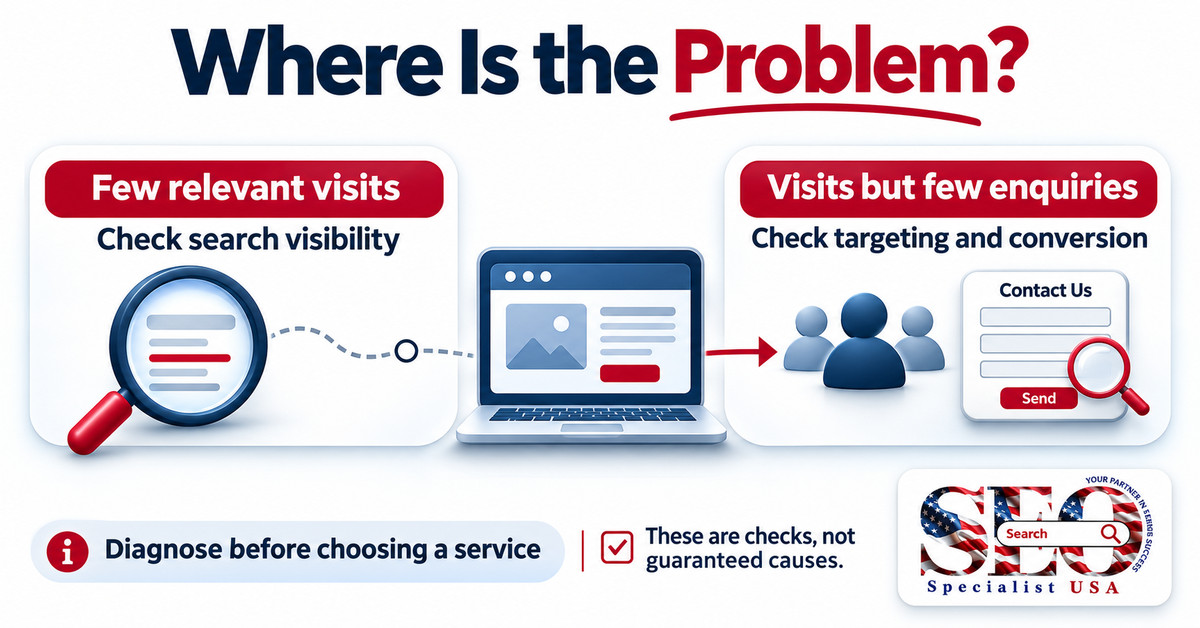
Start with the symptom, then check the evidence behind it.
Are New Customers Finding You or Only People Who Know Your Name?
Branded searches include your company name.
Non-branded searches describe a need, such as roof inspection in Austin.
If most clicks come from your brand name, search may be helping existing contacts reach you while contributing little to new customer discovery.
Review the services, products, and locations that matter to the business.
Look at the impressions and clicks those pages receive for searches that matter to your business.
A roofing company appearing for general DIY questions may still be missing homeowners looking to book an inspection.
More traffic wouldn’t necessarily solve that mismatch.
Can Google Access Your Important Pages?
Use Search Console’s URL Inspection tool to investigate a specific page. An indexing problem needs a different response from a page that’s indexed but competes poorly for useful searches.
Check for accidental noindex settings, inaccessible pages, or problems introduced during a website move.
Don’t assume every excluded URL is a fault. Tracking variations and duplicate addresses may not need their own place in search. Focus on the pages you actually want potential customers to discover.
Are Visitors Reaching the Right Pages and Taking Action?
If traffic is steady but leads have fallen, test the contact form, phone links, and booking process. Confirm that tracking still records enquiries correctly. Then review the landing page: does it clearly explain the service, availability, and next step?
A visitor who wants emergency repair may leave a general information article because it doesn’t help them book. That’s a targeting issue. A visitor who completes a broken form has an access problem. Neither finding justifies ordering more blog posts without further investigation.
When Should SEO Be a Priority and When Can It Wait?
Prioritize SEO when relevant customers search for your offering, you want more of that business, and you can support the work long enough to assess progress.
A large ongoing campaign may be premature if other problems prevent the business from serving or converting those customers.
Prioritize Search When It Supports a Clear Growth Goal
SEO deserves attention when important service pages aren’t reaching prospective customers, you’re entering a new market, or you want to build another source of demand alongside referrals and advertising. Before a launch or redesign, an SEO review can also help preserve useful content and existing search visibility.
Define the goal specifically. Attracting more inspection enquiries within your service area gives the work a clearer direction than increasing traffic across the whole website.
Start With Basic Improvements When Your Needs Are Limited
A small website may first need accurate business details, useful service pages, sensible internal links, and working contact options. Eligible local businesses should also keep their Google Business Profile complete and current.
If you’re already receiving enough suitable work, the priority may be maintenance and monitoring. You can revisit the scope when your capacity or growth goals change. A limited need doesn’t require a broad campaign simply because competitors have one.
Fix Other Obstacles Before Expanding the Campaign
An unclear offer, poor customer experience, or lack of capacity can limit the value of additional visitors. Fix broken enquiry paths promptly. If you need revenue immediately, evaluate faster ways to reach customers rather than relying on a new organic campaign to deliver on a short deadline.
For an unfamiliar product, research the problems and alternatives customers already search for. Little demand for the product’s name doesn’t necessarily mean there’s no relevant search opportunity.
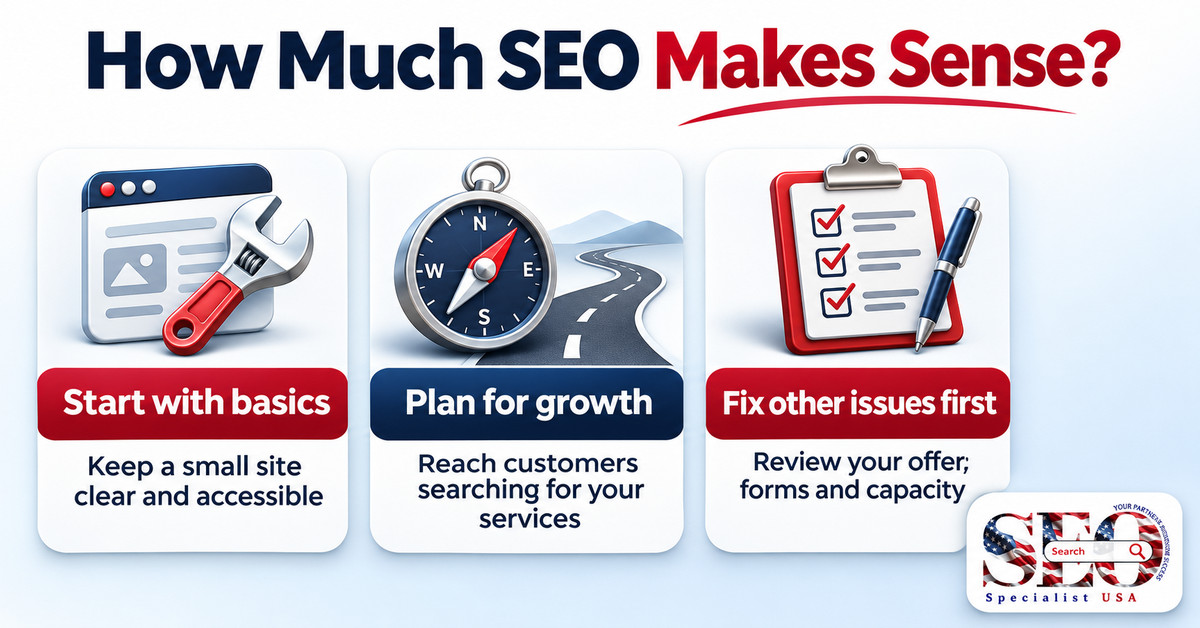
Match the scale of the work to the business’s current needs.
What Type of SEO Help Does Your Website Need?
The appropriate service follows the diagnosis. A site with indexing barriers needs different work from one with incomplete service information.
SEO Specialist USA offers several types of support, so the starting point should be the obstacle rather than a preset volume of tasks.
Finding | Relevant support | What the work should address |
|---|---|---|
The main problem is unclear | SEO audit | Evidence, priorities, and a practical next step |
Important pages face access or indexing barriers | Technical SEO | Crawlability, indexing, and site structure |
Existing pages poorly explain their subject | On-page SEO | Titles, headings, content, and internal links |
Customers’ useful questions aren’t covered | SEO content creation | Intent research and helpful page content |
Nearby searches aren’t reaching the business | Local SEO | Local pages, listings, and Business Profile information |
Store pages miss relevant shoppers | Ecommerce SEO | Product and category discovery |
For example, technical SEO services can investigate access and infrastructure issues. Local SEO addresses visibility around the places you serve. Content creation services can help when important information is missing or poorly matched to customer questions.
These areas can overlap. An audit helps establish priorities so you can focus your budget on the work your website needs.
Need help choosing the right SEO service? Share your website and main business goal with SEO Specialist USA to discuss a suitable starting point.
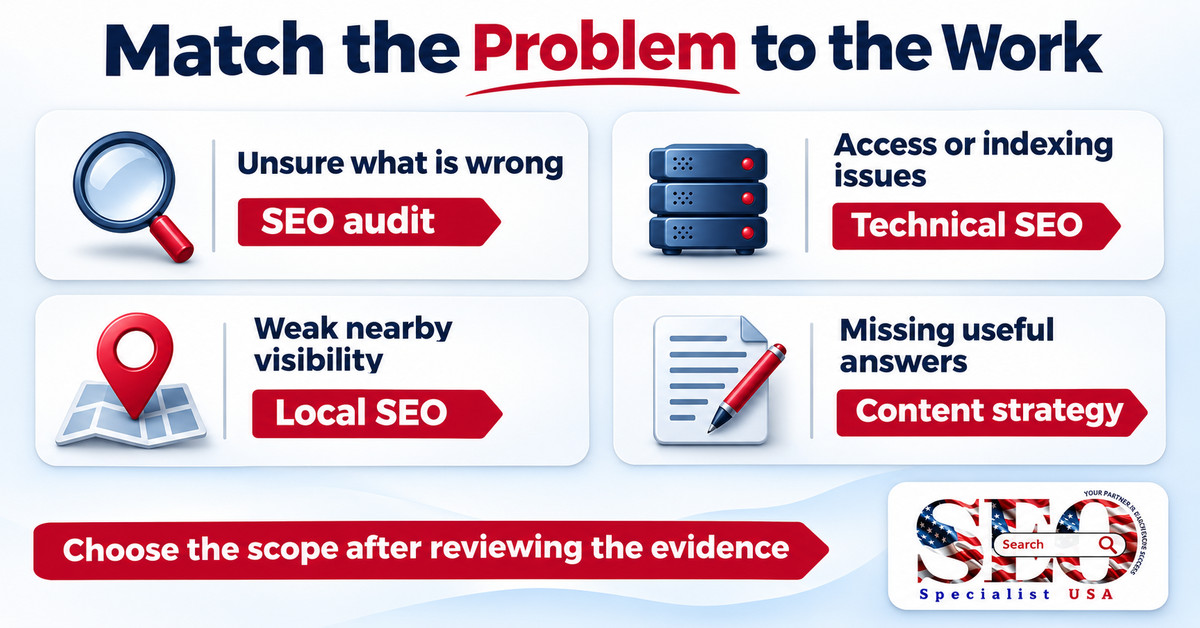
Choose the work after identifying the problem it needs to solve.
Can You Handle SEO Yourself or Should You Hire Help?
You can manage some SEO yourself if the site is straightforward and you have time to learn, implement, and review changes.
Professional help becomes more useful when the work exceeds your skills or capacity, or when a mistake could affect many important pages.
Consider 3 approaches:
DIY: suitable for manageable improvements you can maintain and measure yourself.
A scoped project: useful for a defined issue, such as an audit, service-page review, or migration planning.
Ongoing support: appropriate when technical maintenance, content improvements, and competitive priorities require continuing attention.
Shared responsibility can work too.
Your team might supply product expertise and customer questions while specialists handle technical analysis and page optimization.
Agree on who implements each recommendation so an audit doesn’t become a report nobody acts on.
Before hiring, ask what evidence supports the proposed work, what will be delivered, and how progress will be assessed. Request an explanation of important changes.
Avoid promises of guaranteed first-place rankings; Google explicitly cautions against them in its hiring guidance.
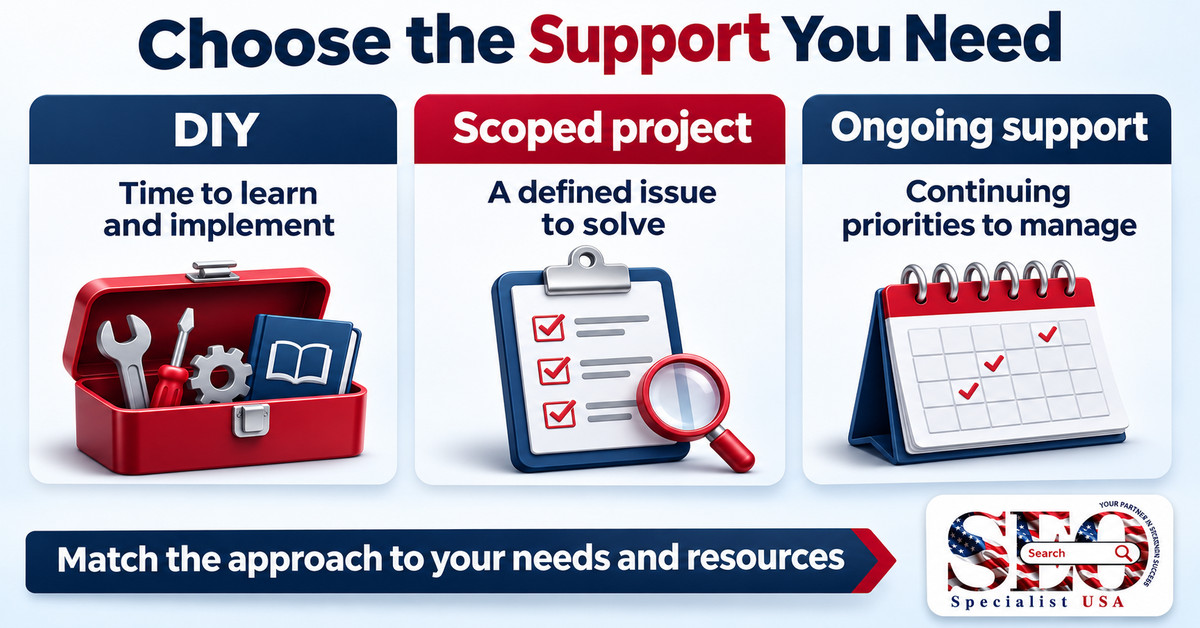
Choose support based on the work, available time, and implementation skills.
Is SEO Worth the Investment for Your Business?
Estimate the additional business relevant searches could generate, then compare that value with the costs. Look at customer value, conversion performance, competition, and your ability to deliver the service. Rankings and clicks help explain progress, but they aren’t a complete measure of return.
For a simple hypothetical example, assume an improvement generates 20 additional qualified enquiries. If one in four becomes a customer, that’s five customers. At $300 contribution per customer after variable delivery costs, they contribute $1,500 before the SEO investment and other overheads. An SEO cost of $1,000 would leave $500 before those remaining overheads.
In a real assessment, include the full investment over the review period, separate new enquiries from those you would have received anyway, and account for the time between an enquiry and a sale. Revenue alone can overstate the benefit when delivery costs are high.
Your reporting should connect:
Relevant search visibility and visits to the pages that matter.
Qualified enquiries or purchases, with reliable tracking.
Customers won and their contribution to the business.
Cumulative SEO costs and the time needed to realize value.
There’s no universal results deadline.
Google notes that some changes can show effects quickly while others take months in its SEO Starter Guide. Agree on review points and evidence of progress rather than a guaranteed outcome date.
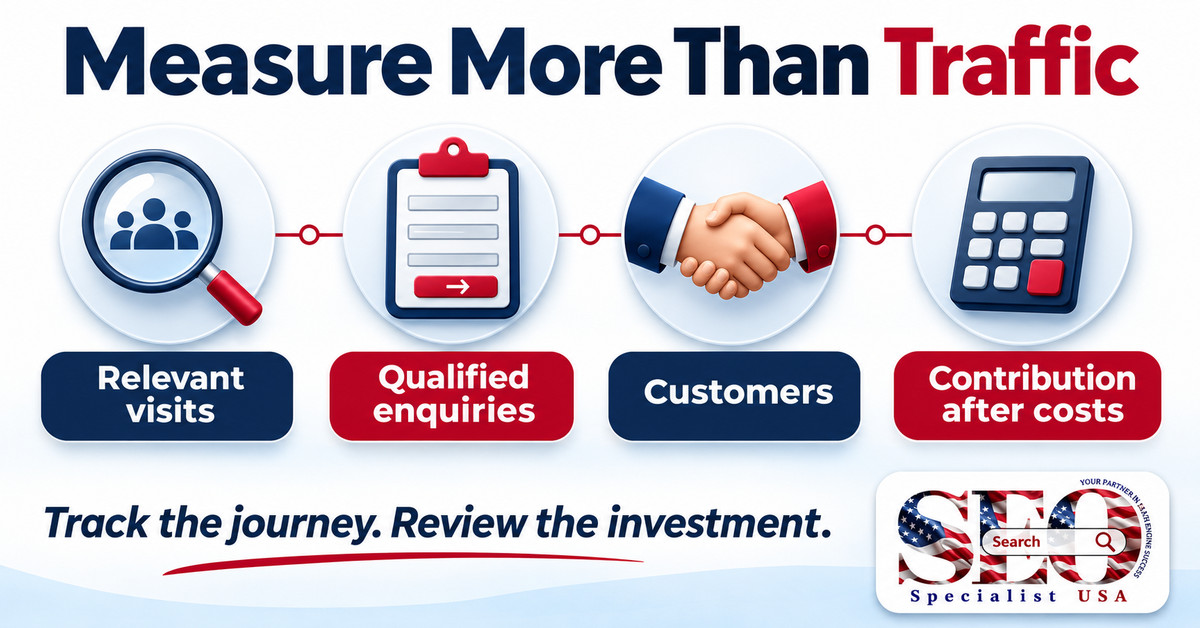
Evaluate business outcomes alongside search performance.
Do You Still Need SEO With AI Search?
SEO fundamentals remain relevant to Google’s AI search features.
Accessible pages, useful text, and clear information help make a website eligible to appear.
An AI answer may satisfy some questions without a visit, so the goal should remain reaching suitable customers rather than maximizing clicks at any cost.
Answer engine optimization, often shortened to AEO, emphasizes clear answers that are easy to understand in context. A useful page gives a direct answer, explains when the advice applies, and supports its claims with evidence. It doesn’t mean repeating the same keywords in every heading.
Google’s AI features documentation says there are no additional technical requirements or special schema needed for AI Overviews and AI Mode. Eligibility doesn’t guarantee inclusion.
Other answer platforms have their own systems, so no provider should promise that one formatting change will earn citations everywhere.
How SEO Specialist USA Can Help You Choose the Next Step
Not sure what’s holding your website back? Start with a review of your search visibility, content, technical access, and business goals. SEO Specialist USA’s SEO audit service is a relevant starting point for identifying obstacles and opportunities.
The next conversation should clarify what needs attention, which work is worthwhile, who will implement it, and how progress will be measured. Depending on the findings, the appropriate scope may involve technical fixes, stronger existing pages, local SEO, or new content.
Ready to turn search visibility into more business opportunities?
Contact SEO Specialist USA to discuss your website, target locations, and growth goals. Tell us where you’re struggling—getting found, attracting the right visitors, or generating inquiries—so we can help identify a practical next step.
Frequently Asked Questions