
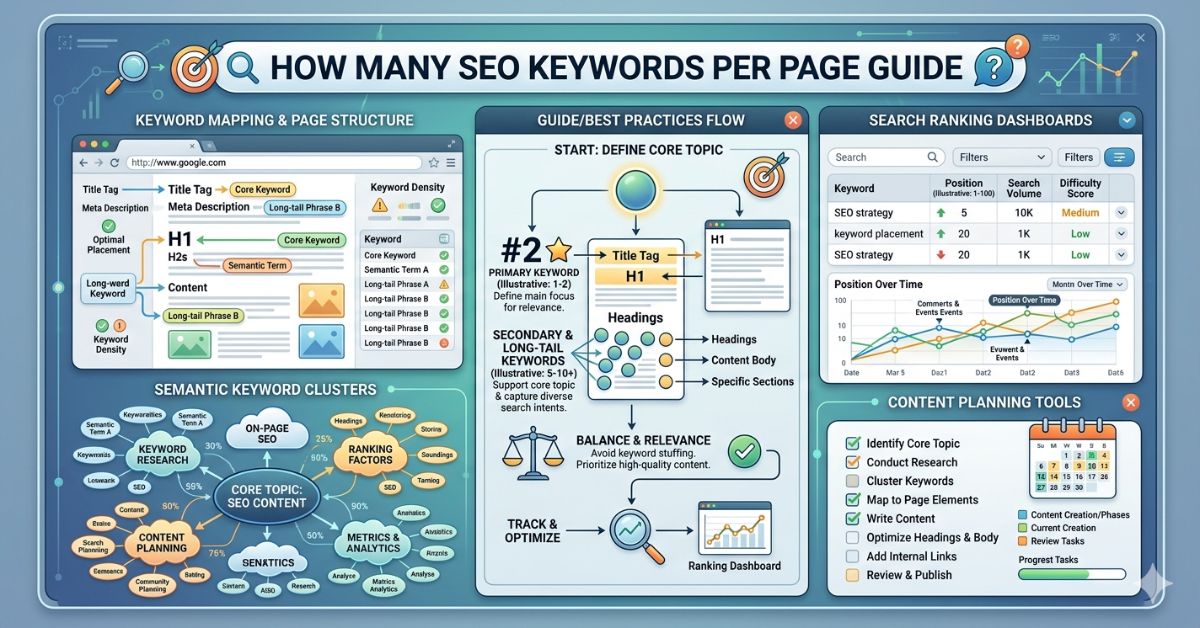
The widely accepted best practice is one primary keyword per page, supported by 2 to 5 closely related secondary keywords, and a natural spread of LSI (Latent Semantic Indexing) or semantic terms throughout the content. There is no hard limit, but targeting too many unrelated keywords on a single page dilutes your relevance signal and can hurt rather than help rankings. Focus beats volume every time.
Key Takeaways
-
 Use 1 primary keyword per page, this is the core focus around which everything else is built
-
Include 2 to 5 secondary keywords that share the same search intent as your primary keyword
-
Use semantic and LSI keywords naturally throughout the content to signal topical depth
-
Keyword stuffing is penalized by Google, quality and natural placement always win over repetition
-
A well-optimized page can end up ranking for hundreds of keywords naturally, even when you only targeted a handful intentionally
-
Where you place keywords matters far more than how many times you use them
Why There Is No Magic Number
If you search for a definitive count, you will find conflicting answers. Some sources say 1 keyword per page. Others say 1 to 4. Some suggest targeting up to 50 secondary terms. The reason for this variation is that the right number genuinely depends on your content type, length, and topic complexity.
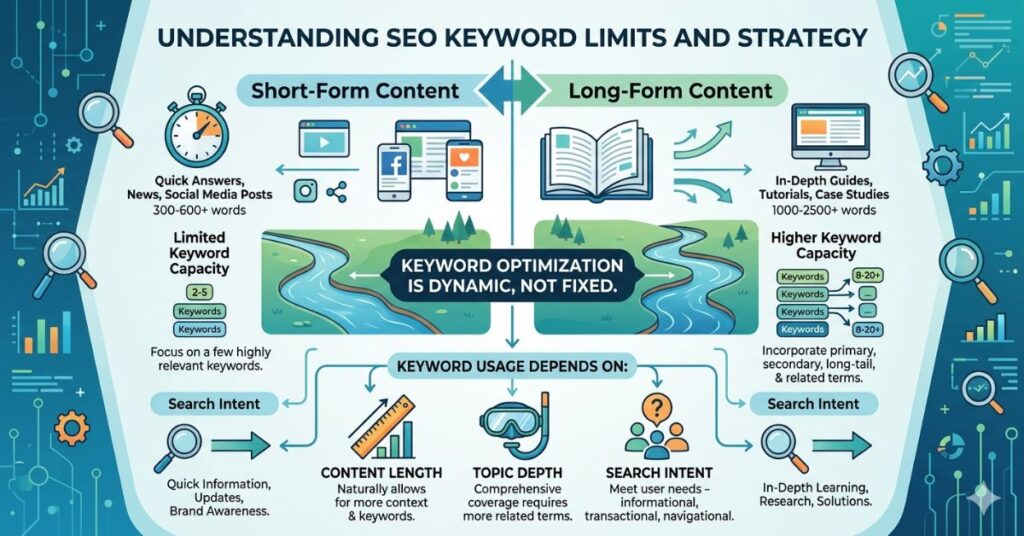
A 300-word product description and a 2,500-word ultimate guide are both web pages but they have very different keyword capacity. What matters is not hitting a specific number but rather covering your topic so thoroughly and naturally that Google understands exactly what the page is about and who it should show it to.
The Primary Keyword: One Per Page, Always
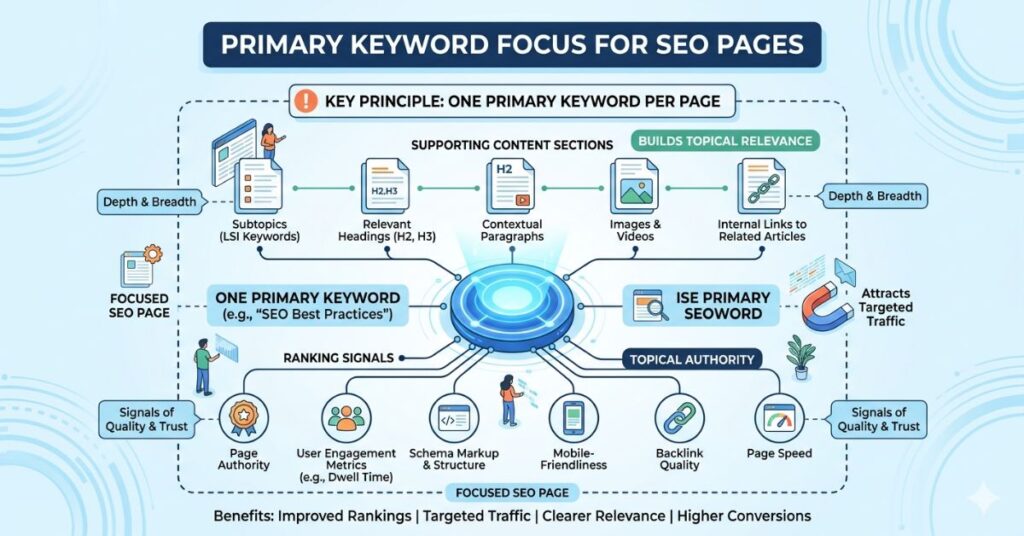
Every page on your website should have 1 primary keyword. This is the term you most want to rank for on that specific page. It is the keyword that defines the page’s core topic and user intent. Every other keyword choice, structural decision, and content section on the page should support and reinforce this primary focus.
Why Only One Primary Keyword?
Google is designed to reward pages that deeply satisfy a specific user intent. A page that is entirely, comprehensively focused on one topic will almost always outperform a page that skims across multiple different topics. When you try to make one page rank for multiple distinct primary keywords, you force Google to choose which intent the page best serves. It often chooses neither, and the page ranks poorly for all of them.
This is called keyword cannibalization, where multiple pages on the same site compete for the same or similar keywords. It weakens the ranking potential of all the affected pages simultaneously. Keeping one primary keyword per page prevents this problem from developing.
Secondary Keywords: Two to Five Related Terms
Secondary keywords are terms that are closely related to your primary keyword and share the same or overlapping search intent. They are not competing with your primary keyword. They are supporting it by helping Google understand the full context of your page’s topic.
What Makes a Good Secondary Keyword?
- It is semantically related to the primary keyword
- It shares the same general user intent (informational, commercial, transactional, or navigational)
- It can be addressed naturally within the same page without forcing a topic shift
- It is a variation, synonym, or closely related phrase that real searchers use
Example: Primary vs Secondary Keywords
Say your primary keyword is ‘best running shoes for flat feet.’ Good secondary keywords might include: ‘flat feet running shoes,’ ‘shoes for overpronation,’ ‘running shoes for low arches,’ and ‘supportive running shoes.’ All of these address the same user who needs running footwear for flat feet. They can all be covered naturally in one well-written page.
A poor secondary keyword choice for the same page would be ‘how to tie running shoes’ or ‘best marathon training plan.’ Those address different intents and different users. They belong on separate pages.
LSI Keywords and Semantic Terms: The Natural Spread
Beyond your primary and secondary keywords, your content should include a natural spread of semantically related terms, also called LSI keywords or semantic SEO terms. These are not keywords you need to target deliberately. They are terms that naturally appear when a knowledgeable human writes thoroughly about a topic.
For example, an article about ‘how to change a car tire’ would naturally mention: jack, lug nuts, spare tire, torque wrench, flat tire, safety hazard, roadside, tire iron, vehicle manual. A writer who genuinely knows the topic will include these terms without thinking about them. That natural coverage is exactly what Google looks for to confirm that a page has real depth and expertise on its subject.
How to Identify Good LSI Keywords
- Look at the ‘People Also Ask’ and ‘Related Searches’ sections in Google for your primary keyword
- Read the top three ranking articles for your keyword and note which terms they consistently use
- Use tools like LSI Graph, AlsoAsked, or Semrush’s SEO Writing Assistant to find semantically related terms
- Pay attention to the bold terms in Google’s search snippets, as these highlight the terms Google finds most relevant to the query
Keyword Density: What the Data Actually Shows
Keyword density refers to how often a keyword appears in your content as a percentage of total word count. Google does not use a fixed keyword density target as a ranking factor, and there is no official Google guideline that says ‘use your keyword X times per 1,000 words.’
That said, most SEO practitioners and tools work with a general guideline of 1 to 2 percent keyword density for the primary keyword. For a 1,000-word article, this means the primary keyword would appear roughly 10 to 20 times. In a 2,000-word article, that is 20 to 40 times. Going significantly above this range starts to look unnatural and can trigger Google’s spam filters.
More important than hitting a density percentage is that every mention of the keyword reads naturally in context. A keyword that appears 8 times naturally will serve your rankings better than one crammed in 20 times with awkward phrasing.
Where to Place Keywords: Location Matters More Than Count
The placement of your keywords across the page has a greater impact on rankings than raw keyword frequency. Google pays closer attention to keywords in certain locations because they carry stronger signals about the page’s topic.
High-Priority Keyword Placement Locations
- Title tag: This is the single most important on-page SEO element. Your primary keyword should appear here, ideally near the beginning. Keep title tags under 60 characters.
- H1 heading: The main heading on your page should include or closely mirror the primary keyword. There should only be one H1 per page.
- First 100 to 150 words: Including the primary keyword early in the introduction tells Google immediately what the page covers. Many SEO professionals prioritize getting the keyword into the first sentence or two.
- Meta description: While meta descriptions do not directly affect rankings, including the primary keyword naturally improves click-through rates from search results, which indirectly supports rankings over time.
- URL slug: A clean, keyword-inclusive URL slug such as /best-running-shoes-flat-feet/ reinforces the page topic for both Google and users.
- At least one H2 subheading: Including the primary keyword or a close variation in one or more H2 headings reinforces the topic hierarchy of your content.
- Image alt text: At least one image on the page should have alt text that naturally includes the primary keyword and describes the image accurately.
- Body content: Distribute the keyword and secondary keywords naturally throughout the content at a reading-friendly pace.
How Many Keywords a Page Actually Ranks For
Here is something that surprises many content creators: a well-optimized page focused on one primary keyword with a handful of secondary terms will, over time, rank for far more keywords than you ever targeted. This happens because Google’s algorithm is sophisticated enough to understand topic relationships and user intent patterns.
A thorough article targeting ‘best HVAC systems for small homes’ might end up ranking for: ‘best mini split systems,’ ‘energy-efficient HVAC for apartments,’ ‘ductless AC units for small spaces,’ ‘how to heat and cool a small home,’ and dozens of related variations. The writer targeted one primary keyword. Google did the rest.
This is why trying to manually stuff dozens of different keywords into one page is counterproductive. Write comprehensively for your primary keyword and the related coverage will follow naturally.
Keyword Per Page by Content Type
Short-form Product or Service Pages (300 to 500 words)
- Primary keyword: 1
- Secondary keywords: 1 to 2
- Keyword density: Keep it tight and natural, approximately 1 to 1.5 percent for the primary keyword
Standard Blog Posts and Articles (800 to 1,500 words)
- Primary keyword: 1
- Secondary keywords: 2 to 4
- Semantic/LSI terms: 5 to 15 naturally integrated
- Primary keyword density: 1 to 2 percent
Long-form Guides and Pillar Pages (2,000 to 5,000+ words)
- Primary keyword: 1
- Secondary keywords: 3 to 6
- Semantic/LSI terms: 15 to 30+, naturally integrated throughout sections
- Primary keyword density: Slightly lower percentage as word count increases, aim for around 1 percent
Local SEO Service Pages
- Primary keyword: 1 (combination of service plus location, e.g., ‘plumber in Austin’)
- Secondary keywords: 2 to 3 (service variations, nearby locations, service area terms)
- NAP data and location signals should appear naturally in multiple places on the page
Keyword Mistakes That Hurt Rankings
- Keyword stuffing: Repeating the same keyword unnaturally throughout content to hit a target count. Google explicitly penalizes this and it makes content unreadable for users.
- Targeting multiple unrelated primary keywords on one page: Creates conflicting intent signals that confuse Google about who to show the page to.
- Ignoring secondary and semantic keywords: A page that only uses the exact primary keyword phrase and never uses naturally related terms looks unnatural to Google and misses ranking opportunities.
- Keyword cannibalization across multiple pages: Publishing several pages targeting nearly identical keywords causes them to compete against each other, weakening all of them.
- Prioritizing keyword count over search intent: The most important question is not ‘did I use this keyword enough times?’ It is ‘does this page fully satisfy what the user is looking for when they search this term?’
How SEO Specialist USA Structures Keyword Optimization for Clients
SEO Specialist USA applies a structured keyword mapping process to every client campaign. Each page is assigned one primary keyword, a set of supporting secondary keywords, and a semantic term framework before content is written or optimized. This ensures that every page sends a clear, focused signal to Google while covering the topic deeply enough to rank for a wide range of related queries.
The same approach is applied to local SEO content, where primary keywords combine a service with a location and secondary keywords cover service variations, nearby areas, and customer intent terms.
Frequently Asked Questions