
SEO interview questions test your knowledge of how search engines work, on-page and off-page optimization, technical SEO, keyword research, analytics, and current algorithm behavior. Interviewers at all levels want to see not just knowledge but practical thinking: how you diagnose problems, prioritize actions, and measure results. This guide covers the most commonly asked SEO interview questions from beginner to advanced, with clear, real-world answers.
Key Takeaways
-
 SEO interviews typically cover four areas: foundational concepts, technical SEO, content and on-page optimization, and off-page or link building
-
Understanding Core Web Vitals, schema markup, canonical tags, and crawl budget is expected in mid-to-senior roles
-
Interviewers value practical problem-solving over textbook definitions, always back answers with how you would apply the concept
-
Knowing how to use tools like Google Search Console, Ahrefs, Semrush, and Screaming Frog is often required
-
Being up-to-date on Google algorithm changes and their real-world impact signals genuine industry engagement
How to Prepare for an SEO Interview
The most effective preparation combines conceptual knowledge with practical experience. Interviewers increasingly favor candidates who can describe how they solved a real problem over those who can recite definitions.
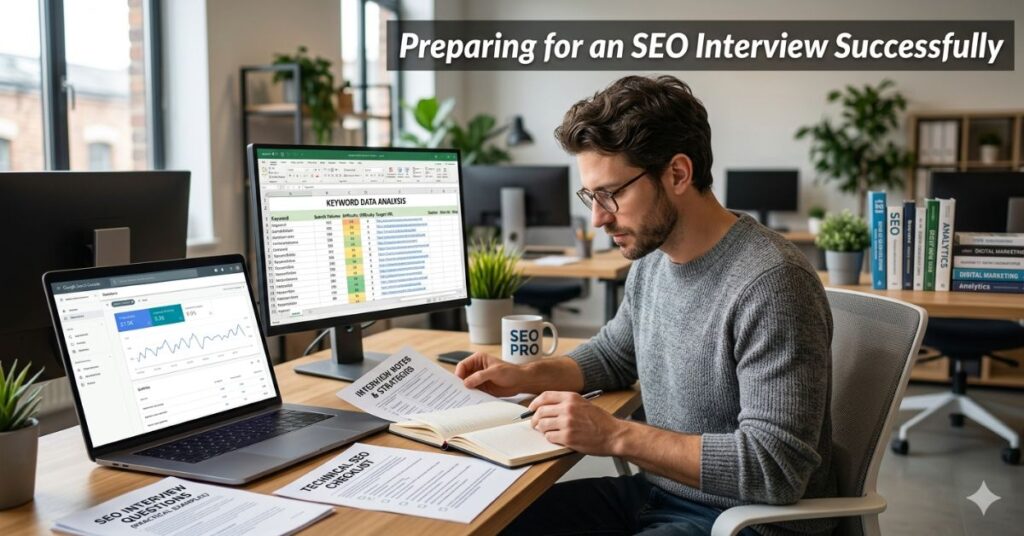
- Review foundational SEO concepts: how search engines crawl and index content, the difference between on-page, off-page, and technical SEO, and what core ranking factors Google has confirmed
- Get hands-on with tools: Google Search Console and Google Analytics 4 are essential. Familiarity with Ahrefs, Semrush, Screaming Frog, or Moz adds significant value
- Stay current with industry updates: Follow Google Search Central, Search Engine Journal, and Moz to understand recent algorithm changes
- Prepare case study examples: Describe specific situations where your SEO work led to measurable improvements. Numbers matter.
- Practice explaining technical concepts in plain language: Interviewers often test whether you can make complex ideas accessible to non-technical stakeholders
Basic SEO Interview Questions
Q: What is SEO and why does it matter?
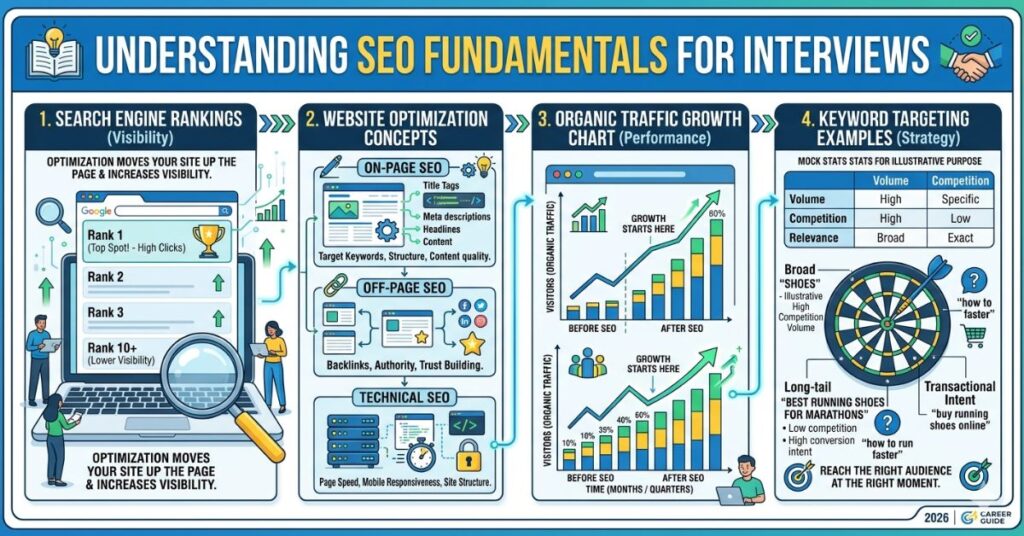
A: SEO stands for Search Engine Optimization. It is the practice of improving a website’s visibility in organic (non-paid) search engine results. It matters because the majority of web traffic comes from organic search, and the businesses appearing at the top of results for relevant queries capture significantly more clicks, leads, and revenue than those ranked lower. SEO is a long-term investment in sustainable traffic that is not dependent on ongoing ad spend.
Q: What is the difference between on-page SEO, off-page SEO, and technical SEO?
A: On-page SEO covers elements within your website that you control directly: title tags, meta descriptions, heading structure, content quality, keyword usage, internal linking, and URL structure. Off-page SEO refers to signals that originate outside your website, primarily backlinks from other websites, brand mentions, and online reputation. Technical SEO covers the infrastructure of your website, how well search engines can crawl it, how quickly it loads, whether it is mobile-friendly, and how it is structured from a code and architecture standpoint. All three must work together for strong rankings.
Q: What is a search engine and how does it work?
A: A search engine is a software system designed to search the internet for information and return relevant results for user queries. Google, Bing, and Yahoo are the most widely used. They work through three main processes: crawling (discovering web pages by following links), indexing (storing and organizing discovered content in a database), and ranking (serving the most relevant results for a given query based on hundreds of ranking signals). Without being crawled and indexed, a page cannot rank.
Q: What is organic search and how is it different from paid search?
A: Organic search results are listings that appear because Google’s algorithm determined them to be the most relevant and authoritative for a query. They are earned through SEO and do not require payment per click. Paid search results, also called PPC (pay-per-click) or SEM (search engine marketing), are advertisements that businesses pay to display when users search specific keywords. They appear at the top and bottom of results with an ‘Ad’ label. Organic traffic is free per click and compounds over time. Paid traffic stops immediately when the budget is paused.
Q: What are meta tags and which ones matter most for SEO?
A: Meta tags are HTML elements that provide information about a web page to search engines and browsers. The two most important for SEO are the meta title (also called the title tag), which appears as the clickable headline in search results and is a direct ranking signal, and the meta description, which appears as the summary text beneath the title in results. The meta description does not directly affect rankings but influences click-through rates significantly. Other meta tags include the robots meta tag (which controls indexing and following), the viewport meta tag (important for mobile rendering), and Open Graph tags (for social media sharing). Meta keywords have not been a ranking factor for Google since 2009.
On-Page SEO Interview Questions
Q: What makes a good title tag?
A: A good title tag includes the primary keyword for the page, ideally near the beginning. It accurately describes the page’s content and gives users a compelling reason to click. It stays under approximately 60 characters so it does not get truncated in search results. It avoids keyword stuffing. Each page on a website should have a unique title tag. The title tag is one of the strongest on-page ranking signals and should be treated as a high priority in any on-page optimization.
Q: What is keyword cannibalization?
A: Keyword cannibalization happens when multiple pages on the same website target the same primary keyword, causing them to compete against each other in search results. This dilutes the ranking potential of each page because Google has to decide which one to show, often choosing to rank all of them lower than a single authoritative page would rank. Fixing cannibalization usually involves consolidating the competing pages into one comprehensive page, using canonical tags to tell Google which version to prioritize, or redirecting weaker pages to the strongest one.
Q: What is internal linking and why does it matter?
A: Internal linking is the practice of linking from one page on your website to another page on the same website. It matters for three reasons: it helps search engines discover and crawl your content more effectively by passing link equity and crawl signals between pages; it signals the relative importance and relationships between different pages on your site; and it improves user experience by guiding visitors to related content that keeps them engaged longer. Pages with more internal links pointing to them tend to rank better because they receive more authority from the rest of the site.
Q: What is a canonical tag and when should you use it?
A: A canonical tag is an HTML element (rel=’canonical’) that tells search engines which version of a URL is the preferred, authoritative version when duplicate or very similar content exists at multiple URLs. Use it when: the same content appears at multiple URLs due to URL parameters, session IDs, or tracking codes; you have HTTPS and HTTP versions of the same page both accessible; you have paginated content where early pages share similar content; or you are syndicating content to another site and want the original to receive ranking credit.
Q: How do you optimize an image for SEO?
A: Image optimization for SEO involves several steps. Use descriptive, keyword-relevant file names rather than generic names like IMG_001.jpg. Write accurate, descriptive alt text that describes the image for accessibility and includes a relevant keyword where it fits naturally. Compress images to reduce file size without sacrificing visual quality, using formats like WebP which offer better compression than JPEG or PNG for most use cases. Add width and height attributes to prevent Cumulative Layout Shift, which is a Core Web Vitals metric. Use a CDN (Content Delivery Network) for faster image delivery across geographic locations.
Technical SEO Interview Questions
Q: What is the crawl budget and why does it matter?
A: Crawl budget is the number of pages Googlebot will crawl on your website within a given time frame. Google allocates a crawl budget based on the perceived authority and activity level of a domain. Crawl budget matters because if your site has many pages, Google may not crawl all of them within its budget, leaving some pages undiscovered or not re-crawled after updates. To optimize crawl budget: block low-value pages in robots.txt or via noindex tags, fix crawl errors, clean up redirect chains, submit an accurate XML sitemap, and eliminate duplicate content. Crawl budget is most critical for large websites with thousands of pages.
Q: What are Core Web Vitals and what do they measure?
A: Core Web Vitals are a set of page experience metrics that Google uses as ranking signals. They currently consist of three metrics: Largest Contentful Paint (LCP), which measures loading performance and should ideally be under 2.5 seconds; Cumulative Layout Shift (CLS), which measures visual stability and should be under 0.1; and Interaction to Next Paint (INP), which replaced First Input Delay (FID) in March 2024 and measures responsiveness to user interactions, with a threshold of under 200 milliseconds considered good. These metrics are measured both in lab conditions using tools like Google Lighthouse and in real-world conditions via the Chrome User Experience Report (CrUX).
Q: What is a robots.txt file and how does it work?
A: A robots.txt file is a plain text file placed in the root directory of a website that gives instructions to search engine crawlers about which pages or sections of the site they should or should not access. For example, ‘Disallow: /admin/’ would prevent crawlers from accessing admin pages. Important notes: robots.txt prevents crawling but not necessarily indexing, a page can be indexed by Google even if it is blocked in robots.txt if it has external links pointing to it. To prevent indexing, use a noindex meta tag or the X-Robots-Tag HTTP header. Also, robots.txt is publicly visible to anyone who accesses it.
Q: What is the difference between a 301 and a 302 redirect?
A: A 301 redirect is a permanent redirect that tells search engines the page has moved permanently to a new URL. It passes the majority of the original page’s ranking authority (link equity) to the new URL and should be used whenever you permanently move or delete a page. A 302 redirect is a temporary redirect that tells search engines the page has moved temporarily but may return to the original URL. It does not pass as much link equity as a 301 and should only be used when the move is genuinely temporary. Using a 302 where a 301 is appropriate can cause ranking issues because Google may continue to index the original URL.
Q: What is schema markup and what is it used for?
A: Schema markup is a form of structured data added to a webpage’s HTML that helps search engines understand the content in a more specific way. It uses vocabulary from Schema.org and tells Google what type of content is on the page and what each element means. For example, schema markup can identify a review’s rating, an event’s date and location, a product’s price and availability, or a recipe’s ingredients and cook time. Well-implemented schema markup can earn rich results (also called rich snippets) in Google’s search results, such as star ratings, FAQ accordions, and event times, which improve visibility and click-through rates.
Off-Page SEO Interview Questions
Q: What is a backlink and why are backlinks important for SEO?
A: A backlink is a link from one external website pointing to your website. Backlinks are one of Google’s most significant ranking signals because they represent a vote of trust and authority from another site. The quality and relevance of the linking site matters significantly: a backlink from a high-authority, topically relevant site is worth far more than dozens of links from low-quality or unrelated sites. Google’s original PageRank algorithm was built on the concept that more linked-to pages are more likely to be valuable. While the algorithm has evolved dramatically, backlinks remain a core ranking factor.
Q: What is domain authority and is it a Google ranking factor?
A: Domain Authority (DA) is a metric developed by Moz that scores a website’s overall backlink strength on a scale of 1 to 100. Ahrefs has a similar metric called Domain Rating (DR). Neither Domain Authority nor Domain Rating is a Google ranking factor. Google does not use these third-party metrics. However, they are useful as relative indicators: a site with a higher DA or DR typically has a stronger backlink profile and tends to rank more easily for competitive keywords. Use these metrics for comparative analysis, not as absolute measures of SEO health.
Q: What is anchor text and how does it affect SEO?
A: Anchor text is the visible, clickable text in a hyperlink. For example, if a link points to your page with the text ‘best HVAC companies in Denver,’ that phrase is the anchor text. Anchor text is an important signal to Google about what the linked page is about. Exact-match anchor text (using the target keyword as the anchor) can strengthen rankings for that term, but overusing exact-match anchor text across many backlinks can look manipulative and trigger algorithmic penalties. A natural backlink profile has a varied distribution of anchor text: branded anchors, partial-match anchors, generic anchors, and some exact-match anchors.
Q: What is the difference between a dofollow and nofollow link?
A: A dofollow link passes link equity (sometimes called ‘link juice’) from the linking page to the destination page, contributing to the destination page’s ability to rank. This is the default state of any standard hyperlink. A nofollow link includes the rel=’nofollow’ attribute, which historically told Google not to follow the link or pass equity. In 2019, Google updated its treatment of nofollow, sponsored, and ugc (user-generated content) link attributes, treating them as ‘hints’ rather than directives. This means Google may still follow and potentially credit nofollow links at its discretion. Paid links should use the sponsored attribute, while forum posts and comments should use ugc.
Tools and Analytics SEO Interview Questions
Q: Which SEO tools do you use and why?
A: A strong answer covers tools across different categories: Google Search Console (free, essential for crawl data, indexing status, keyword performance, and Core Web Vitals) and Google Analytics 4 (for user behavior, traffic source analysis, and conversion tracking) as foundational tools. Ahrefs or Semrush for keyword research, backlink analysis, and competitive intelligence. Screaming Frog SEO Spider for technical site crawls to identify broken links, duplicate content, redirect chains, and missing tags. Moz Local or BrightLocal for local SEO and citation management. The specific tools matter less than demonstrating that you understand what category of data each type of tool provides and how you apply that data to make decisions.
Q: How do you conduct an SEO audit?
A: An SEO audit is a systematic review of a website’s current SEO health. A comprehensive audit covers: technical SEO (crawlability, indexation, page speed, mobile usability, Core Web Vitals, HTTPS, robots.txt and sitemap configuration), on-page SEO (title tags, H1s, meta descriptions, heading structure, internal linking, content quality and uniqueness), off-page SEO (backlink profile quality, referring domain count and authority, anchor text distribution), local SEO for businesses with geographic focus (GBP completeness, citation consistency, local content), and analytics review (traffic trends, top pages, keyword performance, conversion data). Prioritize findings by potential impact and technical difficulty, then build a phased action plan.
Q: What is Google Search Console and what can you learn from it?
A: Google Search Console is a free tool provided by Google that gives website owners data directly from Google about how their site is performing in search. Key data available includes: which queries are generating impressions and clicks, the average position for those queries, indexing status for all discovered pages, crawl errors and coverage issues, Core Web Vitals performance data, manual actions (penalties) applied to the site, international targeting settings, and links report showing internal and external link data. It is one of the most important free tools in an SEO professional’s stack because it provides first-party Google data rather than third-party estimates.
Local SEO Interview Questions
Q: What is local SEO and how does it differ from organic SEO?
A: Local SEO is the practice of optimizing a business’s online presence to appear prominently in location-based search queries. This includes searches with city names, neighborhood names, or the phrase ‘near me.’ It also includes searches where Google infers local intent based on the service type. Local SEO focuses specifically on the Google Local Pack (the top three business listings), Google Maps, and locally targeted organic results. Key local SEO factors that differ from regular SEO include: Google Business Profile optimization, NAP citation consistency across directories, proximity to the searcher, and local review signals.
Q: What is the Google Local Pack?
A: The Google Local Pack, also called the Google 3-Pack, is the block of three local business listings that appears at the top of Google search results for queries with local intent. It includes a map and three business listings showing name, rating, address, hours, and a link to the Google Business Profile or website. The Local Pack typically appears above organic search results and captures the majority of clicks for local queries. Ranking in the Local Pack is determined by relevance, distance, and prominence, three factors that Google uses to evaluate how well a business matches a local search.
Q: What are citations in local SEO?
A: Citations in local SEO are online mentions of a business’s Name, Address, and Phone number (NAP). They appear on business directories, review platforms, social media, and news sites. Citations help Google verify that a business is legitimate and operating at the address it claims. Consistent NAP data across all citations builds trust in Google’s algorithm, while inconsistent data weakens it. Key citation platforms include Google Business Profile, Yelp, Bing Places, Apple Maps, and industry-specific directories. Citation signals are one of the top ranking factors for Local Pack visibility according to Moz’s annual Local Search Ranking Factors survey.
Advanced SEO Interview Questions
Q: What is E-E-A-T and why does Google care about it?
A: E-E-A-T stands for Experience, Expertise, Authoritativeness, and Trustworthiness. Google’s Search Quality Rater Guidelines use E-E-A-T as the framework for human quality raters to evaluate whether pages are genuinely helpful and trustworthy. The additional ‘E’ for Experience was added in December 2022, recognizing that first-hand experience with a topic (such as a product review from someone who actually used the product) adds credibility beyond formal expertise alone. While E-E-A-T is not a direct algorithmic ranking signal, it informs how Google develops and evaluates its algorithms. Pages that demonstrate genuine expertise, real-world experience, credible authorship, and site-wide trustworthiness tend to perform better in rankings, particularly in YMYL (Your Money or Your Life) topics like health, finance, and legal content.
Q: How do you approach a site that has lost significant organic traffic?
A: First, determine exactly when the traffic drop occurred and correlate it with Google algorithm update dates. Use Google Search Console to identify which pages lost impressions and rankings. Check if the drop is consistent across the site or isolated to specific sections or keyword clusters. Audit the affected pages for recent content changes, technical issues, or loss of backlinks. If it correlates with a named algorithm update, research what that update targeted: Helpful Content updates typically affect sites with AI-heavy, low-value content; Core Updates tend to affect overall E-E-A-T; Spam Updates target manipulative tactics. Build a recovery plan based on the root cause, prioritizing the highest-traffic pages first.
Q: What is the difference between a crawl error and an indexing issue?
A: A crawl error means Googlebot could not successfully access a URL, typically due to a server error (5xx), access restrictions (robots.txt blocks), or a broken link (4xx). An indexing issue means Google could access the page but chose not to include it in its search index, or has removed it from the index. Indexing issues can stem from a noindex tag, duplicate content, thin content that Google considers low-value, or a canonicalization problem where Google chose a different URL as the canonical. Both types of issues appear in Google Search Console under the Coverage report, which now shows both error and excluded page categories.
Q: What is JavaScript SEO and what are the common issues?
A: JavaScript SEO refers to the challenges and best practices involved in ensuring that JavaScript-rendered content is properly crawled and indexed by search engines. Googlebot can render JavaScript, but it does so in a second wave of processing that can occur days or weeks after initial discovery. Common issues include: content that is only visible after JavaScript execution may not be indexed promptly; critical content or links inside JavaScript frameworks that Googlebot cannot access reliably; and dynamic rendering setups that serve HTML to crawlers and JavaScript to users, which can be flagged as cloaking if not implemented correctly. Server-side rendering (SSR) or static site generation (SSG) are generally better for SEO than client-side rendering alone.
SEO Interview Tips: How to Stand Out
Beyond knowing the right answers, the candidates who perform best in SEO interviews demonstrate several consistent qualities:
- They answer with specifics, not generalities. ‘I improved organic traffic by 40 percent in six months by fixing crawl errors and building out local service pages’ is far more compelling than ‘I helped grow organic traffic.’
- They connect tactics to business outcomes. Interviewers at good companies want to hear how SEO work affected revenue, leads, or customer acquisition, not just rankings and impressions.
- They are honest about what they do not know. SEO changes rapidly and no one knows everything. Saying ‘I am not familiar with that specific tool but I would approach it by…’ is far better than guessing or bluffing.
- They ask good questions. An SEO professional who asks about the company’s current traffic challenges, which tools the team uses, and what the biggest ranking priorities are demonstrates strategic thinking and genuine curiosity.
Frequently Asked Questions