

How to Prioritize SEO Work: What We Do and What We Skip
The SEO Work We Didn’t Do, and Why
During one SEO campaign, the biggest opportunity wasn’t another 20 blog posts or a larger backlink campaign. The website already had plenty of content and was generating search visibility. The harder part was figuring out where additional SEO work would actually make a difference.
That experience reflects a lesson we’ve seen repeatedly: SEO isn’t about doing the greatest number of tasks. It’s about identifying the right problem and putting resources into the work most likely to solve it.
A family law firm, an e-commerce store, and a local service business can all say “We need more traffic,” while needing completely different SEO strategies. One may need stronger local visibility. Another may have content that needs to be consolidated. Another may already have traffic but struggle to turn visitors into customers.
In practice, this matters. Our family law SEO case study is one example. Over six months, meaningful results weren’t captured by a single ranking position, the campaign produced 752 Google Business Profile calls, 1,417 website clicks, and 2,520 total Business Profile interactions. Rankings were one part of the picture, not the whole story.
So before we recommend another SEO task, we ask a more useful question: What is actually holding this website back?
Sometimes the answer is more content. Sometimes it is technical SEO, internal linking, authority, or conversion optimisation. And sometimes, the smartest decision is to not do something yet.
What You’ll Learn
- ✓ How we decide which SEO activities deserve priority
- ✓ Why creating more content is not always the best next step
- ✓ Why competitor keyword research should not become a copy-and-paste exercise
- ✓ How we evaluate technical SEO issues based on actual impact
- ✓ Why link building should be about relevance and authority rather than monthly numbers
- ✓ What makes a local landing page genuinely useful
- ✓ Why reputation and customer trust belong in the broader SEO conversation
- ✓ Why rankings alone are not enough to measure SEO performance
- ✓ How real campaign experience improves SEO decision-making
SEO Is Not a Checklist
It is easy to turn SEO into a list of tasks. Research keywords. Optimise pages. Publish content. Build links. Fix technical issues. Improve internal linking. Repeat.
There is nothing inherently wrong with those activities. The problem is assuming that every website needs all of them at the same time. Every website has a different starting point. Some have strong content but poor technical foundations. Others have technically sound websites but pages that don’t match search intent. Some have plenty of organic traffic but very few qualified leads.
Start With the Business, Not the SEO Tool
Before looking at what we can change, we want to understand what the business is trying to achieve. A local service business may care primarily about calls and enquiries. An e-commerce company may care about transactions and revenue. A B2B company may be more interested in qualified leads than raw traffic. That changes how SEO should be evaluated.
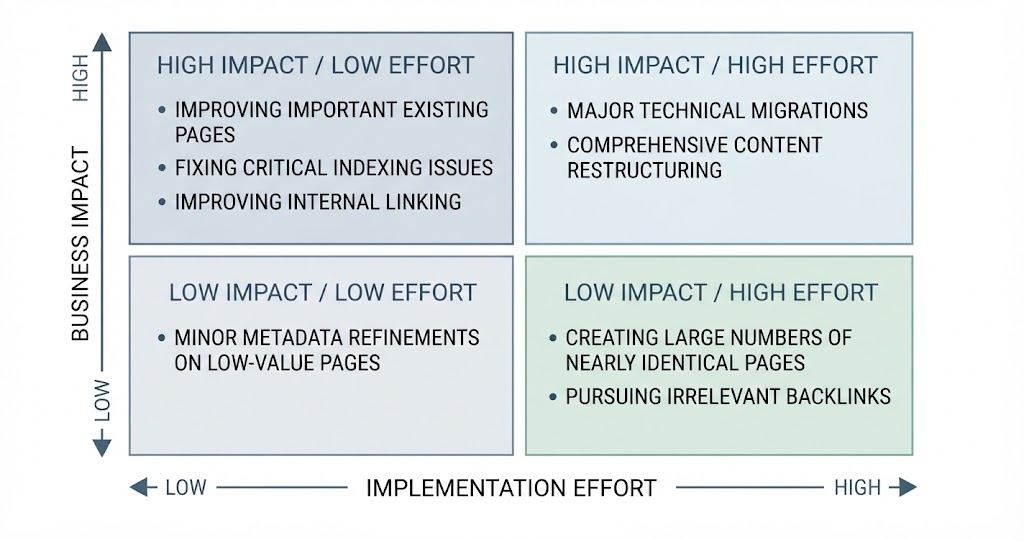
We typically look at:
- Organic search performance
- Important landing pages
- Search queries and impressions
- Existing content and site architecture
- Internal linking and crawlability
- Backlinks and referring domains
- Competitors
- Conversion paths
- Business goals
Google’s guidance encourages people-first content that provides useful information rather than content created primarily to manipulate search rankings. The same thinking applies to SEO strategy itself: do the work because the website needs it, not because it appears on a checklist.
We Don’t Publish Content Just Because a Keyword Tool Suggests It
“Publish more content” is one of the easiest recommendations to make. Sometimes it is exactly right. But we’ve also seen websites with hundreds of pages where adding another batch of articles would not address the real problem.
Look at What Already Exists
Before creating a new URL, we ask:
- Does the website already cover this topic?
- Is an existing page receiving impressions or clicks?
- Does it satisfy the searcher’s intent?
- Are multiple pages covering similar topics and competing with each other?
- Could the existing page be improved rather than replaced?
- Would another page provide something genuinely different?
If an existing page already has visibility and useful information, improving it may make more sense than starting from zero. This can also help prevent a website becoming fragmented, with multiple pages competing for the same topics.
Create New Content When There Is a Real Gap
New content makes sense when there is something genuinely worth adding. Perhaps customers have questions the website doesn’t answer. Maybe an important service hasn’t been properly explained. Or there is a distinct search intent that deserves its own page. The deciding factor isn’t simply search volume, there needs to be a useful reason for the page to exist.
We Don’t Chase Every Keyword a Competitor Ranks For
Competitor research is valuable, but copying another website’s keyword list is not an SEO strategy. A competitor may rank for thousands of queries that have little relevance to your business.
Search Volume Doesn’t Tell the Whole Story
A keyword with 10,000 searches per month can look impressive in a spreadsheet. But what if those searchers aren’t potential customers? A smaller search term can be considerably more valuable when it comes from someone actively looking for what a business provides.
That’s why we consider:
- Who is searching?
- What are they trying to accomplish?
- What stage of the buying journey are they in?
- Does the business serve that audience?
- Can the website provide a genuinely useful answer?
- Is there a realistic path from that search to a business outcome?
Look at the Topic, Not Just the Phrase
This is where semantic SEO becomes useful. Instead of treating every keyword as a separate target, we look at the broader topic, related concepts, entities, questions, and search intent.
For example, someone researching a family law firm may want information about consultations, legal processes, custody, costs, timelines, and what to expect. Those aren’t simply phrases to insert into an article. They tell us what the person is actually trying to understand. and that helps us build content around audience needs rather than a spreadsheet of keywords.
The Problem With Monthly Link Targets
Backlinks can be an important part of SEO, but the number of links acquired in a particular month doesn’t tell you whether a campaign is successful.
Relevance Matters More Than Volume
When evaluating a link opportunity, we consider the source, relevance, quality, legitimacy, and context of the placement. A relevant mention from a credible publication or industry resource makes much more sense than accumulating unrelated links to reach a monthly target. Google’s spam policies specifically address manipulative link practices and link spam, which is one reason we don’t view link building as a race to produce the biggest possible number.
Sometimes Links Aren’t the First Problem
If important pages don’t satisfy search intent, the website has significant technical problems, or the site structure makes important information difficult to discover, acquiring more links may not address the underlying issue.
Before asking, “How many backlinks do we need?” we should ask, “Why isn’t this website performing as well as it should?” That answer determines whether link building belongs at the top of the priority list.
What Location Pages Actually Need
Location pages can be useful for businesses that genuinely serve multiple areas. The problem starts when every page contains almost identical information and the only meaningful difference is the city name.
Give People a Reason to Visit the Page
A useful location page should provide information that is genuinely relevant to people in that area. Depending on the business, this could include:
- Areas actually served
- Local service availability and limitations
- Location-specific customer questions
- Relevant local projects or experience
- Genuine customer experiences from that area
- Information that helps visitors decide whether the business is right for them
Google’s spam policies include doorway abuse, pages created primarily to rank for specific searches without providing unique value to users. That doesn’t mean every multi-location business should avoid location pages. It means those pages should have a genuine purpose.
Sometimes Fewer Pages Are Better
If there isn’t enough useful information to make a location page valuable and meaningfully different, creating another URL simply to target another city may not be the best decision.
The question we ask: Would a customer in this location actually find this page useful? If the answer is no, we would rather reconsider the page than create it simply because a keyword tool suggested another location term.
We Don’t Fix Every Technical Issue an SEO Tool Reports
SEO crawlers are incredibly useful for finding potential problems. But an audit report isn’t automatically a priority list.
Not Every Finding Has the Same Impact
A website can have hundreds of warnings and recommendations, but they don’t all deserve the same amount of attention. We consider:
- Whether important pages are affected
- Whether crawling or indexing is affected
- Whether duplicate or conflicting signals exist
- Whether users are affected
- Whether organic visibility is affected
- How difficult the fix is relative to the likely benefit
Prioritise Problems That Affect Important Pages
For example, Google’s documentation on canonicalization explains how canonicalization helps Google determine which URL should represent duplicate or substantially similar pages. If duplicate URLs are affecting important content, that deserves investigation. A minor warning on a low-traffic page may not warrant the same development time.
Finding an SEO issue does not automatically mean fixing it should be the next task.
We Don’t Write Content That Sounds Like It Was Written for a Search Engine
A reader should not have to fight through awkward language to understand what an article is trying to say. We’ve all seen pages where the same keyword appears in every heading and seems to have been squeezed into every paragraph. That’s not useful to the reader, and it doesn’t reflect how we approach SEO content.
What Useful SEO Content Looks Like
Good content should be:
- Easy to understand
- Accurate and specific
- Relevant to the reader’s actual question
- Helpful beyond the obvious
- Supported by appropriate evidence
- Written from genuine knowledge or experience
- Honest about limitations
Keywords still have a role, search engines need to understand the subject of a page. But repeating a phrase isn’t the same thing as demonstrating expertise.
Show Experience Instead of Simply Claiming It
This is where EEAT becomes particularly relevant. EEAT stands for Experience, Expertise, Authoritativeness, and Trustworthiness. Google’s guidance encourages creators to consider whether their content demonstrates first-hand experience and provides original, helpful information.
For an SEO agency, that means showing how a decision was reached, what the campaign data showed, what changed after implementation, and what was learned. Where client confidentiality allows, useful evidence can include:
- Before and after Search Console data
- Campaign timelines and implementation details
- Methodology explanations
- Real examples from different industries
- Lessons from experiments that did not work as expected
Anyone can say, “We’re SEO experts.” Showing readers how you actually work is considerably more convincing.
Reputation Is Part of the Bigger Picture
There is another part of SEO that is easy to overlook when everything is reduced to rankings and technical metrics: reputation.
A business can have a technically excellent website and strong search visibility, but potential customers still need a reason to trust it.
People Research Businesses Before They Contact Them
Someone who discovers a business through Google may then look at reviews, search the brand name, compare competitors, read testimonials, or check business profiles. The experience outside the website therefore affects what happens after someone discovers the business.
Depending on the industry, we may pay attention to:
- Customer reviews and how they are responded to
- Consistency of business information across directories
- Brand mentions and third-party coverage
- Claims made on the website and supporting evidence
- How clearly services are explained
- The overall credibility of the business
This matters particularly in high-trust industries. Someone looking for a lawyer, healthcare provider, home service company, or financial professional isn’t simply asking, “Who ranks first?” They’re also asking, “Can I trust this business?”
SEO can help a business get discovered. It cannot manufacture a good reputation.
We Don’t Manufacture Expertise
We also don’t believe a business should present itself as something it isn’t. If a company has genuine experience, show it. If a team has worked on difficult campaigns, explain what was learned. If an author has relevant professional experience, make that experience clear. And if a result has limitations, explain them.
Trust comes from evidence and transparency, not from adding an “expert” label to a page.
We Don’t Promise What We Can’t Control
SEO involves factors that no agency can completely control. Google changes its systems. Competitors change their strategies. Search demand changes. Websites are redesigned. Businesses add or remove services.
That’s why we don’t believe responsible SEO should be built around promises such as, “We’ll get you to position one in 30 days.” A more useful conversation looks at:
- What is limiting the website today?
- Which opportunities have the strongest evidence behind them?
- What can realistically be improved?
- What will be measured?
- What does success look like for this business?
- Which factors are outside the agency’s control?
That may not sound as exciting as a ranking guarantee. It is more realistic. And when a business is trusting an agency with its website, reputation, and marketing budget, realistic expectations matter.
Why Rankings Aren’t the Right Metric on Their Own
Rankings are useful. They tell us whether visibility for particular searches is changing. But a ranking isn’t a customer.
Rankings Show Visibility — Not Results
A website can rank for hundreds of keywords and generate plenty of traffic without producing meaningful business results. Another website may receive less traffic but generate more qualified leads because it is visible for searches with stronger commercial intent. That’s why rankings should be viewed alongside other metrics.
Connect SEO to the Business
Depending on the business, useful measurements can include:
- Qualified organic traffic
- Phone calls
- Contact form submissions
- Appointment requests
- Online purchases
- Qualified leads and revenue
- Other meaningful conversions
We Don’t Change Everything at Once
There is another lesson that comes from experience: if everything changes at the same time, it becomes difficult to know what caused the result.
Imagine rewriting 30 pages, changing the navigation, redesigning the website, altering URLs, building new links, and publishing dozens of articles simultaneously. If traffic increases, what caused it? If traffic decreases, what caused it?
Controlled Changes Make Learning Easier
Where practical, we prefer a more deliberate process:
- Identify the problem
- Establish a baseline
- Make the appropriate change
- Monitor performance
- Compare the results
- Decide what should happen next
This is particularly important during website migrations and URL changes. Google’s documentation on site moves recommends planning redirects, mapping URLs, and monitoring performance carefully. SEO doesn’t have to be slow, it should have a reason behind every piece of work being done.
What We Actually Prioritise
If we aren’t trying to maximise the number of SEO tasks, what are we trying to improve? We focus on things that have a clear connection to search visibility and business performance.
Instead of Chasing | We Prefer to Work Toward |
✕ More pages ✕ More keywords ✕ More backlinks ✕ More traffic ✕ Higher rankings for their own sake | ✓ Better visibility for relevant searches ✓ Stronger and more useful content ✓ More qualified visitors ✓ A clearer customer journey ✓ Greater trust and credibility ✓ Better conversion opportunities ✓ More qualified leads ✓ Meaningful business outcomes |
The difference may look subtle on paper, but it fundamentally changes how an SEO campaign is planned, measured, and evaluated.
What Real Campaign Experience Teaches Us
The reason we take this approach is simple: websites don’t behave like identical projects.
Our published work includes campaigns across different industries and business models. The starting conditions, challenges, priorities, and opportunities are different from one website to another. Our SEO case studies, covering a family law firm, a tire wholesale brand, a German care content hub, and others, show why strategy needs to be built around the individual website, not copied from another campaign.
The most useful lessons often come from those differences. A strategy that makes sense for one website may be unnecessary for another. That is why experience matters, not because it means knowing a fixed list of SEO tricks, but because it helps you recognise which problem you’re actually looking at.
The Work We Don’t Do Is Part of the Strategy
Good SEO isn’t about keeping a team busy with an endless list of tasks.
- You don’t need another article simply because a keyword tool found a related phrase.
- You don’t need hundreds of backlinks because a competitor has more.
- You don’t need to fix every warning in an SEO audit.
- You don’t need a location page for every city if those pages don’t provide anything useful.
- You don’t need to promise a ranking position just to make an SEO proposal sound impressive.
Sometimes the best SEO decision is to step back, understand the situation, and put the available resources into something that has a stronger reason behind it.
That’s not doing less for the sake of doing less. It’s doing the right work for the right reason.
Want to See How We Approach Real SEO Campaigns?
If you want to see how this approach translates into actual client work, explore our SEO case studies, including examples from a family law firm, a tire wholesale brand, and B2B businesses across different industries.
Not sure what your website actually needs? Start with an SEO consultation. We begin by understanding your website, your business goals, and the opportunities available before recommending any SEO activities.
Good SEO isn’t about doing everything. It’s about knowing what matters, why it matters, and when to do it.