
Monthly SEO maintenance is the regular process of reviewing your site’s search performance, checking technical health, improving content, fixing broken links, and tracking results. A useful monthly routine combines Google Search Console, analytics, a website crawl, and a prioritized action plan. The goal is to detect problems early and keep valuable pages useful and discoverable.
Key Takeaways
- Monthly SEO maintenance is a repeatable process, not simply running a new audit each month.
- Start with Google Search Console and conversions so you understand which changes matter to the business.
- Check crawling, indexing, internal links, page experience, and other technical problems that affect important URLs.
- Update useful content when there is a real reason, such as outdated facts, changed search intent, or declining performance.
- A monthly SEO report should show what changed, what was fixed, what results followed, and what happens next.
- More frequent checks are appropriate for large, fast-changing, or high-risk sites; urgent outages and security issues should never wait until the end of the month.
What Is Monthly SEO Maintenance?
Monthly SEO maintenance is ongoing care for a website’s organic search visibility. It includes checking whether important pages remain accessible and indexed, assessing traffic and search demand, resolving new technical issues, improving content, maintaining relevant internal links, and reviewing business outcomes.
An initial SEO audit identifies problems and opportunities. Maintenance is the recurring work that follows, including monitoring new problems and checking whether implemented changes worked. An active SEO growth campaign goes further by pursuing additional keywords, creating new pages, and earning appropriate mentions and links.
One size doesn’t fit every site. A small professional-services website may need a brief monthly review plus occasional fixes. A large e-commerce website with changing inventory, templates, and thousands of URLs may need continuous monitoring and more extensive monthly work.
Why Is SEO Maintenance Important Every Month?
Websites change. New content appears, old pages redirect, products become unavailable, developers update templates, and competitors publish new information. Search behavior can change even when your site does not.
Without regular reviews, a business may miss problems such as a valuable service page becoming noindex, internal links pointing to deleted URLs, or organic leads no longer being tracked correctly. These issues aren’t always obvious from the homepage.
The purpose of a monthly SEO maintenance plan is to identify meaningful changes early and prioritize corrective actions. There is no rule that every title, page, backlink, or piece of content must be changed each month. Good maintenance starts by checking evidence and then deciding what needs work.
Monthly SEO Maintenance Checklist
Use this checklist as a working plan. Adjust the frequency for high-traffic, frequently updated, or complex websites.
| SEO maintenance task | What to check | Action when needed |
|---|---|---|
| Search performance | GSC clicks, impressions, CTR, key queries and pages | Investigate meaningful declines or new opportunities |
| Conversion tracking | GA4 organic leads, purchases, key events, form and call tests | Fix missing or incorrect tracking |
| Indexing | Pages report, URL Inspection, canonical pages, sitemap | Resolve unintended exclusions and errors |
| Site crawl | Broken internal links, 4xx/5xx URLs, redirect chains | Update links, repair affected pages, simplify redirects |
| Page experience | Mobile usability, Core Web Vitals trends, loading issues | Prioritize important templates with actual problems |
| On-page content | Query intent, titles, headings, out-of-date information | Improve pages where evidence supports a change |
| Internal links | Important pages with weak contextual links, orphaned URLs | Add useful, descriptive links |
| External links and mentions | Lost valuable links, relevant brand mentions | Investigate recoverable links and legitimate opportunities |
| Local SEO, if applicable | GBP accuracy, opening hours, reviews, local landing pages | Correct details and keep information current |
| Reporting | Work completed, KPIs, outcomes, next actions | Share a prioritized monthly summary |
1. Review Google Search Console Performance
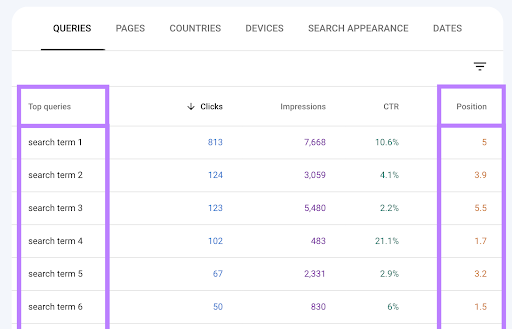
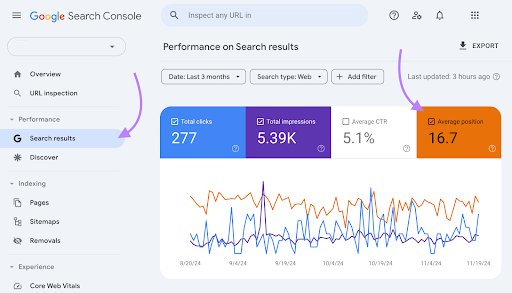
Open Search Console → Performance → Search results. Compare a meaningful period with the previous period and, where seasonality matters, with the equivalent period last year.
Review:
- Organic clicks and impressions across the site.
- Changes in important non-branded queries.
- Pages losing or gaining valuable clicks.
- Click-through rate and average position in the context of query and device.
- Results by country and search type when relevant.
Avoid assuming every traffic decline is an SEO failure. Search demand may have changed, or your website may have started appearing for a broader set of lower-ranking queries. Google explains the Search Console Performance report and its filters in the official documentation.
2. Confirm Organic Conversions Are Still Tracked
Traffic alone doesn’t show whether SEO is helping the business. In GA4 and your lead management records, check forms, calls, purchases, quote requests, and other meaningful outcomes. Where possible, perform a test conversion and verify that the correct event appears.
If forms or tracking tags changed recently, investigate whether attribution or event recording stopped working. A page can maintain its rankings while the reports falsely suggest that leads disappeared.
3. Check Indexing and Crawl Accessibility
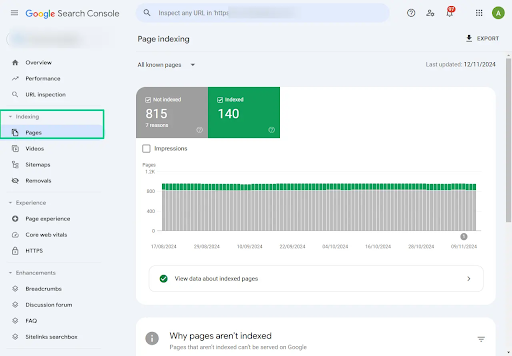
Review GSC’s page indexing report and investigate new exclusion reasons affecting important URLs. Verify representative pages with URL Inspection, especially after redesigns, migrations, template changes, and CMS updates.
Check that:
- Important pages are not unintentionally blocked by robots.txt or noindex.
- Canonical URLs point to the intended versions.
- The XML sitemap lists appropriate canonical, indexable URLs.
- Significant 404, 5xx, redirect, or server problems are diagnosed.
Not every excluded URL is a problem. Duplicate, filtered, and intentionally removed pages often should not be indexed. Investigate unexpected changes to valuable pages, not the total exclusion count alone.
4. Crawl for Broken Links and Redirect Problems
Run a crawler such as Screaming Frog against the website or its priority sections. Review broken internal links, redirect chains, and pages returning unexpected status codes. Start with links in navigation, high-traffic pages, service pages, and pages that have earned external links.
Fix the internal link to the live relevant destination when possible. Use a redirect when a permanently moved URL has a clear replacement. Don’t redirect unrelated deleted pages to the homepage simply to remove 404s from a report.
5. Review Page Experience and Mobile Performance
Inspect Core Web Vitals in Search Console and use PageSpeed Insights to diagnose representative affected URLs. The priority is meaningful user experience problems, especially on mobile, not achieving a perfect synthetic score.
Also check broken mobile layouts, intrusive overlays, forms, navigation, and unexpected changes after development work. For deeper technical work, see the technical SEO checklist and technical SEO services at SEO Specialist USA.
6. Improve Pages Losing Relevant Traffic
Compare search queries and competitor results before updating a page. Common reasons for revising content include incorrect dates or prices, missing information users now expect, outdated examples, or search-intent mismatch.
Make specific improvements. Clarify the answer, add trustworthy examples, remove inaccurate information, improve readability, and review page titles where users do not recognize a relevant result. Changing the publication date alone is not meaningful maintenance.
If one page targets too many unrelated searches, consider whether the site architecture or keyword mapping needs adjustment. However, avoid publishing near-duplicate pages just to cover slightly different keyword wording.
7. Review Internal Linking
New and updated pages should connect to useful existing resources. Check whether priority service pages are supported by relevant blogs, whether new articles are discoverable, and whether important pages are too isolated within the site structure.
Use natural, descriptive anchor text. Every internal link should help a reader find the next useful page. For an example of how this supports content architecture, review what we examine in the first 30 minutes of an SEO audit.
8. Monitor Backlinks and Competitors
Review meaningful new and lost links, brand mentions, and substantial changes in competitors’ relevant content. Not every lost link needs recovery, and low-quality incoming links do not automatically require a disavow file.
Look for realistic opportunities to earn citations or useful links through credible content, partnerships, and industry resources. Don’t treat a fixed number of backlinks as a universal monthly maintenance requirement.
9. Maintain Local SEO Where Relevant
For local businesses, verify Google Business Profile details, hours, service information, and new reviews. Monitor local landing pages and important local search queries. Multi-location businesses may need to audit separate location profiles and pages.
The appropriate cadence differs by task. Our guide on how often local SEO should be updated covers this in greater detail.
10. Document Actions and Share a Monthly SEO Report
A good maintenance report should answer four questions:
- What happened in organic search and business conversions?
- What problems were discovered, and how important were they?
- Which fixes or improvements were implemented and validated?
- What should happen next month, and who owns each action?
This is more useful than a report filled only with keyword rankings and generic statements such as “SEO optimization completed.”
Four-Week Monthly SEO Maintenance Schedule
An easy way to organize recurring work is to assign each week a specific purpose. This is a suggested SEO Specialist USA workflow.
| Week | Main focus | Suggested output |
|---|---|---|
| Week 1 | GSC performance, GA4 conversions, indexing changes | Priority issues and opportunities list |
| Week 2 | Technical crawl, broken links, mobile and site health | Verified technical fix list |
| Week 3 | Content accuracy, page intent, titles, internal linking | Updated high-value pages |
| Week 4 | Local/competitor review, validation, reporting and next plan | Monthly report and action roadmap |
High-priority issues such as outages, security warnings, severe indexing failures, and broken conversion tracking should be handled immediately, regardless of the week.
Monthly SEO Maintenance vs. a One-Time SEO Audit
| Area | One-time SEO audit | Monthly SEO maintenance |
|---|---|---|
| Main purpose | Diagnose existing issues and opportunities | Monitor change, implement fixes, and validate outcomes |
| Timing | At project start or major milestone | Recurring, with urgent checks as needed |
| Deliverable | Findings and prioritized roadmap | Completed work, updated risks, performance summary |
| Main question | What needs attention? | What changed, what was fixed, and what comes next? |
An audit isn’t a substitute for ongoing implementation. Likewise, monthly maintenance doesn’t automatically include a complete sitewide technical audit every 30 days. The scope should match the size and risks of the website.
How Much Does Monthly SEO Maintenance Cost?
There is no standard monthly maintenance price. Cost depends on website size, competition, how often content changes, the number of locations, tracking complexity, and whether the provider only monitors issues or also implements fixes.
Be careful when comparing a low-cost “SEO maintenance” check with a full monthly SEO campaign. One may provide limited monitoring and reporting; the other can include content strategy, on-page changes, technical implementation, local SEO, and legitimate outreach.
Keep your website optimized, technically healthy, and competitive
Our monthly SEO maintenance services focus on identifying issues, implementing improvements, monitoring performance, and supporting long-term organic growth.
Get a SEO ConsultationCan You Handle Monthly SEO Maintenance Yourself?
Yes, particularly for a smaller website with stable content and straightforward technical setup. Business owners can review Search Console, test forms, correct business information, update inaccurate content, and keep useful internal links current.
You may need professional help when the site has complex indexing problems, international or e-commerce architecture, JavaScript rendering, major traffic declines, or changes requiring developer coordination. A specialist can also help prioritize the few issues most likely to affect valuable traffic and conversions.
How SEO Specialist USA Supports Ongoing SEO Maintenance
At SEO Specialist USA, we approach recurring SEO work as a measurable process. We review search performance, check technical health, find content gaps, recommend and implement appropriate improvements, and explain what changed in clear reporting.
Our work can connect technical SEO, content improvement, and ongoing performance analysis so your website receives the attention it needs without unnecessary changes. The objective is to protect useful search visibility while identifying practical opportunities for growth.
Frequently Asked Questions
What is included in monthly SEO maintenance?
Monthly SEO maintenance typically includes checking Search Console performance, reviewing conversions, investigating indexing issues, fixing broken internal links, assessing technical health, updating important content when necessary, and sharing a prioritized report. The exact tasks should match the website’s size, search goals, and complexity.
Do I need to perform SEO maintenance every month?
Most active business websites benefit from a monthly review, but not every task needs monthly changes. A small stable site may need fewer fixes, while high-traffic stores or frequently updated websites often require closer monitoring. Outages, security problems, and critical indexing issues should be addressed as soon as they are detected.
What is the difference between SEO maintenance and monthly SEO services?
Maintenance focuses on monitoring and preserving the site’s technical and content health. Broader monthly SEO services may also build new service pages, develop content, improve conversions, and pursue new keyword opportunities. Ask the provider like SEO Specialist USA which tasks are monitoring only and which include actual implementation.
Should I update all website content every month?
No. Update content when facts change, search intent evolves, or evidence shows a page needs improvement. Unnecessary rewrites can disrupt useful pages without providing benefits. Prioritize pages with outdated information, meaningful traffic losses, weak intent matching, or strong opportunities to serve readers better.
How do I know monthly SEO maintenance is working?
Look for important technical problems being resolved, stable or improving visibility for relevant queries, reliable conversion tracking, and measurable business outcomes. The report should show completed actions and explain the results. Rankings alone can’t establish success, especially when search demand changes.
Can SEO rankings drop even with monthly maintenance?
Yes. Rankings are affected by competition, search behavior, changes to search systems, and the quality of competing results. Maintenance reduces the risk of preventable website problems and supports timely response, but it can’t guarantee specific rankings or prevent every organic traffic decline.
What should I ask an SEO maintenance company before hiring?
Ask what is checked each month, which fixes are included, how content changes are approved, who implements technical updates, which reports you receive, and how results connect to leads or revenue. Confirm ownership of website access, tracking data, and completed work so the process stays transparent.
Final Thoughts
Monthly SEO maintenance works best as a focused routine:
You do not need to change everything every month.
You need to catch important problems, keep useful pages accurate, and direct attention toward the improvements that matter to your audience and business.
Start with the checklist above. If your website needs more technical or strategic support, SEO Specialist USA can help assess priorities and create a clear action plan.
Get Your SEO AuditTalk to an SEO Expert