
SEO helps your business appear for relevant searches, makes your website easier for Google to understand, and gives potential customers useful reasons to choose you. It covers technical improvements, content, local visibility, and trust signals. The real goal isn’t rankings alone. It’s more qualified enquiries and sales.
Key Takeaways
- SEO puts your business in the consideration set. It helps people find relevant pages while they’re researching a problem, comparing providers, or getting ready to buy.
- Good SEO isn’t just a ranking exercise. Useful service pages, clear information, and an easy contact process help search visits become business opportunities.
- Different problems call for different SEO work. An indexing error, a weak service page, and an incomplete Google Business Profile don’t need the same fix.
- Search has changed. AI-generated answers can reduce clicks for some searches, making the relevance and quality of visits more important than raw traffic.
- You should be able to see what your SEO provider did. Ask which pages changed, what was measured, and how those changes connect to your customers.
Imagine a Customer Needs Your Service Tomorrow
It’s 9 in the evening. A homeowner in Dallas discovers water dripping from the ceiling. She opens Google and searches emergency roof repair Dallas.
She isn’t looking for a definition of roofing or a lengthy history of shingles. She wants someone local who can explain emergency repairs, show that the company handles her problem, and make it easy to call.
Now imagine two roofing websites.
Website A has a homepage that says Quality Solutions for Every Need. Its service pages are difficult to find, the phone number is buried, and Google has trouble accessing an important page.
Website B has a clear emergency roof repair page with accurate service areas, helpful next steps, examples of work, and a visible contact option. Its business details are consistent, and the site is accessible on mobile.
SEO is the work that helps a website become more like Website B. That doesn’t guarantee the homeowner will choose it, but it removes important barriers between a real search and a potential enquiry.
This is a fictional teaching example, not an SEO Specialist USA client case study.
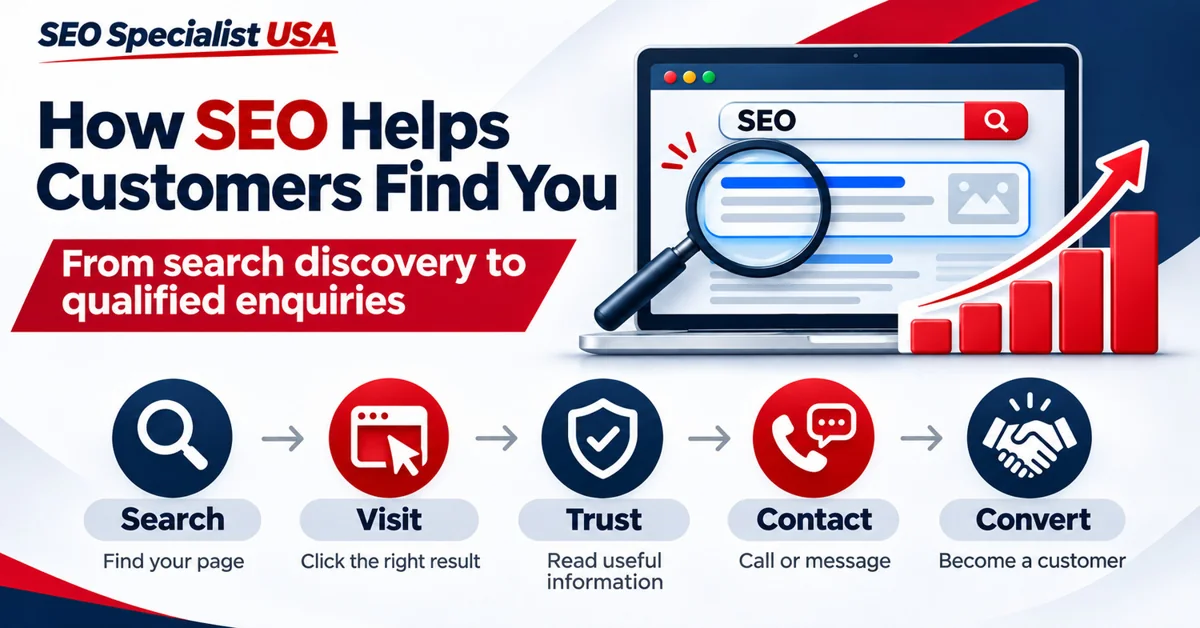
How customers move from discovery to an enquiry and a sale
The Five Jobs SEO Actually Performs
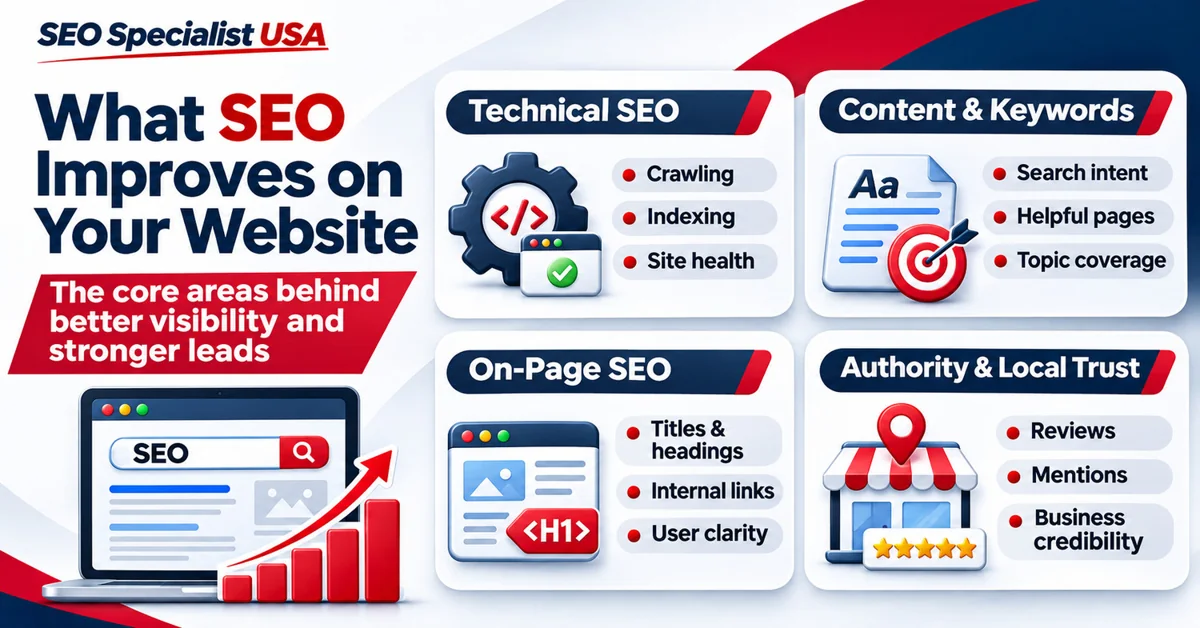
Four areas SEO can improve: technical foundations, content, on-page clarity, and trust
|
Customer moment |
What SEO helps with |
What the business gains |
|---|---|---|
|
1. Discovery |
Helps the right pages become crawlable, indexable, and relevant to searches |
A better chance of appearing for suitable queries |
|
2. Understanding |
Explains services, locations, pricing considerations, and customer questions clearly |
Visitors can quickly tell if the business fits |
|
3. Trust |
Supports accurate information, useful evidence, and a coherent online presence |
More confidence to compare or contact the business |
|
4. Action |
Helps visitors reach a clear booking, quote, or contact path |
Fewer avoidable obstacles to enquiries |
|
5. Learning |
Measures queries, landing pages, and meaningful customer actions |
Better decisions about the next improvement |
1. SEO Helps Search Engines Discover Your Important Pages
Google’s search process includes crawling, indexing, and serving results. An SEO specialist checks that your useful pages are accessible and that technical errors aren’t hiding them. This can include reviewing indexing directives, internal links, redirects, navigation, and how pages behave on mobile.
Think of it this way: if your best service page can’t be found or understood, better wording alone won’t solve the problem. Google’s own SEO Starter Guide stresses helpful content and crawlable links, not secret tricks.
2. SEO Matches Your Website to What Customers Actually Want
A search for how much does a new roof cost needs a different answer from hire roof repair company near me. One person is researching; the other may be ready to request an estimate.
SEO helps decide which pages should answer which questions. That often means improving service pages, writing genuinely useful guides, and avoiding a pile of near-identical pages targeting slight keyword variations.
For a service business, a useful page might explain what the service includes, who it’s for, common questions, and how to get started. For an online store, it might mean clearer category pages and product information.
3. SEO Helps Nearby Customers Evaluate Your Business
Local SEO adds a place-based layer for eligible businesses. It involves accurate Google Business Profile information, relevant categories, service details, location-specific pages, and legitimate review practices.
The need for trust is measurable. In BrightLocal’s 2026 Local Consumer Review Survey, 54% of respondents said they visit a business website after reading positive reviews. In a separate 2026 consumer behavior study, only 6% said they simply click the top local result.
That doesn’t mean reviews or SEO guarantee a sale. It means customers evaluate much more than position alone: proximity, relevant services, business information, reviews, and what they find on your website all influence their choices.
If you serve a specific area, our local SEO services are designed around helping nearby customers discover accurate information about your business.
4. SEO Makes a Useful Visit Easier to Turn Into an Enquiry
Getting a visitor isn’t the finish line. Imagine a page that ranks well but has a confusing contact form, missing pricing context, and a phone number that’s hard to find on mobile.
SEO work often reveals these gaps because an SEO specialist studies the searcher’s intent and the landing page together. Fixing the experience may involve clearer service copy, more helpful links, a better page structure, and sensible recommendations for the contact path.
Not all of these are direct Google ranking factors. They’re still important to the commercial value of organic traffic.
5. SEO Shows You What to Improve Next
Google Search Console can show which queries and pages receive impressions and clicks. Analytics and business records can help connect visits with form submissions, calls, bookings, or purchases, depending on your tracking setup.
A competent SEO provider doesn’t just send a chart saying traffic increased. They explain which pages changed, what the data suggests, what hasn’t worked, and what should happen next.
That’s also the thinking behind our guide to prioritizing SEO work: fix the problem that matters rather than completing a long checklist simply to appear busy.
What Do the Numbers Say About SEO Today?
|
Research finding |
What it actually tells a business owner |
|---|---|
|
54% of respondents visited a business website after positive reviews (BrightLocal, 2026) |
Reviews can lead people to investigate your site before buying |
|
6% of local consumers said they simply clicked the top result (BrightLocal, 2026) |
Visibility matters, but the listing and website still need to earn trust |
|
8% vs. 15% traditional-result click rates in searches with versus without AI summaries in an observed sample (Pew, 2025) |
Some informational clicks are becoming harder to earn |
|
two and a half billion+ monthly AI Overviews users reported by Google in 2026 |
Customers are increasingly encountering AI-assisted search experiences |
A note on evidence: The BrightLocal figures come from consumer surveys, the Pew result comes from observed browsing activity, and Google’s figure describes product usage. They measure different things. None is a forecast of your own SEO traffic or conversion rate.
The Pew Research Center study reported traditional-result clicks in 8% of sampled Google searches with an AI summary, compared with 15% without one. This is one reason we don’t recommend judging every SEO campaign by visits alone.
Meanwhile, Google reported in 2026 that AI Overviews had more than two and a half billion monthly active users. Useful, accessible, credible content still matters, but the formats in which people discover it are changing.
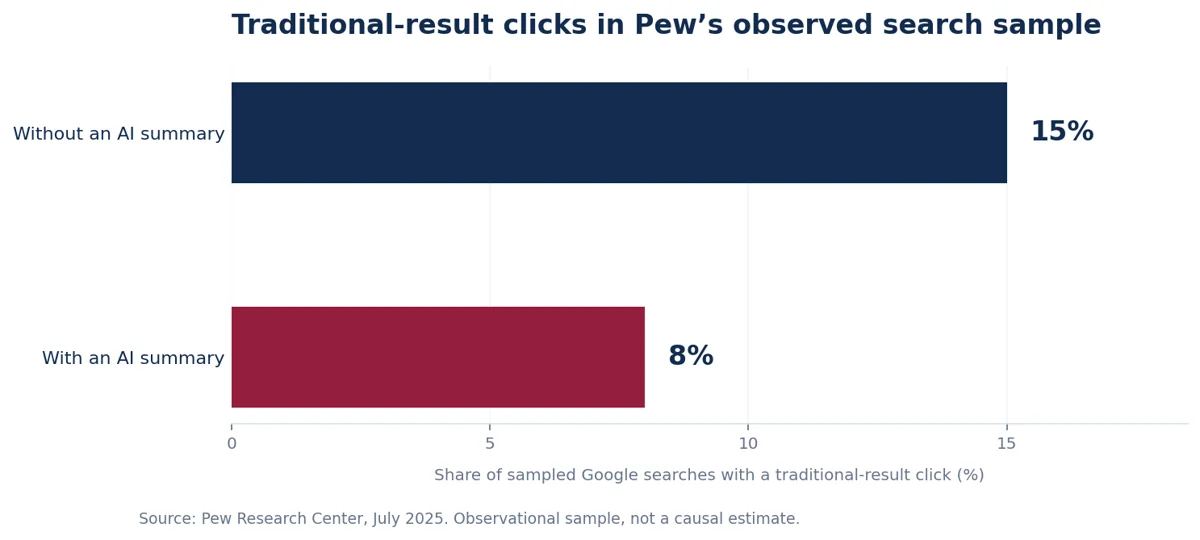
Pew Research Center 2025: traditional-result clicks in observed searches with and without AI summaries
What Business Owners Are Saying on Reddit
It’s worth listening to people who have already hired SEO providers, especially when their experiences aren’t flattering.
In a July 2025 r/smallbusiness discussion, a business owner described paying for months of SEO without getting a call. Other participants debated the importance of seeing specific deliverables and understanding the difference between rankings and customer enquiries.
In a separate r/SEO conversation about agency reporting, a client asked how to look beyond ranking charts and tell if SEO actually generated leads or sales. Respondents emphasized organic-source reporting and meaningful actions such as calls and submitted forms.
These are individual, unverified accounts posted publicly on Reddit, not independently audited results or a representative survey. But the concern is useful: If you’re investing in SEO, you should understand the work and the business purpose behind it.
At SEO Specialist USA, that’s the standard we recommend holding an agency to, including us.
How Does SEO Turn Into Money for a Business?
SEO doesn’t directly create revenue in the way a checkout button charges a customer. It improves the chances that appropriate customers will find you and take the next step. Your pricing, service quality, availability, sales process, and competition still matter.
Here’s a fictional monthly example for a local service company:
|
Stage |
Illustrative figure |
|---|---|
|
Visits from organic search |
500 |
|
Enquiries attributed to those visits |
20 |
|
Enquiries that match the service area and needs |
12 |
|
Booked jobs |
4 |
|
Average revenue per booked job |
$1,500 |
|
Revenue associated with those four jobs |
$6,000 |
That doesn’t mean $6,000 is SEO profit. You’d still subtract job delivery costs, agency fees, and other expenses, and consider how many bookings would’ve happened without the SEO work.
The useful measurement is the progression from relevant discovery to qualified business, not an isolated ranking or a big traffic number.
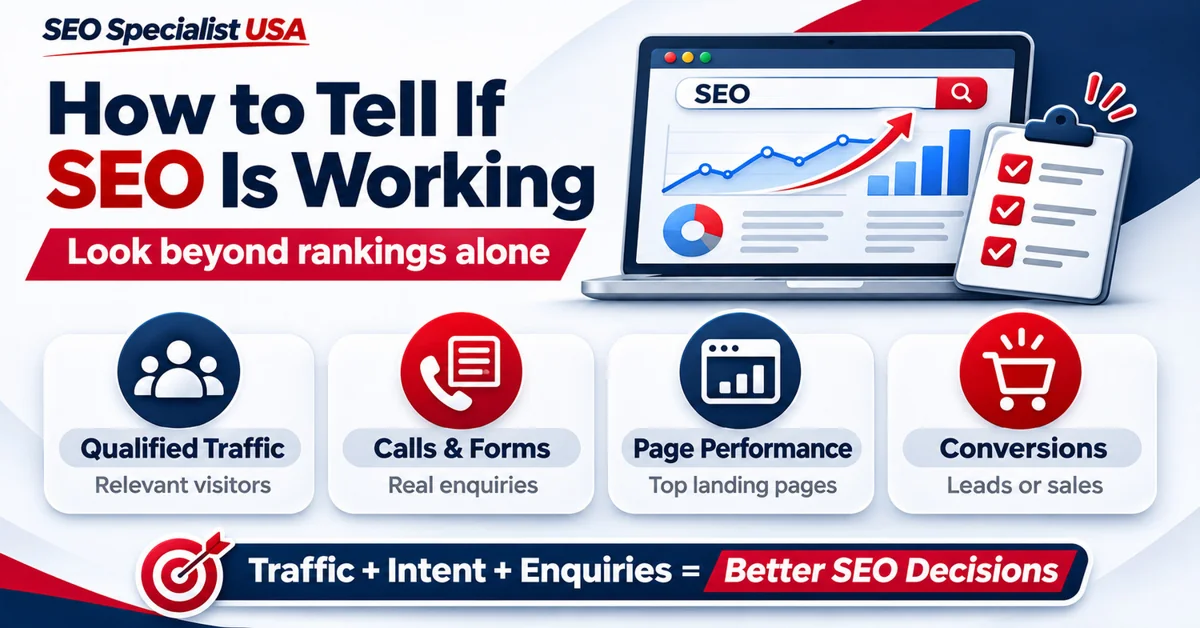
Measure SEO through relevant visits, enquiries, page performance, and conversions
A Realistic 90-Day SEO Roadmap for a Small Business
You don’t need to learn every SEO tool or buy every service on day one. Start with the pages and customer actions that matter most.
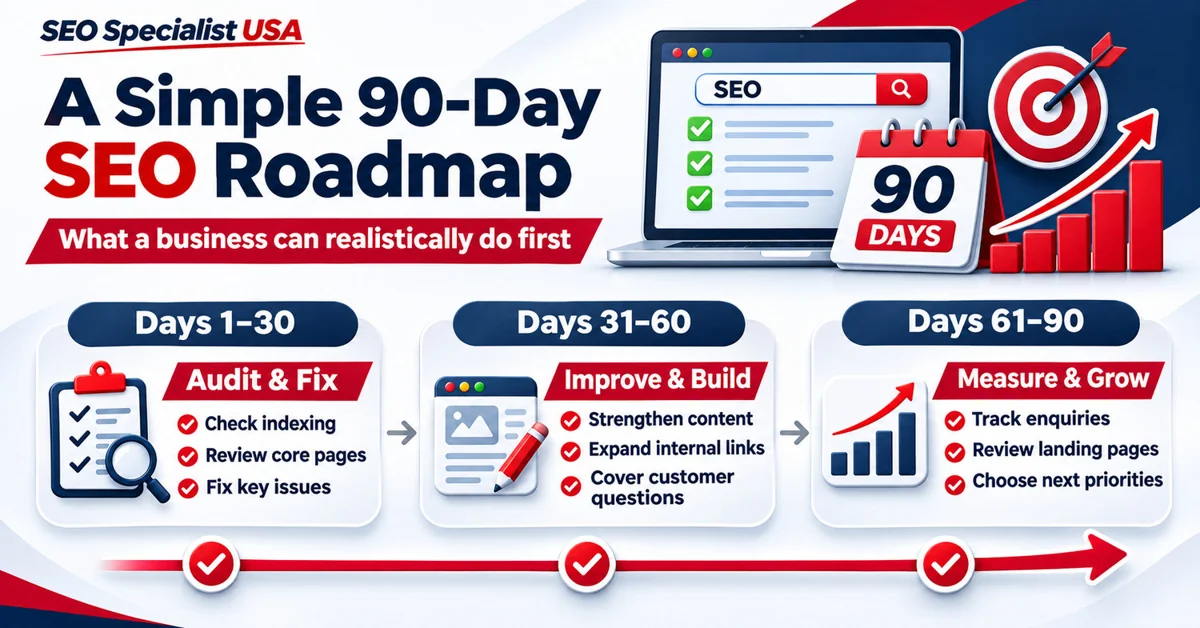
A practical 90-day SEO plan for small businesses
Days 1–15: Find Out What’s Actually Happening
- Identify your most profitable or highest-priority services
- Review Google Search Console and available analytics
- Check if important pages can be indexed and found
- Look at the search intent behind your current traffic
- Check the mobile contact process yourself
- For local businesses, review Google Business Profile accuracy
Deliverable: A short baseline report showing what works, what’s missing, and the three highest-priority opportunities.
Our first 30 minutes of an SEO audit article shows how we approach this kind of initial review.
Days 16–30: Fix the Foundations
- Address important indexing or navigation problems
- Improve titles, headings, and service descriptions where needed
- Make the business’s service areas and contact options clear
- Strengthen useful internal links between related pages
- Confirm that key enquiries can be measured
Deliverable: A change log with the exact pages and problems fixed, rather than vague notes saying SEO completed.
Days 31–60: Build Where Customer Demand Exists
- Improve one or two priority pages based on actual search intent
- Publish genuinely useful content for unanswered customer questions
- Update evidence of your work, policies, and business details
- Address relevant local visibility gaps if your business qualifies
- Review early Search Console patterns without overreacting to normal fluctuations
Deliverable: Better-targeted pages and a documented explanation of why each change was made.
Days 61–90: Review Qualified Enquiries and Choose the Next Move
- Compare relevant landing pages and queries with the baseline
- Evaluate calls, form submissions, booked consultations, or sales where tracking supports it
- Identify pages receiving suitable traffic but few enquiries
- Decide which improvements need continued work and which can wait
- Set the next period’s priorities based on evidence
Deliverable: A plain-English review of completed work, early signals, limitations, and the next actions. Ninety days is a planning checkpoint, not a promise of rankings or profit by day 90.
Do You Need SEO Services or Can You Do It Yourself?
You can handle basic tasks yourself: keep business information accurate, write genuinely helpful service descriptions, check your site on mobile, and learn the fundamentals of Search Console.
Professional help becomes more valuable when your site has technical barriers, your competitors are stronger, your business has multiple services or locations, or you’ve invested in marketing without understanding where customers are being lost.
Before hiring anyone, ask for answers to these five questions:
- What’s the first problem you’d fix on my website?
- Which pages and customer searches matter most to my business?
- What work will you actually deliver this month?
- How will we tell qualified enquiries from irrelevant traffic?
- What would make you change the plan?
If an agency can’t explain its answers in plain English, a larger package isn’t automatically the solution.
How SEO Specialist USA Can Help Your Business Grow
At SEO Specialist USA, we look at SEO through a business owner’s eyes. A ranking is useful when it helps the right person discover your business. A new page is useful when it answers a real customer question. A technical fix is worthwhile when it resolves a meaningful barrier.
Our work can cover technical SEO, content strategy, on-page improvements, local SEO, and search performance measurement. The right mix depends on your market, website, and goals.
We’d rather discuss the pages that deserve attention than recommend a long list of activities without context. If you’re uncertain about your next step, start by reviewing your current search visibility and the quality of the enquiries you’re receiving.
Frequently Asked Questions
What exactly does SEO do for a business?
SEO helps people find a business through relevant organic searches. It improves website accessibility, content usefulness, and search visibility. For businesses, the practical goal is attracting suitable visitors who may later request information, call, book an appointment, or purchase.
Does SEO help you get more customers?
SEO can help generate more customer opportunities by making a business visible for relevant searches. It can’t guarantee sales. Results also depend on the strength of your offer, competition, service quality, pricing, and how effectively your website converts visitors.
Does SEO only mean ranking number one on Google?
No. Rankings are one measurement, not the final business goal. SEO also involves helping visitors find accurate information, understand services, and take useful actions. A lower-volume query that generates qualified enquiries may be more valuable than a popular, irrelevant keyword.
How long does it take for SEO to work?
SEO improvements can take days or months to be reflected in search results. More competitive goals often require sustained evaluation. A responsible plan measures implementation, indexing, relevant visibility, and enquiries rather than guaranteeing a particular position by a fixed date.
Can SEO work without paid advertising?
Yes. SEO focuses on unpaid search visibility, although creating and maintaining useful website content still costs time or money. Paid ads aren’t required for organic rankings. Businesses sometimes combine both approaches because they serve different needs and time horizons.
Is SEO still useful with ChatGPT and AI search?
Yes. Businesses still need accessible, accurate, helpful information as people discover options through traditional and AI-assisted search. Some searches now generate fewer clicks, so tracking qualified visits and business outcomes is increasingly important. No agency can guarantee AI citations.
What does an SEO agency do each month?
Monthly work may include diagnosing performance changes, improving key pages, fixing technical problems, building helpful content, and reviewing local visibility. A good agency should explain completed tasks, relevant results, outstanding issues, and which work deserves attention next.
How can I tell if SEO is worth paying for?
Track the quality of organic enquiries, booked jobs, sales, and the costs needed to acquire those customers. Ask for a change log and clear reporting. Avoid judging the investment by keyword positions, total traffic, or backlink counts alone.
Final Thoughts
SEO isn’t a magic switch that turns a website into a sales machine. It’s the ongoing work of helping the right people find the right information about your business, then giving those visitors a clear next step.
If your website isn’t attracting suitable customers, you don’t need a bigger list of SEO buzzwords. You need to know what’s preventing people from finding you or choosing you.
At SEO Specialist USA, we’re ready to help you identify those priorities and build a sensible plan around your business goals.
Sources and Further Reading
- Google Search Central: SEO Starter Guide
- Google Search Central: How Google Search Works
- BrightLocal: Local Consumer Review Survey 2026
- BrightLocal: Consumer Search Behavior Study 2026
- Pew Research Center: Click Behavior With AI Summaries, 2025
- Google: New Opportunities and Insights for Website Owners, 2026
- Reddit r/smallbusiness: SEO agency experiences
- Reddit r/SEO: What clients expect in reports