
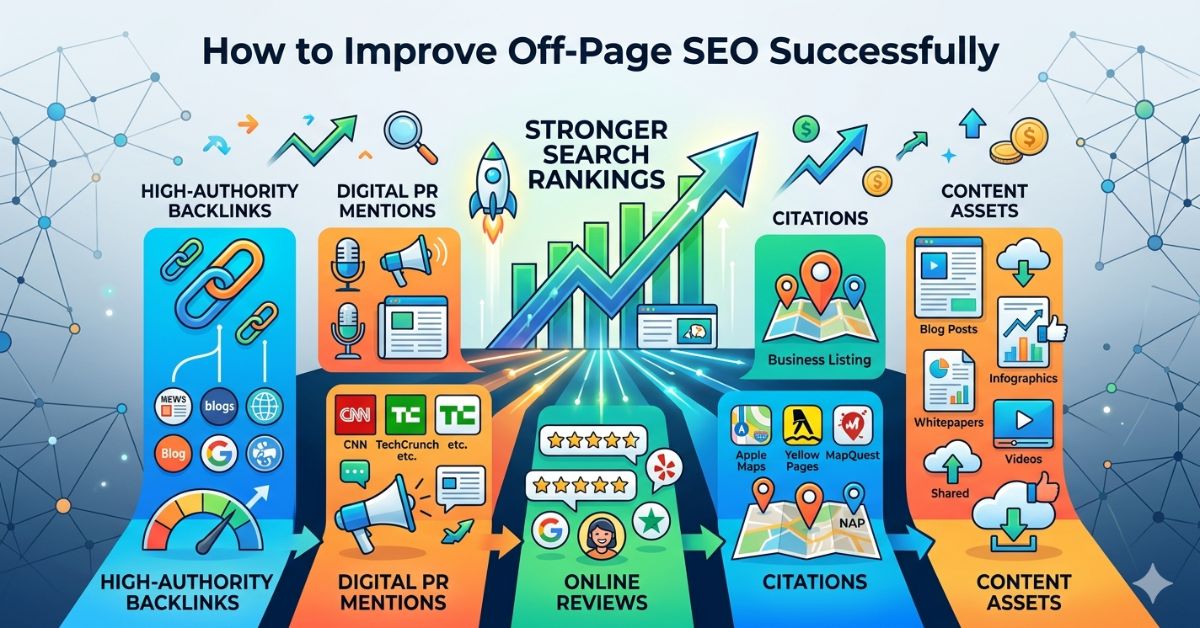
To improve off-page SEO, focus on earning high-quality backlinks from relevant and authoritative websites, building consistent citations across major directories, generating fresh customer reviews, executing a digital PR strategy that earns press coverage, and creating linkable content assets that naturally attract links over time. The most effective off-page SEO improvements come from combining several of these strategies consistently, not from any single tactic in isolation.
Key Takeaways
-
 Backlink quality and topical relevance outperform quantity, 10 strong editorial links beat 500 low-quality directory links
-
Content assets (original research, in-depth guides, data-driven studies) are the most sustainable way to earn links at scale
-
Digital PR generates some of the highest-authority backlinks available because editorial links from news and industry sites carry significant trust
-
Local citation cleanup and consistency should be addressed before building new links, bad data undermines good links
-
Review velocity and response rate are off-page signals that directly affect local rankings
-
Monitoring your backlink profile monthly allows you to catch toxic links before they cause ranking issues
Why Most Off-Page SEO Efforts Fail
The most common reason off-page SEO doesn’t produce results is strategy mismatch. Businesses either focus on volume over quality, building hundreds of low-authority directory links that Google discounts, or they work on tactics in isolation, building links without fixing on-page issues that prevent those links from improving rankings.
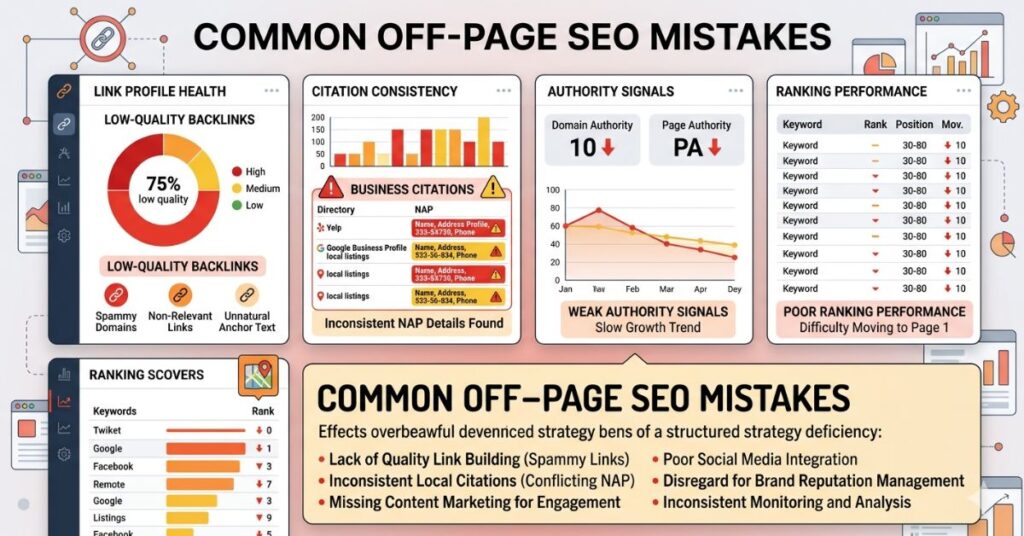
Effective off-page SEO requires a clear understanding of your current backlink profile, your competitors’ link profiles, and the specific tactics best suited to your industry and content assets.
Start with a clear picture of your current off-page standing. Request a off-page SEO audit to identify exactly where the gaps are.
Strategy 1: Build Links Through Original Content Assets
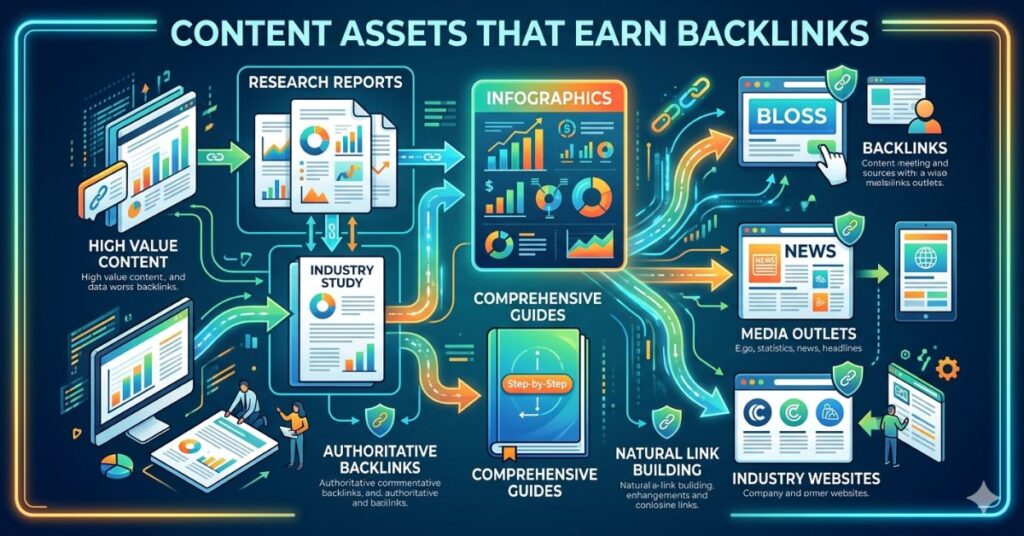
The most sustainable link building strategy is creating content so useful, data-rich, or insightful that other websites naturally link to it as a reference. These linkable assets attract links passively once they are indexed and discovered.
Types of Content That Earn Links Naturally
- Original research and industry surveys: Data no one else has published compels journalists and bloggers to cite you as the source
- Comprehensive topic guides: In-depth, definitive guides on subjects within your expertise become reference pages that accumulate links over time
- Unique tools and calculators: Interactive resources (cost calculators, comparison tools) attract links from people who find them genuinely useful
- Infographics and visual data: Original statistics presented visually get shared and embedded with attribution links
- Case studies with measurable outcomes: Documented results attract links from industry publications and practitioners looking for real-world evidence
For help creating content that earns authority, explore SEO Specialist USA’s content creation services.
Strategy 2: Digital PR and Editorial Outreach
Digital PR involves pitching original stories, expert insights, data findings, and newsworthy content to journalists, editors, and publishers in your industry. When coverage results in a publication linking to your website, that editorial backlink carries significantly more authority than any link you could build through outreach alone.
Digital PR Tactics That Generate Backlinks
- Expert commentary and quotes: Position yourself as an industry voice by responding to journalist queries through platforms like HARO (Help a Reporter Out) or Connectively, where reporters actively seek expert sources
- Data-led press releases: Original statistics and research attract press coverage. A well-crafted data story sent to relevant publications can earn multiple editorial links from a single content piece
- Newsjacking: Responding quickly to breaking news with relevant expert commentary positions your brand as a source and earns timely links from news coverage
- Award and recognition submissions: Industry award listings often include links back to the winning business website
Understand how press releases fit into an off-page strategy by reading are press releases good for SEO.
Strategy 3: Broken Link Building
Broken link building involves finding pages on authoritative websites that link to dead or redirected pages, then contacting the site owner to suggest replacing the broken link with a link to your relevant, live content. This tactic is effective because it provides genuine value to the site owner (fixing a broken user experience) while earning a link.
How to Execute Broken Link Building
- Use Ahrefs, Semrush, or the Check My Links Chrome extension to find broken outbound links on relevant websites in your niche
- Identify which of your existing content (or new content worth creating) would be a natural replacement for the broken link target
- Contact the site owner or editor with a clear, brief message pointing out the broken link and suggesting your content as a replacement
- Personalize each outreach email, templated mass outreach produces low response rates
Strategy 4: Guest Posting on Relevant Publications
Contributing original articles to respected websites in your industry earns editorial backlinks, builds brand authority, and drives referral traffic. Guest posting works when it is approached as a genuine editorial contribution, not as a link placement scheme.
Guest Posting Best Practices
- Prioritize relevance over domain authority alone, a link from a mid-authority site in your exact industry is more valuable than one from a high-authority site with no topical connection
- Pitch original, valuable content ideas rather than recycled or generic articles
- Include one natural, contextually relevant link to your site per article, avoid stuffing multiple links
- Build ongoing relationships with editors rather than treating each placement as a one-off transaction
Guest posting in exchange for payment or with links that are not disclosed as sponsored violates Google’s guidelines. Stick to genuine editorial contributions where the content earns its placement.
Strategy 5: Local Citation Building and Cleanup
For businesses serving a local market, citation building is a foundational off-page SEO task. Citations (mentions of your name, address, and phone number on directories and local platforms) build geographic authority that influences local rankings.
Citation Improvement Process
- Run a citation audit to identify inconsistent or incorrect NAP data across existing listings
- Fix all inconsistencies before building new citations, adding new citations on top of bad data amplifies the problem
- Submit to core data aggregators (Data Axle, Neustar Localeze, Foursquare) to ensure your correct data propagates across the directory ecosystem
- Build citations on industry-specific directories relevant to your business category
- Add listings on local community sites, chambers of commerce, and neighborhood platforms for geographic relevance
Strategy 6: Review Generation and Management
Customer reviews are an off-page signal that affects both local search rankings and click-through rates from search results. A systematic review strategy builds the social proof and ranking signals that passive review accumulation never achieves.
- Send review request messages within 24 to 48 hours of a positive customer interaction while satisfaction is at its highest
- Include a direct link to your Google review profile in the request, reducing friction significantly increases completion rates
- Respond to every review, positive or negative, within 24 hours
- Monitor review platforms beyond Google: Yelp, Trustpilot, G2, Capterra, and industry-specific platforms depending on your sector
- Never incentivize reviews or write fake ones, both violate platform guidelines and can result in penalties or profile suspension
Strategy 7: Monitoring and Disavowing Toxic Links
Off-page SEO improvement is not only about building new links, it is also about protecting your link profile from harmful links. Spammy, irrelevant, or manipulative links pointing to your site can dilute your link authority or, in severe cases, trigger a manual penalty.
- Review your backlink profile monthly using Google Search Console, Ahrefs, or Semrush
- Flag links from known link farms, PBN networks, unrelated foreign-language sites, and over-optimised anchor text patterns
- Use Google’s Disavow Tool to tell Google to ignore links that cannot be removed manually
Learn how to check and interpret your backlink data in how to check backlinks in Google Search Console.
How SEO Specialist USA Improves Off-Page SEO
SEO Specialist USA executes structured off-page SEO improvement campaigns built around your site’s specific authority gaps, competitive landscape, and content assets. The team handles link prospecting, outreach, citation management, review strategy, and digital PR, with transparent monthly reporting on every link built and every citation updated.
Frequently Asked Questions