
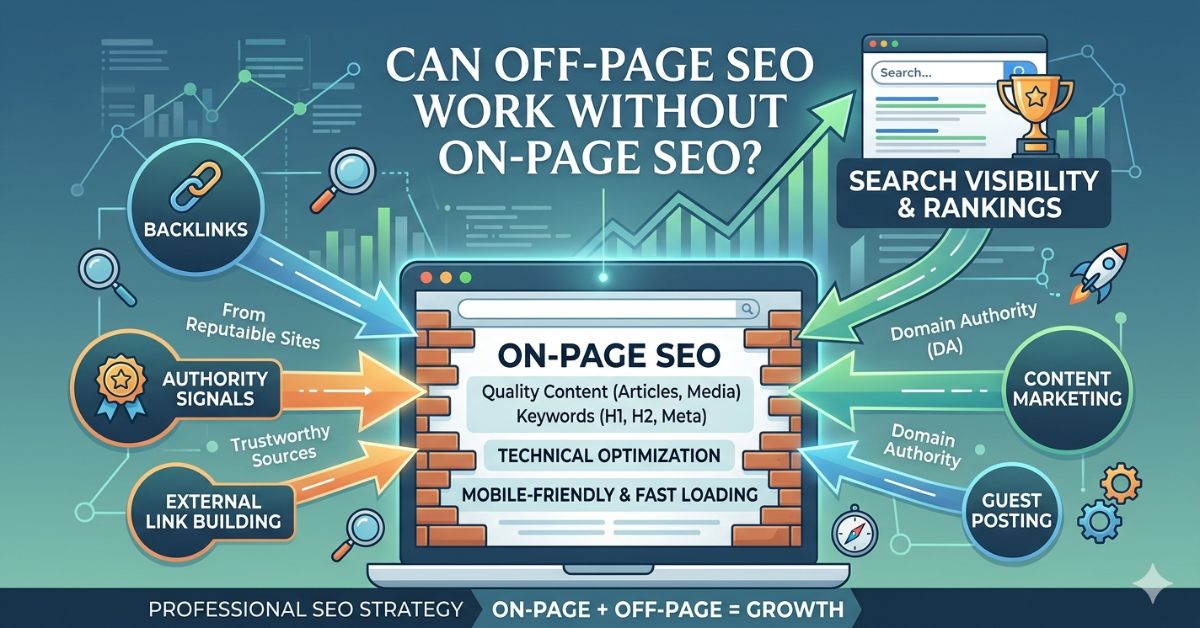
Technically yes, but it rarely produces lasting results. Off-page SEO without on-page SEO is like driving traffic to a closed shop. You can build strong backlinks and earn brand authority, but if Google cannot properly crawl, understand, or index your pages due to poor on-page optimization, those off-page signals cannot fully translate into rankings. The two disciplines work as a system, off-page authority amplifies on-page relevance, and on-page quality makes off-page effort worthwhile.
Key Takeaways
-
 Off-page SEO and on-page SEO are complementary, not interchangeable, doing one without the other consistently underperforms doing both
-
In very low-competition niches, off-page links alone can produce rankings even with weak on-page SEO, but this is the exception, not the rule
-
Poor on-page SEO wastes the authority off-page links provide, Google cannot rank a page for a keyword if the page does not clearly signal relevance for that keyword
-
The most common real-world scenario where this question arises: businesses that have invested in link building but neglected on-page optimisation and see poor ranking results
-
The correct sequence is: fix technical and on-page SEO first, then build off-page authority on a solid foundation
Why Both On-Page and Off-Page SEO Are Necessary
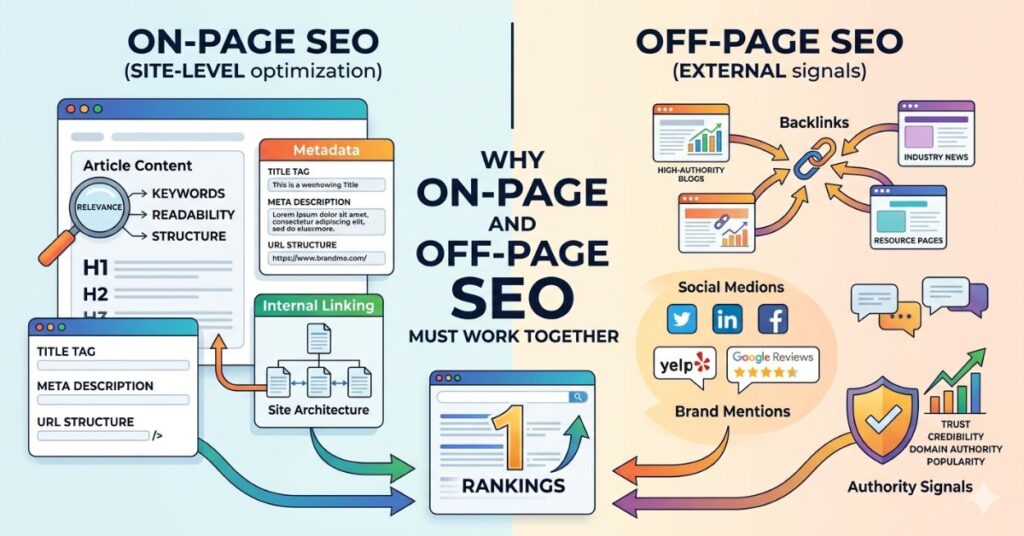
Google’s ranking process involves two fundamental assessments for every page. First, relevance: is this page actually about what the user searched for? Second, authority: should this page be trusted enough to rank highly for that query? On-page SEO determines relevance. Off-page SEO builds authority. Neither question can be answered by the other’s signals alone.
A page with excellent on-page optimisation but no off-page authority signals will rank for low-competition terms where no competing pages have links. As competition increases, authority becomes the tiebreaker, and that page will plateau below well-linked competitors.
A page with strong off-page authority but poor on-page optimisation will send mixed signals to Google. The links say the page is valuable, but the page’s content does not clearly match the query. Google may rank it for loosely related terms but will not reliably rank it for the specific queries it could rank for with proper on-page SEO.
What Happens When You Do Off-Page Without On-Page
Wasted Link Equity
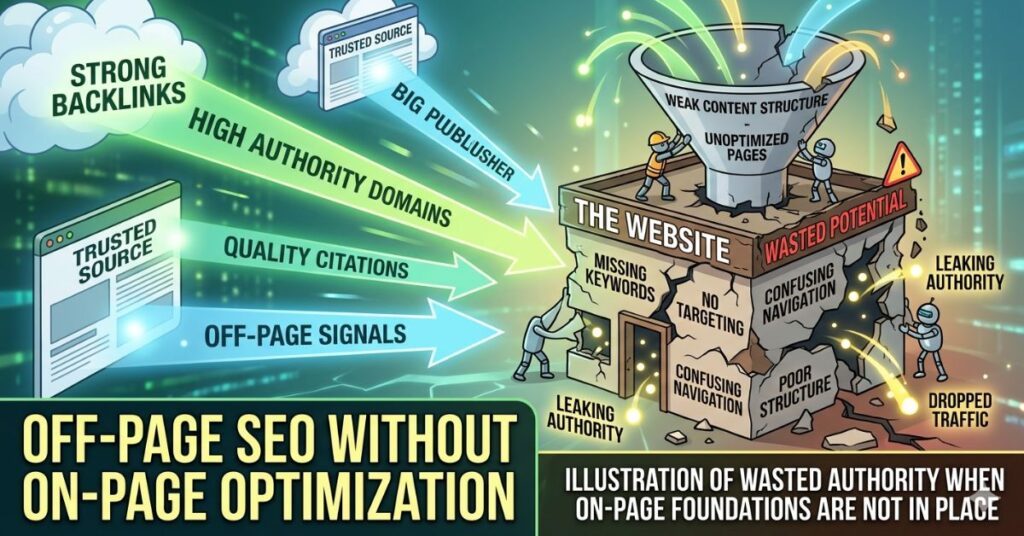
When a page has strong inbound links but poor on-page optimization, the authority passed by those links is partially wasted. The page lacks the content depth, keyword relevance, and structural clarity that would allow Google to confidently assign it top positions for target queries. You are funding a ranking campaign for a destination that is not ready to receive it.
Rankings for Wrong Keywords
Without on-page optimization directing Google’s understanding of what a page is about, links alone may produce rankings for unintended queries. A page about ‘commercial roofing services’ that lacks proper on-page optimisation but has acquired links might rank for tangential terms while missing the primary target keyword entirely.
Poor Conversion Rates
Even when links push a page into rankings without on-page support, the landing experience for users is often poor. Pages with weak content structure, unclear calls to action, and missing trust signals convert traffic at significantly lower rates. High rankings with low conversion rates produce minimal business value.
Short-Term Gains, Long-Term Fragility
In some scenarios, off-page authority alone can temporarily push a page into the top ten for a competitive query. However, these positions are fragile. Competitors with equivalent or better on-page optimisation alongside similar link profiles will consistently outrank a page that relies solely on accumulated authority without content quality.
What Happens When You Do On-Page Without Off-Page
The inverse situation is equally limiting but more commonly misunderstood. Businesses that invest heavily in on-page SEO, excellent content, perfectly optimised title tags, schema markup, fast pages, and neglect off-page authority building will:
- Rank well for low-competition, long-tail queries where no competitor has built link authority
- Struggle to move above positions 8 to 20 for any moderately competitive term
- Find that adding more on-page content produces diminishing returns beyond a certain point because the authority ceiling prevents further ranking improvement
- Lose ground over time as competitors build authority while they remain static
On-page SEO without off-page investment is the most common reason websites plateau, the work is visible, the investment feels productive, but the missing authority piece keeps competitive keywords out of reach.
The Right Order: Foundation Before Authority
For businesses building or rebuilding SEO from scratch, the correct sequence is:
- Step 1: Fix technical SEO issues, crawlability, indexation, page speed, mobile usability, Core Web Vitals. Technical problems limit the impact of all other SEO work.
- Step 2: Build on-page foundations, keyword research, optimised title tags and meta descriptions, structured content, internal linking, and schema markup. Each page should clearly communicate its relevance for its target keyword.
- Step 3: Begin off-page authority building, start with citation management and foundational directory listings, then move into editorial link building, digital PR, and content-led link earning.
- Step 4: Maintain and compound, continue content production, link building, and technical monitoring as an ongoing effort rather than a one-time project.
This sequence ensures that every link built has a well-optimised page to point to, maximising the ranking impact of each off-page investment.
To start with technical foundations, explore technical SEO services. For on-page optimisation, see on-page SEO services.
When Off-Page SEO Temporarily Works Without On-Page
There are narrow scenarios where off-page SEO produces rankings without solid on-page foundations:
- Very low-competition queries where no competitor has any significant authority, the page wins by default
- Branded queries where Google’s entity recognition of the brand does the relevance work
- Pages that rank for queries broadly related to their general domain topic even without keyword-specific optimisation
These scenarios are the exception rather than the norm, and they do not scale. As competition in any market increases, the ceiling imposed by weak on-page SEO becomes the limiting factor regardless of link strength.
How SEO Specialist USA Integrates Both Disciplines
SEO Specialist USA builds integrated SEO campaigns that address on-page, technical, and off-page SEO as a coordinated system. Every client engagement begins with an audit that identifies the relative state of all three pillars, then prioritises fixes and investments in the sequence that produces the fastest and most durable ranking improvements.
Clients do not have to choose between on-page and off-page, both are covered within a single strategy built around their specific competitive situation and business goals.
Frequently Asked Questions