

The four commonly taught types of SEO are on-page, off-page, technical and local SEO. On-page work improves the usefulness of individual pages. Off-page work concerns relevant recognition beyond the website. Technical SEO helps search engines discover and process important pages. Local SEO helps nearby customers identify and contact eligible businesses. These categories overlap; they are a teaching framework, not four separate Google ranking systems.
Key takeaways
- Match the work to a verified problem rather than buying an equal amount of every SEO service.
- Useful content cannot compensate for a page that search engines cannot access or index.
- Relevant editorial links and genuine business recognition matter more than a raw backlink count.
- Local SEO combines accurate business information with useful pages and working contact routes.
- Measure suitable enquiries and customer outcomes alongside rankings and traffic.
A business can have several problems at once. Its service page might answer the wrong question, a migration might have broken important URLs, and its public business listing might show outdated hours. Publishing another article will not repair all three. A useful audit separates the findings, records evidence and assigns an implementation owner.
The four types of SEO at a glance
On-page
Main question: Does this page answer the customer’s search need?
Useful evidence: Relevant queries, clear service information and qualified enquiries
Off-page
Main question: Does the wider web recognize the business for a legitimate reason?
Useful evidence: Relevant referring websites, editorial mentions and referral visits
Technical
Main question: Can search engines reach and process the intended pages?
Useful evidence: URL Inspection, indexing information and crawl findings
Local
Main question: Can nearby customers understand and contact the right business?
Useful evidence: Accurate profile information and tested customer journeys
Different guides classify SEO differently. For example, Ahrefs’ types-of-SEO guide distinguishes the core disciplines and specialist applications. Local SEO is useful to discuss alongside the other three because geography changes a customer’s search and buying journey. It is not the only additional specialty: international, ecommerce and enterprise SEO can introduce their own requirements.
1. On-page SEO: Make the page a useful answer
On-page SEO improves the information and navigation on individual pages. It includes search intent, titles, main headings, explanations, supporting evidence and internal links. The aim is to give the intended visitor a clear and trustworthy answer, rather than repeat a keyword throughout the text.
Imagine a commercial cleaning company targeting office cleaning in Chicago. Its page lists generic benefits but never explains which buildings it serves, what a visit includes, whether evening work is available or how a property manager can request a quote. The immediate gap is useful service information.
What to examine on an important page
- Identify whether visitors want to learn, compare, book or buy.
- Give each important page a distinct job. Review overlapping URLs before creating another near-identical page.
- Use a clear title and introduction that accurately describe the offer and audience.
- Add relevant service details, limitations, genuine examples and practical next steps.
- Link to the contact page or another useful resource where it helps the reader.
Search Console can show the queries and pages receiving impressions and clicks. If a page appears for relevant queries but gets few clicks, inspect its search appearance and competing results. If people visit but do not enquire, check the offer, trust information and contact path. These observations guide investigation; they do not prove a single ranking cause.
Google’s SEO Starter Guide recommends descriptive titles and helpful content. Modern matching systems can understand related terms without every variation being repeated verbatim. A practical deliverable is a page improvement brief naming the audience, missing information, links and intended visitor action. Explore on-page SEO support when this is your main constraint.
2. Off-page SEO: Earn relevant recognition
Off-page SEO concerns references originating outside the website. Editorial backlinks are a familiar example, alongside relevant coverage and genuine business recognition. Not every mention is a ranking signal, and counting links alone does not establish their quality.
A roofing contractor might create a useful severe-weather inspection resource that a regional publication cites. That reference can introduce a relevant audience and provide an editorial link. Its value comes from why the resource was cited and who finds it useful.
What good off-page work looks like
- Publish resources that offer useful detail, original research or reliable local information.
- Develop genuine relationships with relevant associations, partners and publications.
- Keep information accurate on platforms that customers actually use.
- Review the context, audience and relevance of referring websites.
- Measure suitable referral visits and business discovery alongside organic performance.
A hundred unrelated paid placements are not automatically better than a few relevant editorial references. Google lists manipulative link arrangements, excessive exchanges and low-quality directory links among its link-spam examples. Paid advertising and sponsorship links should be appropriately qualified. Avoid promises that a particular link count guarantees rankings.
A useful deliverable is a shortlist of legitimate coverage opportunities with the reason each is relevant. Ask whether a mention would still help the intended audience if search engines did not exist. Read the off-page SEO guide or review off-page services for further context.
3. Technical SEO: Remove access and usability obstacles
Technical SEO helps search engines discover, access, render and index important pages. It also covers site architecture and technical usability. Page speed is one part of this work, rather than the whole discipline.
Google describes three baseline technical requirements: Googlebot must not be blocked, the page must return a successful response, and its content must be indexable. Meeting those requirements makes a page eligible; it does not guarantee indexing or rankings.
Start with priority URLs
- Inspect important service, category or location pages in Search Console.
- Look for unintended indexing exclusions and conflicting canonical destinations.
- Check redirects and broken URLs after a migration.
- Make important pages reachable through useful internal navigation.
- Test readable text, mobile navigation and working forms.
- Use structured data only when it accurately describes visible information.
Suppose a platform migration sends forty valuable category URLs to irrelevant destinations. A redirect map and URL-level validation deserve attention before writing twenty new articles. In contrast, a minor warning on an unused archive may be less urgent. Prioritize the observed business impact.
A technical findings log should include the affected URL, evidence, proposed repair, owner and retest result. Use the technical SEO service or technical SEO checklist when you need a more detailed review.
4. Local SEO: Help nearby customers find the right business
Local SEO matters when location affects which business is useful. A person seeking an emergency electrician nearby needs genuine coverage and an accessible contact route. Adding a city name to every sentence does not meet that need.
Google says local results mainly depend on relevance, distance and prominence. Businesses can improve accurate information and useful customer experiences, but cannot buy a better organic local ranking or make one office physically close to every searcher. See Google’s local ranking guidance.
Check the whole local journey
- Confirm eligibility and represent the real business name, location or service area accurately.
- Choose categories that match genuine activities.
- Test the published phone number, hours and website links.
- Make location and service-area pages useful and truthful.
- Request genuine feedback without incentives, selective positive-review requests or pressure.
- Check that a customer can find the correct team and make an enquiry.
A plumber visiting customers without receiving them at a staffed storefront should follow the service-area rules and hide a residential address when required. A virtual office is not a shortcut to legitimate coverage. Google’s business representation rules explain eligibility and address requirements.
A useful local deliverable combines profile accuracy, appropriate website pages, review-process notes and tested contact actions. Explore local SEO services or use the 32-point local SEO checklist.
Which type of SEO should you work on first?
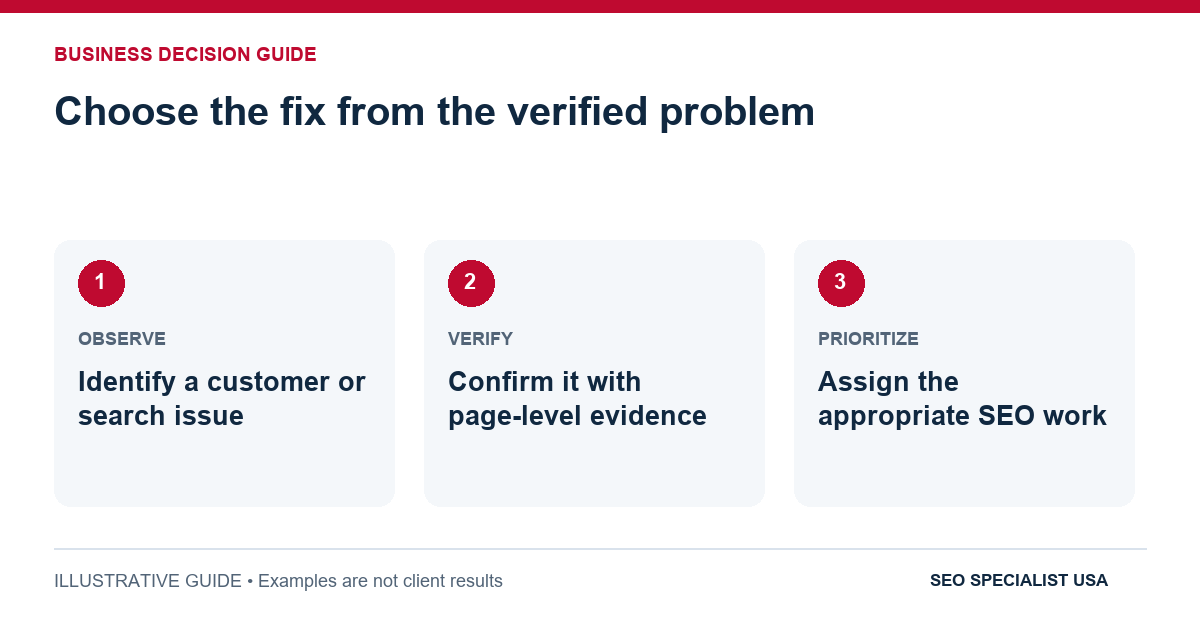
Start with the problem you can verify. An excluded priority page suggests technical investigation. A visible page that fails to answer its visitors’ questions suggests on-page work. Incorrect hours or a broken profile website link may make local accuracy urgent. Strong pages with little relevant external recognition may justify off-page work.
These are hypotheses, not diagnoses. Check the live page, Search Console and business records before assigning work. A broken enquiry form can deserve attention before either new content or outreach.
How all four types of SEO work together: one example
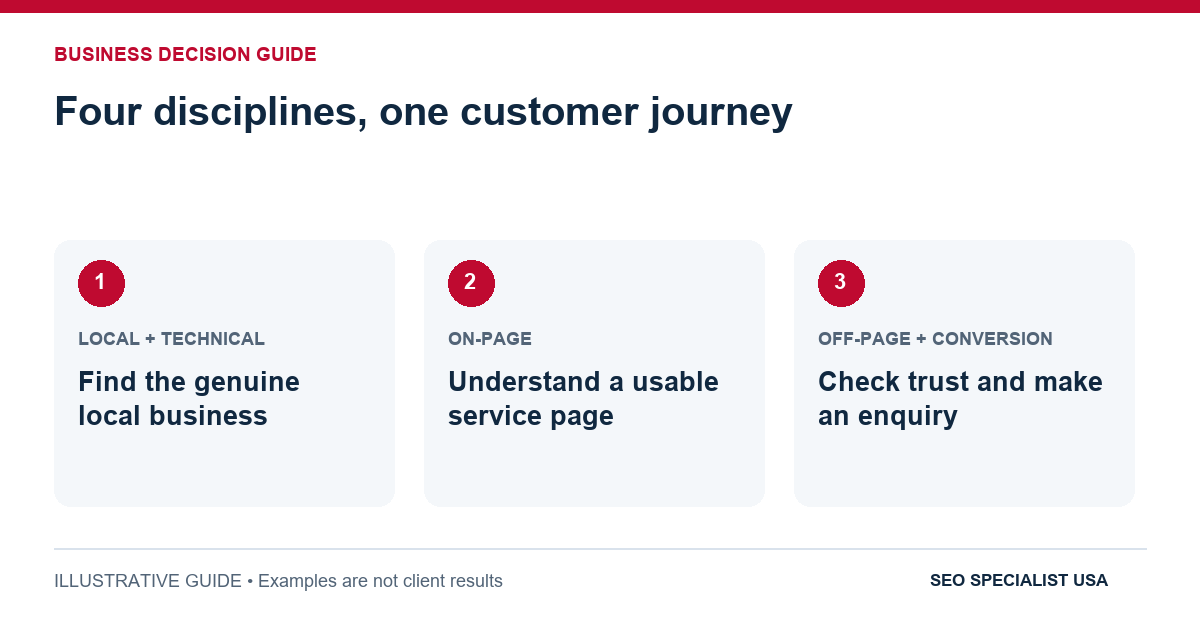
Consider a fictional HVAC company serving Austin. Technical work keeps its repair page accessible and usable on mobile. On-page work explains actual coverage, service limits and booking. Local work corrects its eligible profile and public hours. Off-page work earns relevant coverage through a useful seasonal resource. Each discipline supports a connected journey from discovery to enquiry.
For an illustrative calculation, two thousand organic visits at a one-percent qualified-enquiry rate produce twenty enquiries. At one point eight percent, the same traffic produces thirty-six: sixteen more. This is arithmetic, not a client result, forecast or proof that an SEO edit caused an improvement. Define enquiries consistently and record other changes, seasonality and traffic quality.
Measure progress without confusing activity with results
Record a baseline, the affected pages, implementation dates and measurement definitions. Compare relevant clicks and qualified enquiries with indexing findings, referral visits and local profile actions. Profile call-button clicks are not necessarily completed calls, and direction requests are not confirmed visits. Availability and local results can vary by business and search location.
A passing audit, more backlinks or a higher traffic total cannot establish business success alone. Recheck completed changes and ask the people handling enquiries whether lead quality improved.
Frequently asked questions
Is technical SEO part of on-page SEO?
They overlap. Technical SEO typically concerns access, indexing, rendering, architecture and performance, while on-page SEO emphasizes page content and relevance. Teams separate responsibilities for practical reasons; Google does not require four isolated workstreams.
Is content SEO a fifth type?
Some marketers use that label separately; others place content within on-page SEO. The four-type framework is an educational shortcut, not an official exhaustive list of specialties.
Can you improve SEO without new backlinks?
Yes. Fixing indexing, internal navigation, page usefulness and contact paths can be valuable without acquiring new links. Relevant external recognition may still matter in competitive markets.
Should a small business invest equally in all four?
No. Allocate effort according to verified needs, customer behavior and resources. A neighborhood service business may prioritize local accuracy and core service pages; a national store may need a different mix.
How long does SEO take to work?
There is no universal timeline. Google says some changes may take hours to be reflected and others several months. Confirm implementation, choose suitable comparison periods and avoid guaranteed ranking dates.
What should you do next?
Choose one important page or business listing. Identify the main customer need, verify access and accuracy, and document the most important gap. Fix and retest it before expanding the plan.
SEO Specialist USA offers on-page, technical, off-page and local SEO. If the first priority is unclear, discuss a focused SEO audit.