
No, SEO isn't usually a one-time thing. You can fix technical issues, optimize key pages, and set up tracking as individual projects. But search performance can change as competitors, customer demand, and your website evolve. The right amount of ongoing SEO depends on your business goals, not a monthly checklist.
Key Takeaways
- One-time SEO is real and useful. Finished page improvements and technical fixes don't vanish when a project ends.
- Stopping SEO doesn't trigger a Google penalty. A page can keep earning visits, although its visibility may rise or fall over time.
- Monthly retainers aren't mandatory. Some businesses need periodic checks; others have enough new work to justify active support.
- Ongoing SEO should solve new problems. Repeating keyword reports and publishing content just to stay busy isn't a strategy.
- Judge SEO by business value. Look at relevant traffic, qualified enquiries, booked work, and the changes behind those outcomes.
Can You Do SEO Once and Leave Your Website Alone?
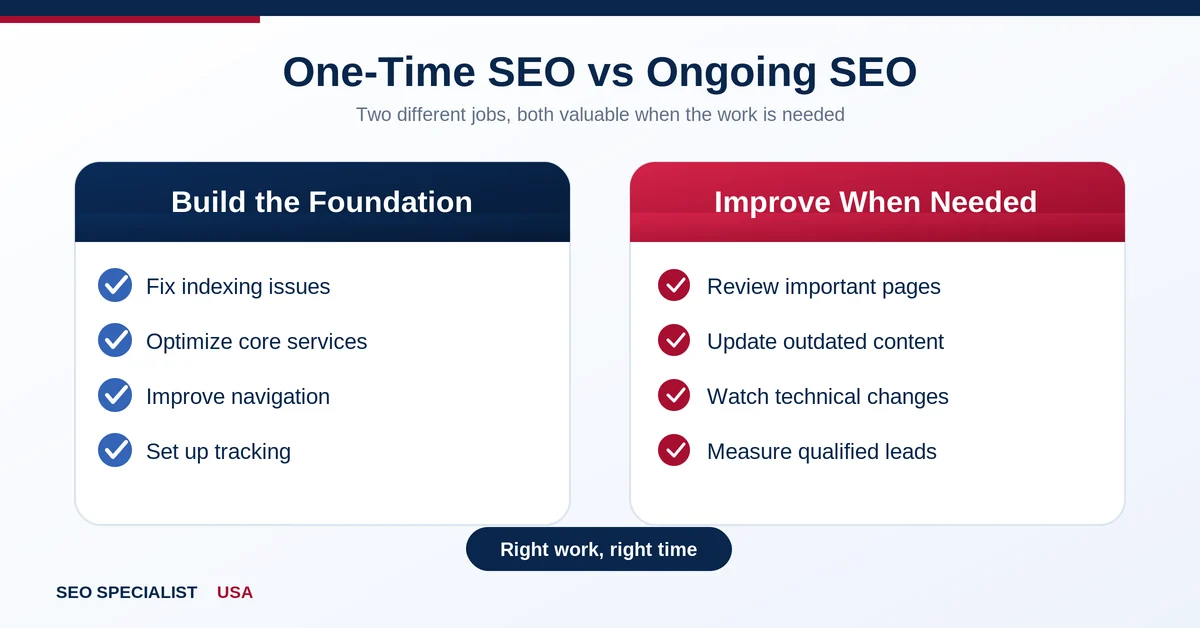
Yes, for some websites. Imagine a small plumbing company hiring an SEO specialist to repair indexing problems, reorganize its services menu, and improve three important landing pages. Those fixes can keep helping visitors and search engines after the specialist has finished.
The owner doesn't need to pay someone every month to make the same corrections again. The important question is what happens after the foundation is fixed.
Maybe the company introduces drain-camera inspections. Maybe its mobile quote form stops working after a website update. Or maybe another local plumber publishes a more useful emergency-repair page. Each situation creates a different reason to revisit SEO.
A useful way to think about it: One-time SEO creates or repairs assets. Ongoing SEO helps you decide when those assets need attention, when to build something new, and when to leave a successful page alone.
What Happens When You Stop Paying for SEO?
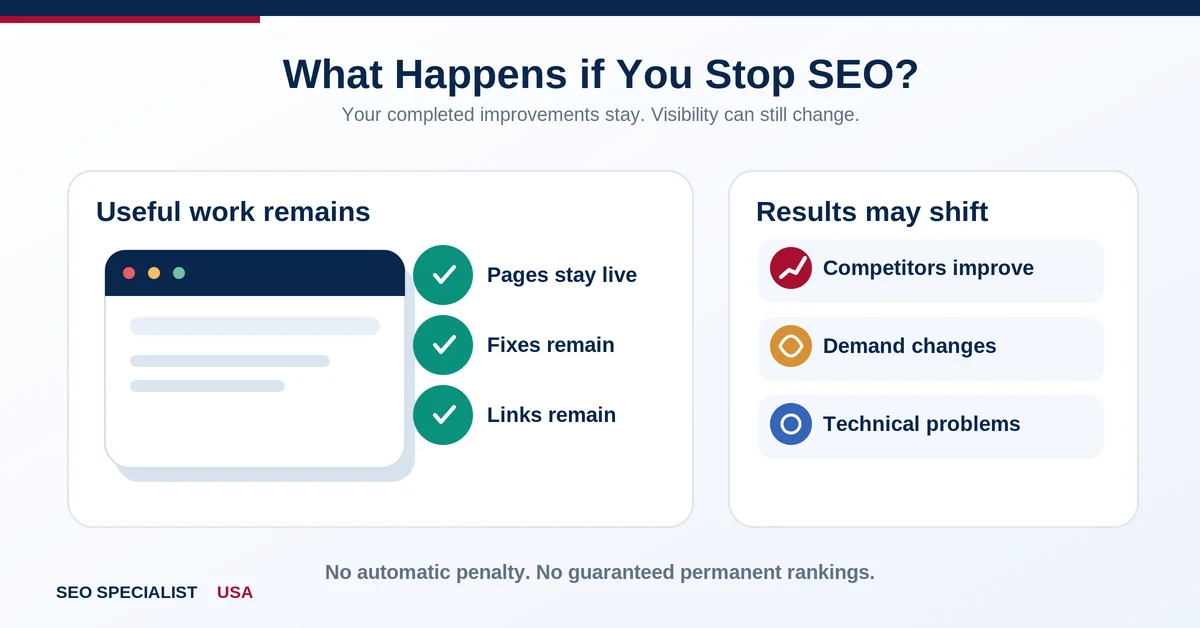
Your rankings don't disappear automatically. Google doesn't charge businesses for organic rankings, and it doesn't require you to keep an SEO agency on retainer. Your website, content, internal links, and completed improvements remain in place unless something changes them.
But keeping the work doesn't guarantee keeping the same traffic. Google's guidance on diagnosing traffic drops explains that technical issues, changing search demand, search-system changes, and competition can all affect performance.
|
If this happens |
What it could mean |
Sensible next step |
|---|---|---|
|
Organic enquiries remain stable |
Your existing pages may still meet customer needs |
Monitor; don't make changes just to show activity |
|
Impressions drop across many pages |
A technical, demand, or wider search issue may exist |
Check Search Console and compare periods |
|
One service page loses visibility |
Search intent or competing pages may have changed |
Review the specific query and page |
|
Traffic holds steady but enquiries fall |
The problem may be conversion quality or tracking |
Test forms, calls, and customer journeys |
|
You add a new service |
Your website may not answer those searches yet |
Improve or create the appropriate service page |
A small movement in rankings isn't always an emergency. Google specifically cautions against making radical changes to a page that's doing well because of routine fluctuations. Investigate a meaningful pattern before paying for a major overhaul.
Which SEO Tasks Can Be Completed Once?
Some tasks are naturally project-based. The scope is clear, the work can be checked, and the business owns the result.
Technical fixes with a defined problem
Examples include removing an accidental noindex directive from a valuable page, correcting broken redirects, fixing internal links to important URLs, or repairing a broken mobile navigation menu. The fix should be verified, documented, and considered complete unless the issue returns.
Improving priority service pages
A local dentist might need clearer pages for emergency appointments or dental implants. An SEO specialist can examine customer questions, improve the information and page structure, and create a more useful route to booking. The dentist doesn't need to rewrite those pages every month for the sake of freshness.
Organizing the website
A one-time project might improve navigation, consolidate overlapping content, or connect related pages with helpful internal links. This work can benefit users over a long period without constant repetition.
Setting up measurement
Configuring Google Search Console, relevant analytics events, or a sensible call-tracking process can be a defined project. Tracking should be checked after major website changes, but the original setup isn't something to bill for repeatedly.
The test is simple: Can the agency describe a finished deliverable and show that the issue was resolved? If yes, it may be a strong candidate for one-time SEO.
What Makes Ongoing SEO Worthwhile?
Ongoing SEO is justified by changing conditions or valuable new opportunities, not by the calendar alone.
Monitoring the pages that matter
An SEO specialist might notice that a roofing company's repair page is appearing for relevant searches but isn't attracting clicks. That creates a reason to compare the page with current results and improve its title or content, where appropriate.
Updating content when customers need something different
Prices, service coverage, regulations, and products can change. An outdated page needs attention when its information no longer serves readers. Useful evergreen content doesn't need a meaningless rewrite every few weeks.
Supporting new services and locations
A legitimate new branch, product line, or service can create new search demand. Businesses grow, and the website should accurately reflect that growth. Avoid copying near-identical city pages simply to collect more keyword variations.
Fixing problems introduced by website changes
A redesign, migration, plugin update, or product-catalog change may affect crawlability, navigation, or important pages. Larger, frequently updated websites often need closer monitoring than a stable brochure website.
Improving conversion opportunities
A website can attract qualified visitors yet lose enquiries because its forms are confusing or its services aren't explained clearly. Improving the experience may be more valuable than chasing another traffic milestone.
Should You Pay for SEO Every Month?
Not necessarily. Ask what valuable work is left to do, how often your website changes, and what would happen if you paused the campaign.
|
Your situation |
A reasonable approach |
Why it makes sense |
|---|---|---|
|
New business, small website, limited budget |
One-time setup plus basic DIY checks |
Get the essentials right without a large commitment |
|
Local service business in a competitive area |
Focused ongoing SEO |
Watch important services and local enquiries |
|
Ecommerce store adding products regularly |
More active SEO support |
New pages and technical changes create recurring tasks |
|
Established site with stable useful traffic |
Periodic review and targeted projects |
Protect what works without inventing extra work |
|
Website redesign or migration |
Defined technical project plus follow-up |
Confirm that important pages and tracking still work |
A monthly contract isn't automatically a bad decision. It becomes a poor decision when the agency can't explain its priorities or keeps billing for work that no longer needs to be done.
What Should an SEO Agency Actually Do Each Month?
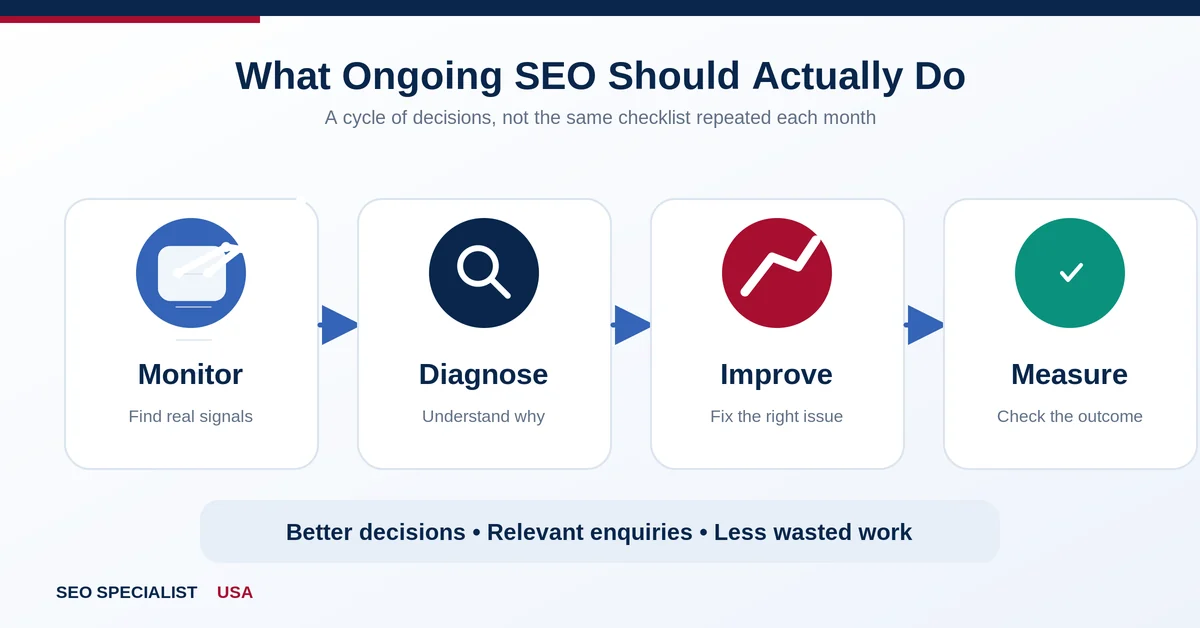
A valuable monthly report should answer three questions: What did we find? What did we change? What are we watching next?
An agency may spend time researching, monitoring, implementing, and testing. The deliverables will differ each month, but the explanation should be clear.
|
Weak report |
Useful report |
|---|---|
|
Tracked 100 keywords |
Two high-intent service pages lost relevant clicks; we checked the causes |
|
Optimized content |
We updated the emergency repair page to answer missing customer questions |
|
Built links |
We earned a relevant local industry citation and checked its accuracy |
|
Traffic increased |
Organic enquiry quality improved, and here's how we measured it |
Consider two campaigns. One agency delivers a long task list but can't explain which changes helped customers. Another identifies an important page that gets visitors but few calls, improves the contact journey, and measures the outcome. The second approach gives the business owner a better basis for decisions, even if it involves fewer tasks.
The principle is consistent with SEO Specialist USA's guide to prioritizing SEO work: prioritize work that matters rather than completing tasks simply because they're on a checklist.
When Is It Reasonable to Pause or Reduce SEO?
A lighter arrangement can make sense if your priority pages are healthy, there's limited high-value work remaining, and your company isn't making major website or service changes. You might monitor Search Console internally and request help when a specific issue appears.
Pausing isn't the same as ignoring the website. Set a simple schedule to review business-critical pages, enquiries, and significant technical changes. SEO Specialist USA's article on how often to get an SEO audit can help you decide when a deeper review is useful.
Don't make the decision from rankings alone. If a page continues bringing qualified enquiries, that's worth protecting. If an agency's monthly tasks don't connect to business outcomes, ask for a clearer plan or change the scope.
A Five-Question Check Before You Buy Another SEO Month
- Can Google find my important pages? Check page indexing and accessibility before assuming a content problem.
- Are the right people finding me? Review the queries and landing pages bringing relevant visitors.
- Do visits turn into enquiries or sales? Check forms, calls, appointments, and where possible, qualified outcomes.
- Has something changed? Think about services, competitors, locations, the website, or the way customers search.
- Can an agency point to the next useful improvement? Ask what needs doing, why now, and how you'll judge the result.
If you're unsure, a focused SEO audit can help you see the current problems before committing to ongoing work.
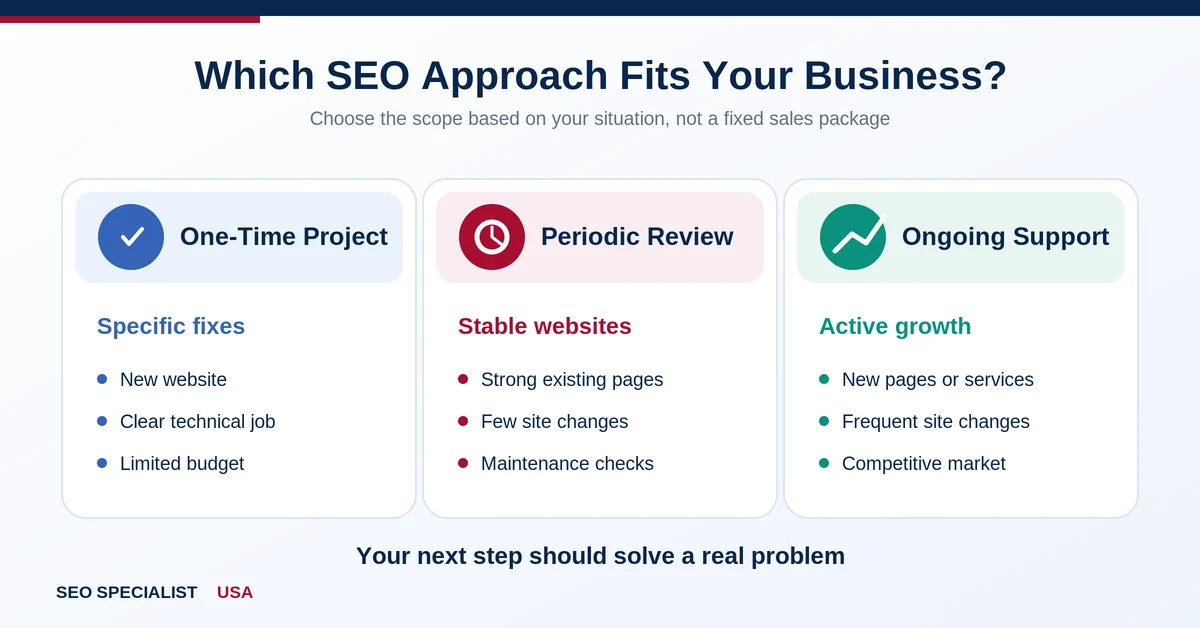
How SEO Specialist USA Approaches One-Time and Ongoing SEO
A business should be able to understand what it's paying for. At SEO Specialist USA, the approach we recommend is to start with the website's actual search performance, important pages, technical barriers, and conversion opportunities, then prioritize useful improvements.
That might mean fixing one serious indexing issue before creating new content. It might mean improving a service page instead of publishing ten similar articles. Or it might mean monitoring a site that's already performing well rather than changing it without a reason.
We don't think clients should pay to solve the same problem again and again. If ongoing work makes sense, it needs a clear purpose. If a one-time project or occasional review is enough, that's a legitimate strategy too.
You shouldn't have to buy a bigger SEO package to get an honest explanation of your website's needs.
Frequently Asked Questions
Is SEO a one-time thing?
SEO can include one-time projects, but it's rarely something to ignore forever. Technical repairs, page improvements, and initial tracking can be completed once. Additional work may be useful when your website, competitors, or customer needs change.
Can I stop SEO after six months?
Yes. You can stop after six months, but review what was completed and what remains. A stable small website might shift to periodic checks, while an expanding business may still have important content, technical, or conversion opportunities.
Will my rankings disappear if I stop paying for SEO?
No. Stopping an agency contract doesn't automatically remove Google rankings. Existing pages can continue performing, though visibility may change with competition, search demand, or technical issues. Monitor significant changes before deciding on another SEO project.
Do I have to pay for SEO every month?
No. Google doesn't require businesses to pay a monthly SEO fee to appear in organic search. You can choose one-time fixes, occasional audits, DIY maintenance, or ongoing agency support based on the website's needs and budget.
How often should a small business update its SEO?
It depends on how often the business and website change. A stable site may need occasional monitoring and targeted updates. A competitive or frequently changing business may benefit from more regular reviews. Update content when there's a meaningful reason.
Is one-time SEO worth paying for?
Yes, when it solves a real problem. Fixing indexing errors, improving important service pages, or organizing website navigation can have lasting value. Ask for a defined scope, completed deliverables, and verification instead of promises of guaranteed rankings.
Can I maintain my SEO without an agency?
Yes. Owners of smaller websites can often check Search Console, update accurate business information, and watch enquiry trends. Complicated indexing, migration, or competitive problems may still need specialist help. You can hire support for those specific projects.
How do I know ongoing SEO is worth the money?
Ask what changed, why it mattered, and what business result you're measuring. Relevant organic visits, qualified leads, booked jobs, and sales are more useful than isolated rankings. Good reporting also explains uncertainty and the next priorities.
Final Thoughts
SEO doesn't have to be an endless monthly expense. One-time work can create lasting improvements, and ongoing support can be valuable when there's a good reason for it.
The best choice isn't always to do more SEO. It's to do the right work at the right time, then measure whether your business benefits.
If you're deciding between a one-time project and ongoing support, start with a clear view of your website's needs.
Sources and Further Reading